Your Very Good Health!

I don’t have perfect health. My body after nearly 47 years taking breath, has had things happen to it, and has broken in several places. A casual passer-by would never know but, I have; ligament damage to my knee, a weak Achilles tendon, currently a bad back (from sitting funny last week and spreadsheeting for three hours), and a severely damaged inner ear. Also, various other temporary aches and damaged bits come and go, along with the rounds of viruses, bacteria, and so on. My skin and bones record dozens of small scars from long forgotten injuries.

This is my normal. Having a blemish free body, unaffected by incidents after so long would be unnatural. It is a miracle I am alive at all! I marvel at how well biology does at maintaining this form I inhabit in recognisable similarity year to year, despite replacing all the cells on a regular basis.

Evolutionary adaptation takes into account this wear and tear, accidental impacts, and attacks from hostile micro-organisms. As well as repair, it has blessed us with death, and its companion, reproduction, so as to give the life force a restart every generation. Our tissues are designed to receive damage and recover from it as best as possible. Life expects us to be hurt.

I once heard a skin specialist being interviewed, who was asked what we could do to keep our skin totally safe. He said, cover it in petroleum jelly and stay indoors permanently; which he immediately followed with, of course that is impossible. Living entails a process of acquired ‘imperfections’. Like trees none of us has grown entirely according to the biological instructions we were provided with at conception, our surroundings alter our shapes and behaviours. This even applies to how our DNA instructions manifest themselves (see epigenetics).

Having experiences gives us personalities, and interesting appearances. Like trees, the ‘perfect’ human form would likely seem bland and without character.

My perfect tree

My perfect tree

Part of living is accepting that we do not remain in that mythical state of ‘perfection’, even if we are born with no obvious errors; which in itself is not something we ought to expect. Having the ability to see what we do have, in the face of adversity, to count our blessings, gives us a different take on who we are.

In a world influenced by the futile quest for a standardised perfected body image, the scars and marks of survival can loom large. For me a big step in defining myself came when I was asked by my friend (a psychologist with many years experience of counselling those with chronic conditions) what percentage of me was ‘ill’, and what ‘healthy’. I realised that whilst my internal sense of (literal) balance was flawed, it made up only about 3% (subjectively) of Me. The other 97% was in fact in pretty good shape. Suddenly instead of feeling broken, beyond repair, I felt that I had worked well at keeping what I could functional; my senses were fine, I had limbs that did what they should, I had reasonable fitness. I could do more things to make that ok part of me better, or perhaps Good; even if I couldn’t change the damaged inner ear.

And so I did. I’ve spent the last few years practising yoga, eating well, ensuring I sleep properly, and enjoying the things I can do, pushing aside the terror of inadequacy by building the abilities I have; so that when I get dizzy or have issues then the weller bits of me can compensate. This is not a perfect solution, but, as well as the health benefits, this strategy has made me feel I have influence over myself, my behaviours. A feeling not to be underestimated in its power.

On a magickal level the approach has changed my attention, which for me right now seems to be one of the defining skills of a magician; to direct attention as necessary for optimal results. And as I switched to this different perspective, I began to discover (by myself, and via information shared by others with me), possible remedies for the problem, as its import shifted to non-critical. Perhaps, by allowing the damage to be there, whilst seeing the strengths I had, this made space for the previously non-existent (in my world) herb-lore to appear?

However, I write this suggestion very cautiously. It is easy to say, ‘think positively! and all your ills will vanish!’ That is not my intention here. Our aim ought to be to acknowledge our imperfections, our normal state which means we cannot, then look for and focus on the normal we have which means we can.

My inner ear is not mendable. The surrounding biological systems and my way of life however can adapt, so nowadays when I lose balance I barely notice that my body catches me before I stagger and fall. The fatigue can be held at bay (mostly…) by factoring in rest periods throughout every day. Feeding the health, giving attention to wellness, pushing aside the trauma of not-perfect.

Recently I visited my mum, and we were talking of my university days; and I found myself glad that I had done that training, but, pleased it had been forced to stop, as I now have a career which suits me far better. With hindsight, I learnt so much from the years of pain and discomfort, those twists of my branches away from the programmed high reaching symmetry of a scientist has given me a lower profile with greater stability, and arguably made me far more likeable… though without a control it is hard to tell 😉

I would like to encourage those readers who have health issues, whether intrinsic or from external sources, to make a slight shift in perspective, and (in a Pollyanna way…) play the game of rejoicing in their abilities.

Accentuating the positive can drive out the negative. Directed attention does miraculous things to the bodymind. We notice what we look for; seek out your strengths, and you might be amazed at how those weaknesses atrophy.

NW

A harvest of magics – tools, text and talks to feed your head

I’ll start this Lammas-tide gathering of top mind-manifesting resources with the books. First up is Ayahuasca Shamanism: In the Amazon and Beyond a cutting-edge collection of ethnographic academic papers edited by Beatriz Caiuby Labate & Clancy Cavnar. This is a wonderful book that describes and analyses the ayahuasca culture in South America and internationally. Many of the essays focus on the interface between western ayahuasca or shamanic tourists and native users.

Detail of cover artwork by Clancy Cavnar

Snake Shaman

Here we see a subtle series of explorations; nothing as simple as native=good and western=bad, but a far more nuanced and well evidenced collection of observations about the meeting of these worlds, and the creation of a shared culture. What’s particularly cool about this book is that it overturns the simplistic view that all Amazonian tribes have used ayahuasca for n-thousand years for y-spiritual purposes. In fact for many of the tribal Amazon cultures ayahuasca has just arrived, being spread through social changes such as the rubber tapping boom of 1879 to 1912, and even as an unintended consequence of missionary activity. In some cases knowledge and use of ayahuasca has come to indigenous forest people via the cities, through the emerging religions of the Santo Daime Church, the União do Vegetal and others. It’s also the case that while some cultures use ayahuasca for ‘shamanic’ healing, there are also documented examples of societies that use it to get everyone fired up before going hunting, to war, and other cultures that pretty much think of it as a nice recreational buzz.

Even in context of what we may think is an agreed idea of shamanism (between indigenous and visiting cultures) there can be some amazing misunderstandings which, paradoxically, can lead to a newly emerging shared culture. A simple difference is that in an indigenous context a shaman will often try to sell their skills in removing curses, banishing bad spirits and providing magical protection. However western ayahuasca pilgrims (or tourists if you prefer) don’t want that freaky stuff, they want to meet spirit guides, to address a sense of ennui and perceived lack of wholeness; to explore who they are and what their lives mean. These very different perceptions of what ayahuasca shamanism can achieve get blended into a curious mash-up of intentions and cultural meanings that leaves both sides thinking they are understood by the other.

The next offering is Neurotransmissions: Essays on Psychedelics from Breaking Convention. This is a collection of texts derived from talks presented at the 2013 Breaking Convention conference. There’s a wonderful range of writing from the cutting edge of this field. My personal favourite is the long exploration of the ‘reality’ (whatever that means) of DMT entities, as well as a potted history of this fascinating material, provided by David Luke and Andrew R.Gallimore There’s a great download about MDMA therapy by Michael Mithoefer and one by yours truly; Stoned Temple Pilots – Set, Setting and Substance in Contemporary Entheogenic Spirituality, and much more.

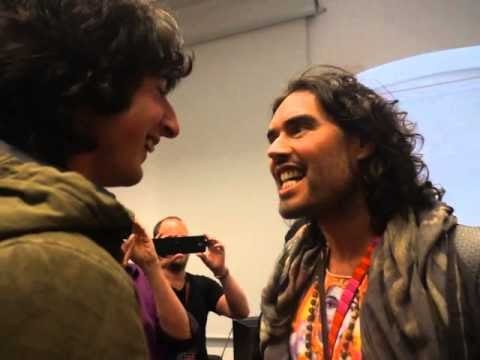
In addition to this printed record of lectures past you can also now begin to catch up on any of the amazing presentations from Breaking Convention 2015 that you may have missed. These are starting to be posted here. First uploads include a Q&A with Russell Brand and Daniel Pinchbeck. I strongly recommend the talk by Rick Doblin of MAPS (to be added soon) where Rick provides a well considered strategic vision of how his organisation is working towards the end of prohibition and to create spaces where psychedelics can be used, not only for therapy, but more broadly.

Russell chin wagging with a deligate at BC15

Russell chin-wagging with a deligate at BC15

This road-map to a brighter, psychedelic-positive future aims, eventually, towards establishing locations where people can go to experience a psychedelic initiation and, once they have completed this and demonstrated that they are trustworthy, be licensed to own and use psychedelic drugs. Such a model is very similar to that proposed by Timothy Leary in The Politics of Ecstasy all the way back in 1971. Thing is, this isn’t just a DMT-pipe dream. MAPS, along with other organisations, have the money, the nous, the allies and the vision, to make this possible. As Rick Doblin said in his talk; if you’re in the audience thinking that you’d love to work legally with psychedelics then today you actually have a very good chance of this happening.

Another forthcoming filmic release of a lecture is one by chaos mage Dave Lee, held in July at Treadwells in London. In this talk he provides a history of The Magical Pact of the Illuminates of Thanateros. Dave writes:

“People interested in watching a video of my recent talk at Treadwells on the History of the IOT shoud email me at info@chaotopia.co.uk. 

If you’d also like to join in a discussion about the talk and IOT history, you can join me at 6pm (BST) on August 16th 2015, to watch the video then talk on Google Hangouts. (This will require your having a gmail address.)”

(I’m also doing a workshop at Treadwells on Saturday 26th September btw, details from Treadwells – JV.)

In addition Dave has kindly provided a photo of his altar, and a little description to share, following our articles about altars (here and here). Mr Lee tells us:

“This is very much a Chaos Magic altar – Baphomet has pride of place. To the left, you see Bast – we did some recent work around cats. The blue disc with a pencil through it is a Wheel of Wealth – anyone who is curious about that working, which is ongoing, is welcome to ask me via Facebook.

The big entity at the front is very special. Its name is Izawa, and it is an egregore entity, made by a group, to protect, sustain and nurture the psychedelic gnosis. As things are at present, it has its work cut out for it, but there are some hopeful signs in the offing. “

Psychedelic installation

Psychedelic installation

Our spirit of the psychedelic gnosis, Izawa, would certainly approve of our next item, the Ploom PAX Vaporizer.

I’d done extensive research on-line with a view to finding a suitable hand-held vaporiser for smoking mugwort, tobacco and, where it’s safe and legal to do so of course, cannabis. After only few days use I’m quite sold on this little baby. The unit itself charges from the mains (my only gripe being that a US to UK plug wasn’t supplied). Plug the device into the docking station and the X shaped light glows red as it absorbs power. Once ready to go herbal material may be loaded into the chamber (which uses a cunning magnetic closure). Set the temperature, wait for the illuminated X to change from purple to green, and then suck.

Green for go!

Green for go!

What happens next is, apparently, nothing; hardly any smoke (except on the highest of temperature settings and with the chamber quite full), it’s just like breathing in a straight forward lung-full of air. No coughing, no carbon monoxide, no particulates. But does it work? Certainly! Moreover the lack of the usual body load associated with using joints or pipes means that high provided by cannabis is much ‘lighter’, in some respects more intense but with less of a ‘drunk’ or ‘dopey’ feeling. One can taste the herb but there is very little smell as the material is vaporised. The battery life from one charge is pretty good and the build quality excellent. Add to this the fact that the machine is guaranteed for 10 years and you’ve got a real winner. There’s a nice show and tell video about this product here and purchases can be made from here. Highly recommended 😉 (British voters who may like to use this product with cannabis may wish to sign this rapidly growing petition to end cannabis prohibtion here.)

The final sheaf of goodness for this Lammas is totally free. This is the second offering in the Secular Sermons project by Leipzig based scientist Daniel Böttger.

In the First Sermon Daniel created a long poem that skilfully uses cosmology as a stimulus for the numinous imagination; crafting a text that has a religious sensibility but is explicitly grounded in the scientific reality that many of us inhabit. In this Second Sermon: The Games of Entropy Daniel takes us on another rhyming journey through the intimate space of the biological cell and that intricate complexity of chemical reactions that we call life. The poem elegantly presents what we know about these processes in well-phrased rhythmic text, and calls upon us meet these facts with an attitude of wonderment.

Good news from science

Good news from science

The Secular Sermons project is following a seven-fold model meaning we’ve still got another five amazing texts still to come, so as Böttger explains, this work is unlikely to be completed for several years.

There is a nicely typeset pdf of the first two poems at the website and the work is copyright free. Divested of any explicit religious iconography, this is a perfect holy book for those agnostic or atheists out there who appreciate the human capacity for awe, reverence and spirituality, but want to move beyond the superstitious aspects of conventional religion. Science be praised!

JV