Wyrd Relationships

When following a path of initiatory magic, however much we may want to emphasize our rugged individualism and uniqueness, most of us eventually come to the realization that we can’t do this on our own. However potent our initial gnostic insights regarding the need to take a radical degree of responsibility for own salvation, we soon realize that we will need to connect to the others for this process to be sustainable.
web1

Creating New Connections

I have already written on this blog about the influence of Gurdjieff/Fourth Way ideas on my path generally, but I have been especially influenced with regards to that tradition’s focus on the importance of finding dynamic spiritual relationships, in order to challenge and deepen our own explorations. Learning something by one’s self is of course possible, but most of us realise quickly that everything from Tai Chi to foreign language learning is made easier (and ultimately more fun) if we have a competent teacher or teachers. In having an experienced mentor, our learning becomes more rounded as pitfalls are avoided and the full range of sensory and kinaesthetic information becomes available to us.

Learning within an esoteric or magical context is usually associated with groups of other humans who organise themselves into Orders, Schools or networks centred on a shared philosophy, lifestyle or ritual aesthetic. This is often how we do things as Homo sapiens and however much our politics and aspirations hope to flatten hierarchies, we usually self-organise into something that looks like a tribe or family system. When we enter such environments, inspired by our search for meaning, it is unsurprising that most of us look to the longstanding members of such groups both for guidance, and evidence that the group’s claims have some degree of validity.

Okay, so far so good, but if such groups can be beneficial why is it that they can also be a complete pain in the arse? For me, part of why Schools and Orders can be challenging is they often have profound tensions at their core. In reflecting on this, here are a few of them that seem critical:

Openness versus Discernment

Most religious and philosophical groups require the internalization of a certain amount of information and adherence to specific behavioural requirements. When we enter this as a newcomer to a group we can often feel that we re-enacting those scenes from our childhoods in which we were seeking approval. When this is going on alongside the message that we should be aspiring to become powerful, competent initiates we can be forgiven for becoming somewhat confused and disheartened.

For me, the saying attributed to Christ is helpful: “Be as wise as serpents and as innocent as doves” (Matthew 10:16). If we are too naïve we risk exploitation and buying into a type of group-think that can run contra to the aims of initiation, but if we are too shut off and not willing to unlearn then there is little point in being there.

Most of us don’t get it right upon the first time of trying and it is also possible that part of our difficulty lies in bringing the same expectations to the School that we would to other (more conventional) religious contexts. Many enter a School seeking a Church and then seemed shocked that it feels more like a dojo!

Freedom versus Structure

Working with others can be tricky. By definition most magical practitioners are free spirits with anarchic tendencies. We can experience a deep desire to work with others in order to empower and sharpen our work, but most of us are prone to experiencing claustrophobia when we feel our agency and liberty is being threatened!

In traditions that involve truly transformative perspectives there is a certain inevitability that we will need to challenge existing values and certainties. While they will never be perfect in their execution, many Orders out of necessity have had to spend time reflecting on how they provide boundaries and guidance to ensure that ethical standards are understood and respected. Such reflection often takes decades of shared work to develop maturity and shouldn’t be dismissed lightly. Groups will always make mistakes in the doing of the Great Work, but what feels critical is that they have mechanisms for feedback and reflection so that the inevitable mistakes are learnt from. The presence of such processes for self-reflection are vital in ensuring that a School’s core philosophy is both truly life promoting and able to counter any organizational excesses.

Personally speaking, being part of a more formal magical Order has provided me with an excellent opportunity to learn. Even if I might not agree with some of what’s being proposed, the content and structure of such systems provide me with something solid to bash up against and thus refine my own initiatory understanding. The pursuit of grades and curricula may become yet another form of “spiritual materialism”, but at best they can fulfill our need for structure and a way of mapping our development, especially in the early to intermediate stages of training.

box1

Something clever about trying to think outside the box

Personal versus Impersonal

While undertaking any deep spiritual work will inevitably lead to the forming of close relationships with others, one of the strengths of an Order is that they usually provide a corpus of techniques and perspectives to engage with. Without a solid body of ideas and practice with which to engage, there is a danger that our involvement becomes overly reliant on interpersonal connection. While warm rapport and friendships can be a major strength in the sustainability of group involvement, if we become overly dependent on this, then our own motivations for doing the work can become distorted. People inevitably come and go from magical and initiatory groups as their own focus changes or the costs of involvement outweigh the benefits. Finding like-minded souls can feel amazing after perhaps years of feeling isolated, but we must remain clear about our own goals, and alive to where we may need to go next.

These tensions are likely to remain in play while we choose to take the risk of working magically with others. The probability of finding some imagined perfect balance between these polarities is both unlikely and frankly a bit dull. Like the perfect job or the perfect relationship, the perfect group or school simply doesn’t exist, but in recognizing the dynamics at work we may become more conscious of the push and pull of such forces and how we might play with and respond to them more skillfully.

Steve Dee
 

Queer Magic in Theory and Practice

The relationship between magic and queer is something that Steve Dee and I have explored in multiple articles on this blog (do a search for ‘queer’ to find them). Recently I had the opportunity to put some of these ideas into practice during my Queering Magic workshop at Treadwell’s Books, London.

The word queer relates, among other things, to notions of sexuality, gender and identity. More broadly it can be taken to suggest liminality, uncertainty, curiosity and the disruption of (apparently) fixed systems, through to what Freud would call the ‘uncanny’ and others might describe as ‘the weird’ (or wyrd).

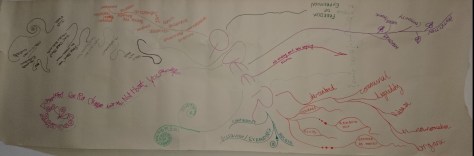
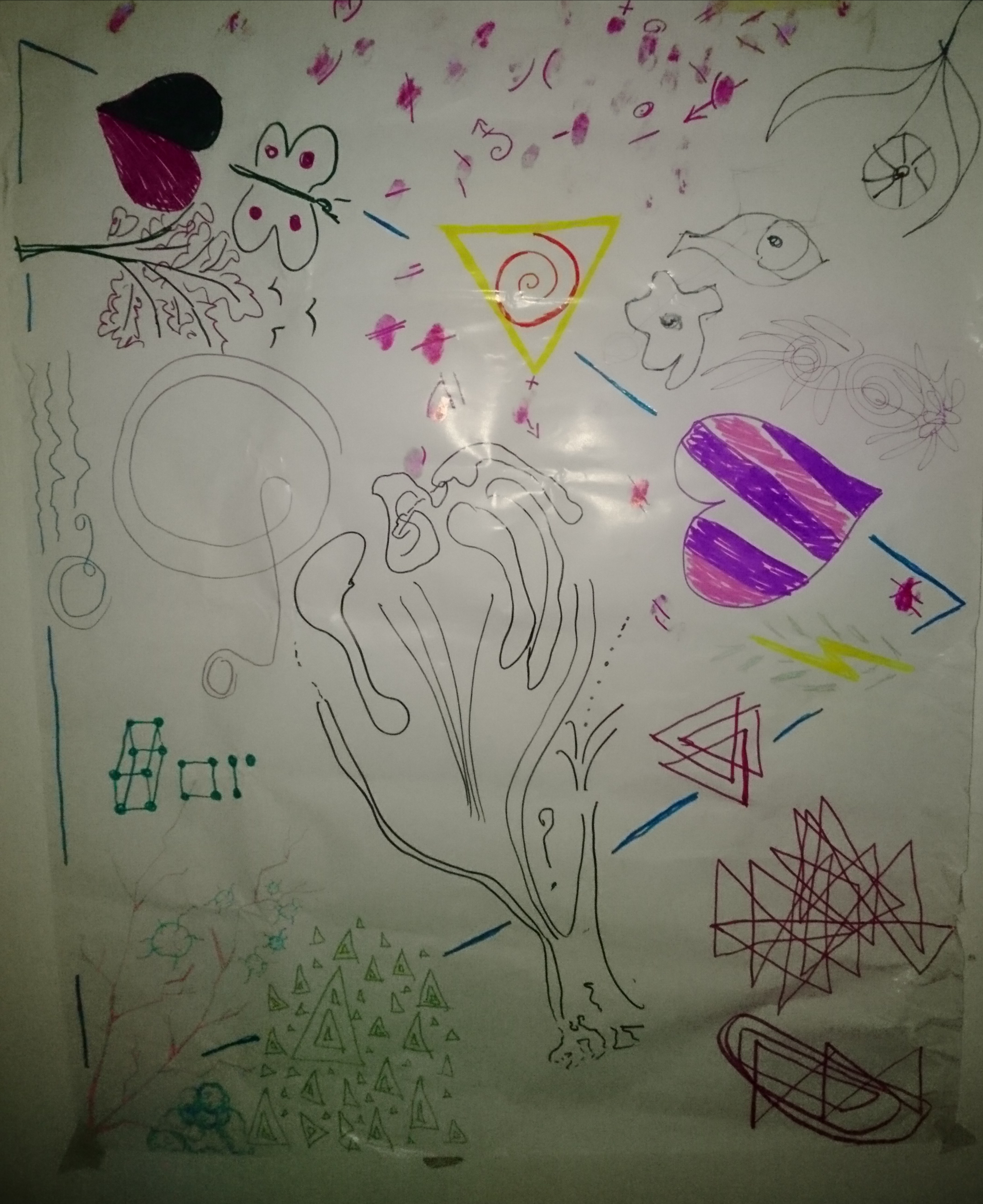
With such a broad and morphing constellation of meanings it’s interesting to attempt to articulate these, and at the workshop that’s what we did, both in writing and through colour and form.

DSC_3556

queerwords.jpg

Queer connects us to mythical and historic figures; bisexual deities such as Pan, the Divine Androgyne of Hermetic mysticism, and our queer ancestors from Aleister Crowley to Tove Jansson. Identifying these allies makes a real difference when it comes to claiming our own identity as queer people and especially as queer occultists.

Seeking historical exemplars helps us recognize that we stand in a lineage of queer folk. Knowing this history helps challenge the view that wyrd-kids-today are adopting non-binary identity simply as a fashion statement. That was the kind of thinking behind Clause 28, a bit of British law from the 1980s designed to stop regional governmental bodies “…intentionally promote homosexuality or publish material with the intention of promoting homosexuality” or “promote the teaching in any State funded school of the acceptability of homosexuality as a pretended family relationship”. (Those who find this kind of repressive legislation repulsive should know that they are not alone. This law was repealed by the then new Scottish Parliament in 2000 as one of their first legislative acts, and in England and Wales in 2003.)

Rather than something ‘new’ growth of the queer in Western culture represents a recognition that human identity, social roles, gender and sexuality have actually always been multiple and complex. The queer isn’t something original, as much as a recognition of what has actually always been the case. Supporters of this increasingly visible culture (like me) enjoying pointing out that many other societies (notably those of many Native American nations) include much richer, often more fluid, vocabularies for describing gender and sexual identity. Physical gender is a continuum or field of possibilities, sexual preference or social role even more so. This is why I like queer, it’s a useful umbrella term which reminds us to keep in mind – or in ‘play’ as Jacques Derrida might say – the mutability and flexibility of human nature. This isn’t necessarily a rejection of words like ‘gay’ or ‘male’ but rather queer acts as a reminder that these labels are convenient, contingent fictions and subject, like all things, to flux.

Magic, according to Crowley in 777, is ‘energy tending to change’ and more famously “the Science and Art of causing Change to occur in conformity with Will”. Thus the relationship of magic, change and queer(ing) is apparent at a deep esoteric theoretical level as well as in the actual lives of many occultists.

As we explore the meanings of queer we find it in contact with many other words of magic. Take for example the etymology of the word ‘witch‘. Grimm suggests that *weik- “to curve, bend” and *weg’h- “to move” (in a “mysterious” way) are concepts at the root of ‘witchcraft’. Such an imaged etymology of ‘witch’ contains ideas of bending or twisting both as demonstration of mysterious control (‘the witch bent men to her will’) or a turning away from the right/true/moral (ie socially acceptable) path and instead following of the a ‘road less traveled’ or a ‘crooked way’. ‘Witch’ exhibits Similar negative associations of spoiling or going wrong that have been linked to queer. The potentially transgressive, antinomian and outsider qualities of ‘witch’ are echoed in ‘queer’ in that both words have been reclaimed, recuperated and re-imagined not as epithets of denigration but instead identities of celebration, empowerment, transformation and resistance.

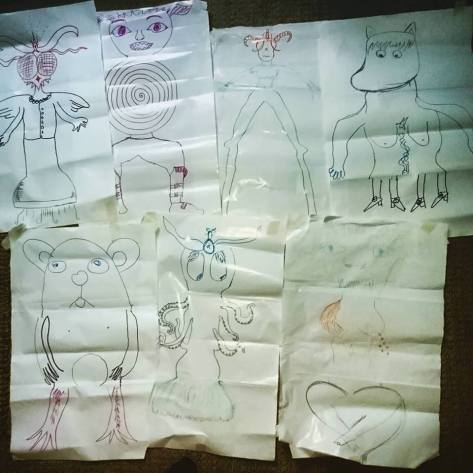
In a mythological context the ‘cut-up’ deities of Baphomet and Abraxas can also be considered pretty queer.  These spirits have obscure backstories and yet, especially in the case of Baphomet, a wild proliferation of forms, imbued with multiple meanings. ‘Baphomet’, like the ‘queer’ is a placeholder for an uncertain, powerful, morphing ‘energy tending to change’. At Treadwell’s we decorated our ritual space with Baphomets generated through the ‘picture consequences’ or ‘exquisite corpse’ method. Here are a few of the chimeric beings we spawned:

baphpics

Queer Truth is mutable and multiple.

There are of course those folks who, for whatever reason are unsure of all this queerness around magic. A few esoteric writers, typically of the probably-gay-but-unable-to-admit it type are hostile to queer cultures. Heteronormativity is writ large in the worlds of polarity structured occultures (such as Wicca) and also Medicine Path groups (where the language of familial heteronormativity often appears in ceremonial songs) – but this is changing. (By Medicine Community I mean folk using psychedelics such as ayahuasca, peyote and other sacraments as part of their spiritual process, often in a way informed by ‘native’ practices.)

Wicca has proliferated into many forms where queer identity is welcomed, celebrated and included. There are indications too that in Medicine Community contexts where previously there was only a relative mono-culture of male-female tropes, a richer linguistic ecology is developing. We can see how people wrestle with the boundary crossing experience that ayahuasca and other psychedelic drugs induce, sometimes in cultural settings where diverse sexual identity doesn’t necessarily get acknowledged. For more on this check the work of Clancy Cavnar for instance this article and this presentation.

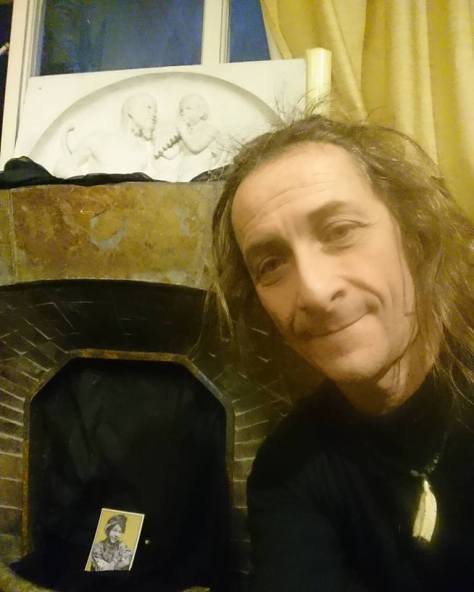
Back at Treadwell’s, part of our practice was to collectively offer our thanks to the artist, queer icon and Golden Dawn initiate Pamela Coleman Smith. ‘Pixie’, as she was affectionately known to her friends, lived in the Cornish town of Bude where I’d previously done magical work intended to re-ignite interest in her phenomenal oeuvre.  Following recent repairs to her former home Treadwell’s was able to acquire Pixie’s original fireplace. This charming ovoid hearth now stands in the basement of one of the leading bookshops and venues for the sharing of magical practice in Britain. A fitting place of power to house this magical object. Our group took time to appreciate Pamela Coleman Smith, the woman who designed the best-selling classic modern tarot. A woman who lived for many years with her female companion. A person, I’m pleased to report, increasingly recognized and celebrated as a key figure of the Western magical tradition. (Check out this wonderful new collection of writings on, and art by, Pamela Coleman Smith.)

pixie

Fireside conversation with Pamela Coleman Smith

Whether we wish to claim an identity such as ‘queer’ for ourselves or not my feeling is that occultists of all stripes can benefit from an exploration of these ideas. For those who apply the word to themselves and their work, seeking out mythic and historical allies, and recovering, creating and honouring their stories is vital work. For the queer spaces in culture are not themselves inevitable or irrevocable. For this is ‘energy tending to change’ – it is all those ongoing acts of witness, of rebellion, or bravery and of ‘queer truth’ that act together to create and maintain this space. A queer space in culture where the diversity of human experience can be shared and valued rather than repressed and feared.

Thanks to all those that came to the workshop and respect to all those queer wyrd people wherever and whenever they may be!

Julian Vayne

A few more thoughts on ritual process, magic and queer here


PS I’m doing another workshop at Treadwells in May on psychogeography, hope you can join me for some magic in the streets of London. 🙂