Recently I’ve been ploughing through some of the dustier tomes on my bowing book shelves in order to discuss with a group of counsellors how we might work with spiritual themes in therapy. I have been revisiting some of psychotherapy’s heavy hitters and wrestling with the maps that they devised and what relevance they have in understanding approaches that might broadly be called “Transpersonal”.
On a superficial reading Freud was a good rationalist/scientist in presenting his psychoanalytic insights to the world. He viewed religion as repressive and as a result of psychological immaturity: God being an illusion that is improvable and that faith in him/her is a defence against “the crushing superiority of nature.” On closer analysis, when we reflect on the degree to which he relied on the mysterious realm of the unconscious, we still have to consider that he faces similar problems around provability that a religious person does. While the analytic tools of free association and dream analysis may be very helpful, they are still based on a faith position.
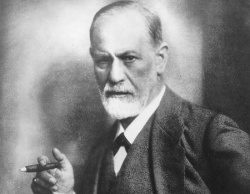
Sometimes a cigar is just a cigar.
Anyone interested in this territory is going to have to deal with the therapeutic giant that is Carl Gustav Jung. The acolyte of Freud who broke with him over his belief that humanities goal was for meaning rather than pleasure alone, Jung’s own crisis of faith was to become axiomatic in his quest to understand the process of human individuation.
Running contra to the current obsession with “evidence-based” approaches to therapy, the concepts that Jung developed were largely as a result of his own Gnostic/spiritual encounters. In concert with his own therapeutic practice, these experiences contributed to the evolution of a decidedly rich vein of ideas: the Collective Unconscious, Archetypes, Synchronicity….the list goes on. In my view the descriptive language of western occultism would be noticeably poorer without the presence of the Swiss hexenmesiter!
Moving on to the insights of the humanistic psychology (Maslow, Rogers, Assagioli et al) we see in their post-war optimism a rejection of the pathology driven perspectives of analytic psychotherapy, and a desire to understand more fully what constitutes “positive mental health”. While Abraham Maslow’s exploration of “self-actualization”, sought to grapple with the outer dimensions of Self and the way in which Gnostic insights might break into consciousness, it was Assagioli that sought to map this process more fully.
In one of his letters Freud said, “I am interested only in the basement of the human being.” Assagioli’s desire to cultivate interest in “the whole building” of consciousness eventually lead him to formulate a therapeutic approach that he dubbed Psychosynthesis:
“That means Psychosynthesis is holistic, global and inclusive. It is not against psychoanalysis or even behavior modification but it insists that the needs for meaning, for higher values, for a spiritual life, are as real as biological or social needs. We deny that there are any isolated human problems.
Nature is always trying to re-establish harmony, and within the psyche the principle of synthesis is dominant. Irreconcilable opposites do not exist. The task of therapy is to aid the individual in transforming the personality, and integrating apparent contradictions. Both Jung and myself have stressed the need for a person to develop the higher psychic functions, the spiritual dimension.”
While I generally find over complicated “Maps” of the Self both difficult to use practically and quite speculative (Ken Wilber’s work being a case in point!), Assagioli’s “egg” diagram continues to be very helpful.

It’s all in the egg
While time dictates that a fuller explanation of “the egg” must be left in the hands of Google (other search engines are available), as a Magical practitioner I am particularly interested in the insights it provides in understanding the process of personal initiation.
I think that for me as I revisited the Egg model I was able to see reflected within it some key aspects of my personal spiritual journey that remain highly resonant in terms of where I find myself today. In the lower segment of the egg, I find myself re-contacting the pagan, the ancestral and the primal. Whatever my struggles might be with regards the overly romanticized lens of Neo-Paganism, I cannot and must not disconnect from the story of my beginnings, my context and the messy realities of embodiment. The richness of these connections and potent longings that bubble up from the unconscious are the life-blood of my magical craft. Without the dark, the earth and the drives of the Id, I potentially jeopardize both depth and mystery.
The central zone of Assagioli’s map is largely concerned with the present- “the work of this Moment” as Toni Packer might put it. However we might conceive of “the Self” at the centre of our being, awareness is amoeba-like in its shifting fluidity. The pre-occupations that writers on this blog have with mindfulness and awakening are often interacting with this realm. What does it mean to be here? Who am I? How should I then live? These are good questions with a multiplicity of answers that are often less important than the sense of questioning and wonder that they provoke. The tools that allow us to explore this territory-mindfulness practices, body work, artistic exploration etc. are as much means for tolerating our own uncertainty as they are ways of gaining spiritual insight.
The upper realm belongs to my inner-Gnostic! For me this is the path of aspiration, guarded futurism and teleological endeavor. Magical work that has no aspiration, no real longing that it is seeking to fulfill is unlikely to sustain focus. Most of us who seek to follow an initiatory or magical path do so because we want more. We aspire to understand our past and who we are today so that we might maximize our being and pull-in gnosis from our future magical selves. Nema in her excellent Maat Magick locates such work in the figure of “N’Aton”, an androgynous future Self that holds within it both our individual and collective genius. In my own explorations I have gained much from seeking to interact with this concept/being/, and such workings can provide rich illustration regarding what we aspire to be and the challenges that might limit such becoming.
Assagioli’s map provides us with a helpful tool for self-exploration and for me its three “realms” speak powerfully to the pagan, meditative and Gnostic aspects of who I am. While the map continues to not be the territory, “the egg” with its’ dashed-lines speak of a permeability and fluidity that we as magicians can play with as we balance and counter-balance in our Great Work.
SD