
The relationship of mindfulness meditation and ritual practice is something that we’ve written about before in this blog. In terms of the chaos magick style, mindfulness can be imagined as being the ‘Ninth Gate’, the vacuity of Kia in the centre of the chaosphere. It is the still point in the circle of chaos, the moment before a decision is made to move outwards along one of the innumerable arrows of possibilty (though, to save ink, typically only eight rays are shown) and into a particular paradigm (or behaviour).
Chaos magick often seeks to deliberately throw us off balance (by asking us to enter into novel belief structures, by stirring the cauldron of the unconscious, and occasionally by doing bat-shit crazy practices) and so having a psychic place that we can return to and be still in is very valuable.
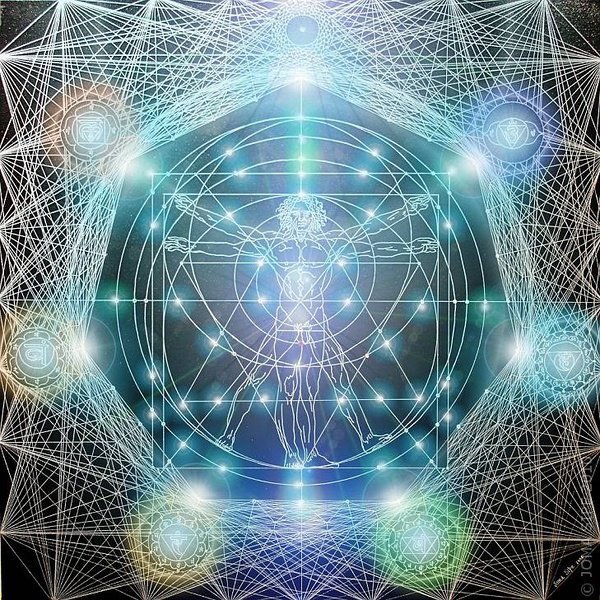
Very pretty, but just focus on your breathing and it will go away…
Mindfulness itself is also a process, and there are various states that can be encountered while we do it. These jhānas are described through various models within the Buddhist tradition, typically as states that arise when the mind is free from hindrances such as craving, aversion, sloth, agitation and doubt. These jhana states can be pretty weird in themselves (with things like delusions of enlightenment, freaky experiences of universal bliss, and other wild forms of ideation taking place). These are phenomena that don’t get mentioned very much with within the contemporary vogue for using mindfulness as an therapeutic tool. Such states can be unsettling, ecstatic or just plain weird and may not be what you ordered, especially if you’re doing mindfulness just to help you de-stress and relax! Sometimes when we encounter these states it may simply be time to stop mindfulness (or to change the structure of this practice) for a while.
Although I’ve suggested that mindfulness is the ‘still point’ in the whirling chaos of our lives the paradox is that it is, of course, still a technique. At a meta-level (and it’s the use of meta-level or systemic thinking that makes chaos magick such a great tool) the process of, ‘sit, observe the breath, thoughts arise, notice them, return to observation of breath’ is itself a type of ‘trance’ (or ‘script’). Sure it aims to allow us to ‘sit with’ whatever is going on, but there may be times when silent mediation really isn’t what you need*. In these circumstances it can be better to mindfully do something; washing up, sweeping the floor, bathing (which are natural acts of banishing) or gathering food, cooking, and chopping firewood (acts of nurturing). It’s also sometimes helpful to try different types of sitting; sitting for ten minutes with short gaps between sessions can be a helpful, try sitting with eyes open or half-closed and so on. These methods also help counter the belief that more (ie longer) is necessarily better. Sure vipassana works for some folks but, like with brushing one’s teeth, sometimes little, gentle, and often works better than lots, hard, and irregularly.
That paradox; that mindfulness is a magical technique that aims just to allow things to be as they are (rather than trying to stamp our Will on reality), is the flipside of the fact that ritual practice and daily life (where we often have an intention of ‘doing something’) can also function like mindfulness if approached in the right way. Being ‘in flow‘ within any activity (be it going for a walk, playing music or doing some wild ceremonial ritual) can provide many of the same benefits as mindfulness (from improved immune system function to cognitive enhancements such as increased working memory). The difference is that these activities often have some form of core message or intention embedded within them (as explained HERE) whereas mindfulness meditation seeks only to explore how things appear to awareness in that moment.
As we explore mindfulness/flow in more detail we might experience forms of radical cognitive discontinuity (sometimes called enlightenment) where it seems that we’ve made some kind of global shift in perception. As a chaos magician I like to hold onto these moments of illumination gently and think of them as waves upon the shore of Self. Each wave remakes the coastline and certainly there are times when radical shifts of awareness (think of these as amazing landslides like the one HERE) take place. However, for as long as we are aware and identified as individual entities (people) new waves (new experiences) will beat upon the shore, allowing new features to emerge in the landscape (the narrative of Self). Mindfulness may significantly re-model our sense of self, leading us to be less attached to things, more aware of flow, and to change the overall shape of our personal narratives. But even the enlightened person continues to change, to learn and to grow.
So each moment of illumination is not a final goal, but the dawn of a new becoming.
*And of course there are times when, rather than attempting to sit with how things appear, we should instead be fucking angry. As magicians we aim to change the world from lead to gold and as both Pete Carroll and John Lydon put it, ‘anger is an energy’.
JV