I recently noticed a whole clutch of my magical friends on facebook getting very excited about the recent release of Scarlet Imprint’s latest title “At the crossroads” http://www.scarletimprint.com/crossroads.html . This volume (produced with the level of aesthetic excellence that we become used to from Peter and Alkistis) provides us with a mouth watering menu of written and visual pieces that seek to distil the contemporary dialogue going on between Western Occultism and the magical religions of the African Diaspora. The list of contributors is impressive, and this anthology promises to capture some of the complex diversity that emerges as practitioners seek to evolve contemporary practice.
Personally speaking, these aren’t traditions with which I am hugely familiar (so many paradigms, so little time!). That being said, because their influence seems to being increasingly important to the evolution of spiritist models of magic, I have tried to gain some understanding of traditions such as Santeria, Vooodou and Macumba. To state the somewhat obvious, with the hyper-real nature of global communication, these traditions are already playing a crucial role in the evolution of our understanding of sorcery, the role of the Goetia and the evolution of the Witch archetype.
As we know, magic is a funny old game! If we try and understand something new as human beings we aren’t usually allowed the luxury of confining it to our brains. If we have spent decades training ourselves not to ignore the promptings of our dream lives and extra-dimensional input, synchronicities and Gnostic insights don’t take too long before they come crawling out of the woodshed. Hence the Were-spiders! In reading Louis Martinie’s excellent chapbook “Waters of Return: The Aeonic Flow of Voudoo” and David Beth’s brilliantly evocative “Voudon Gnosis” I got caught by the concept of the Spider-Loa and its ability to enable the magician to travel upon the inter-connected web of space-time.
Spiders and their webs have long fascinated me. Having spent a fair part of my childhood living in Australia I have a real respect for their creepy arachnid ways. Perhaps not unsurprisingly then, as I stumble along the magical path one of the reoccurring motifs that keeps bubbling up from my unconscious relates to eight limbed creatures and the multi-directional complexity they seem to embody. Not for them the comparatively linear ways of bi-pedism!
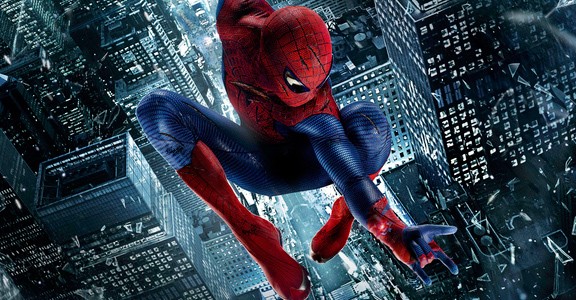
Spidey makes the mudra of Baphomet
One of the on-going projects here at Blog of Baphomet is the exploration of how a technologically savvy magickal tradition like Chaos Magick can interface with earth based traditions like Wicca. As I’ve been re-familiarising myself with some of the complex mythic back-story that knits together to form contemporary Witchcraft, I was struck by the prevalence of weaving and other spider related imagery. Whether considering classical sources (Arachne), Heathen mythology (Frau Holda) or African traditions (Anansi) these divine heroes seem to be employing magicks whose receptive sensitivity is enhanced by their place on the web of connection. At a practical level, for those of us seeking to re-engage with the ways of Dionysian charm and spell-craft, it seems appropriate that these cunning ways often involve the hands-on skills of knitting, weaving and creating art in the magical process. The repetition involved in these activities often allowing us to engage with trance and right-brain creativity.
The notion of connectivity and web-structures also lays at the heart of the new science- the very birth of Chaos Magick in the late 1970’s was in-part the result of a heady fusion of punk rock energy and quantum insights. Although vulnerable to getting coated in a tidal-wave of New Age gloop, ideas regarding quantum mechanics and chaos theory did much to further an awareness of interconnectivity and inter-dependence. At the beginning of the 21st century, few would blink an eye at ideas around complexity within systems, and the metaphor of the web fits not only our computer networks, but also the accelerated way in which seemingly small events cascade to precipitate change (recent events regarding Pussy Riot spring to mind).
For me images of spiders and connectivity echo throughout the Chaos approach in part because of the eight-pointed star as its central glyph. Magick is complex and multi-directional; the moment you think you’ve got your Yin aspect covered its becoming Yang! Connection surrounds us and as we begin our magical training so our sensitivity to it increases. This can be a blessing if managed well, but we also need to contend with the danger of losing the plot! In Pete Carroll’s work the Apophenion he helpfully identifies three sister-goddesses’ of connectivity. If Eris represents the disruptive potency of chaos itself, Apophenia is the goddess of meaningful connection whilst their sister Pareidolia represents that psychotic cliff-edge of making connective meaning that is highly subjective (Pareidolia’s symbol being Rorschach Blot). Perhaps the difference for Apohenia is that she skilfully walks her web rather than getting caught within it like a fly!
Over at enfolding.org Phil Hine has written an excellent piece on the complex and creative process involved in seeking to engage with the tantric tradition(http://enfolding.org/jottings-on-defining-tantra/ ). Whether working with Tantric traditions or those of the African Diaspora, as we seek to evolve our own contemporary practice we need to remain awake to the complex diversity of primary source material and the potential pitfalls of cultural appropriation. As I walk my own web of developing a path that has both relevance and depth I remain aware of the tightrope “wobble” from time to time as I seek connections that are both strong and flexible. Here’s to the Spider-Heroes and the web of connection! IA!
SD