Rise of the Mesopagans

Having recently given some thought to the rise of interest in African Diaspora traditions I’ve found myself wondering again about that old trouble maker Yeshua Ben Yosef  (Jesus to his greek speaking friends). Whatever one makes of claims regarding the historical accuracy of the New Testament record, one would be hard pressed to deny the mythic potency of the Jesus story and seismic impact that responses to it have had on world history. In the hands of monotheism, the myth of the dying and rising god has provided a decidedly “mixed bag” of outcomes as we humans have tried to make sense of the mystery of existence.

Probably  as a result of my own Christian past, the presupposition pool that I swim in is going to be one in which I remain sensitised to motifs within the pagan/magical community that echo Judeo-Christian themes. This seems inescapable both personally and culturally-however revolutionary our newly adopted world views, the software from the past 2000 years is still running and even the most thorough-going pagan reconstructionist seems to be responding to it at least unconsciously.

In seeking to escape the limitations of the sexism, homophobia and specisim that have often been perceived as going hand-in-hand with Christianity, it seems that many of us have fallen into some seemingly inevitable traps. Whether by idealising paganisms past or failing to see the genuinely helpful spiritual impulses of the Christic tradition, we can all be guilty of developing blind spots as we are temporarily dazzled by the shiny newness of neo-paganism. As someone who is both a Jungian and a guarded optimist, I believe that our struggle to find meaning and to balance the light and shadow of ourselves, will have their evolutionary expression through our art, science and religion whichever symbol set our cultures’ currently favour.
Jesus remains strong!

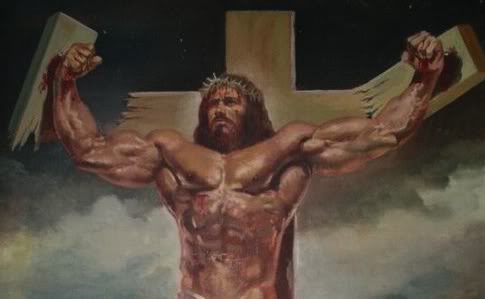
Jesus remains strong!

What I find really interesting as Neo-paganism enters its third or fourth generations, is the increasingly important role that is being played by those traditions (both new and old) that are making creative use of the meeting points that exist between apparently divergent currents. In the course of mulling over some of these ideas I was struck once again by Isaac Bonewits’ ideas regarding  “Mesopaganism”:

“The term MesoPagan was first put forth by Isaac Bonewits in an attempt to categorize modern Paganism. According to Bonewits, MesoPagan religions are those that developed from PaleoPagan or native Pagan religions that were influenced by Monotheistic, Dualistic or Nontheistic philosophies. These include all synchretic religions including Christo-Paganism, many Afro-Diasporic faiths, such as Voudun, Santeria and Candomble, and Sikhism as well as many occult traditions including Thelema, Freemasonry, Rosicrucianism, Theosophy and Spiritualism and many modern Witchcraft traditions, including many Wiccan denominations. Also, some Satanic traditions could fall into this category.

The definition of MesoPaganism is nearly identical with that of syncretism, a word that enjoys common use in academic circles.”  http://www.witchipedia.com/mesopaganism

Although the term may have limited value in that almost all pagan religious expression seems to have syncretism as one of its defining traits, it does point toward a more transparent recognition of key component parts that are being held together. Practitioners laying claim to “traditional” witchcrafts or African diaspora lineages seem, in part, to be attracted to the dynamic frisson created when we attempt to hold together ideas and practices that fall outside neat categorization. Often we flounder as we attempt to compartmentalize ideas and to formulate our theologies whilst removed from the ritual chamber or circle. To me it feels that the organic symbiosis that exists in these traditions is profoundly praxiological. Yes read books, visit websites etc, but personally I learn more when I see the dissonant array of iconography on an altar space or experiment with technique with some intrepid chums.

On a personal level, the process of syncretism is part of my own journey towards integration. Beyond the labels and brand names of faiths and orders are my own struggles to make sense of the tension between the transcendent and the imminent, sense and nonsense. What does it mean to seek awakening within this world and in this bodymind? Perhaps the tension generated as we wrestle with the dialectic shakes us out of our slumber and takes us to a juncture at which new truths can be found.

If we journey to the crossroads in our attempt to rediscover our magic, we are inevitably entering a realm of liminal possibility. The crossroads is a meeting place of apparent opposites and seeming contradictions. The dynamic tension generated by the friction between these polarities makes it the place of initiation. Whether it’s Old Horny offering a contract, a one-eyed Buddha figure or Hecate with her baying hounds, the shit has just got very real and choices are going to be made either way.

SD
The Mythos: Big in America. Ia! Ia! Cthulhu fhtagn!!!!!

[The following essay was discovered on a memory stick found down the back of a sofa in North Carolina in the summer of 2012. No information about the author is available at this time, the file called simply 2012revelations.doc, author information; blank.]

Flying makes you see the world differently. Clouds look big. Like, REALLY big. Miles across…

Driving in a straight line for 12 hours, makes you see the world differently. The landscape looks big. Like, REALLY big. Thousands of miles across…

I was lucky enough to visit America recently, courtesy of some pooled airmiles from friends & relations. Whilst there, I got to spend some time with Cthulhu Cultists, who shared their Deep Starry Wisdom with me.

As a long time aficionado of Lovecraft’s writings, I got to thinking, Why? Why does this made-up mythology have such appeal in this new country? The States has existed for more than a hundred years but much of it only goes back a century since it was settled, and even today vast tracts of the continent remain free of the marks of civilisation (despite having been inhabited by humans for longer than most of Europe).

Lovecraft didn’t get out much. As I understand it, the story goes a bit like this: A sickly child, he spent far too much time looking at books, including reports from the Egyptian discoveries of Howard Carter, and his dad’s Egyptian Rite Masonry materials. He corresponded at length with others, and today the interweb would have been heaven for him, constructing conspiracy theories and typing frantically on facebook chat beneath the blankets as eldritch scratching noises came from the youtube tab, despite the video of the vorticitating hypersphere having played in full some moments earlier…

The horror!!! Of those things of which man was not meant to know!

Here, we can start to glimpse what appeals about the Mythos, referred to in this way as a body of work as more than one author has engaged with this ramshackle collection of Elder Gods and dreamrealms. American culture has suddenly appeared, transplanted from the comforting ancient world of Europe and Africa, to a land without a written past. Any ancientness had been swept away wholesale, along with the living remnants of the original population, and the towns sprang up without a past, when the people there expected, at some level, to have one. Into this gap the hole of a vast amount of freedom of belief emerges; for Lovecraft, a stay-at-home paranoiac, it looked terrifying. To people today who marvel at the space this lack of myth provides, it inspires Awe.

But why use the Mythos? Why hark back to this cray rambling lacking in adjective semi comedic tract of works, instead of simply making it up from a blank canvas?

Lovecraft, in magickal terms, cast a circle, within which he conjured shadowy shapes, vague horrors of unnamed dread, and thus banished a space in the imagination for those who came after. His very failure to describe accurately the entities, the occurrences in his tales, provides the room for the reader to add in details ( an essential quality for a good story to survive the years), it delineates a literary and emotional semiotic space, within which impossible geometries and aeonic time play out in a rather chaotic fractal sense of unlimited potential, yet clearly defined. Comfortable existentialism, if you like.

While this bounded finite space, enclosing infinite possibilities of time and space manifestations, appeals to all of us, for those souls who have been born into the cultural void of North America it offers immense appeal. With a national myth constructed by Hollywood for the past century, a Mythos of fictional, and more attractively yet horror based fiction, offers a route straight to the emotions primal in its contents. Lovecraft’s opus taps into the wonder and fascination with The Ancient, the nameless past these people face each day, an unacknowledged knowledge of millennia of human habitation in the lands with few, if any, concrete memorials.

Working with the Mythos then, in a magickal context, provides a group of magicians with a common language to refer to the deep past, the origin/creation myth of a race. As an island nation (albeit big), the US of A fears and loves the sea and its creatures, the deep waters (here be monsters!) both isolating and protecting them from the strange foreigners and their (overt) ancient ways, bizarre rituals and worm eaten ruins, rigid societal structures and intricate, strange geometries.

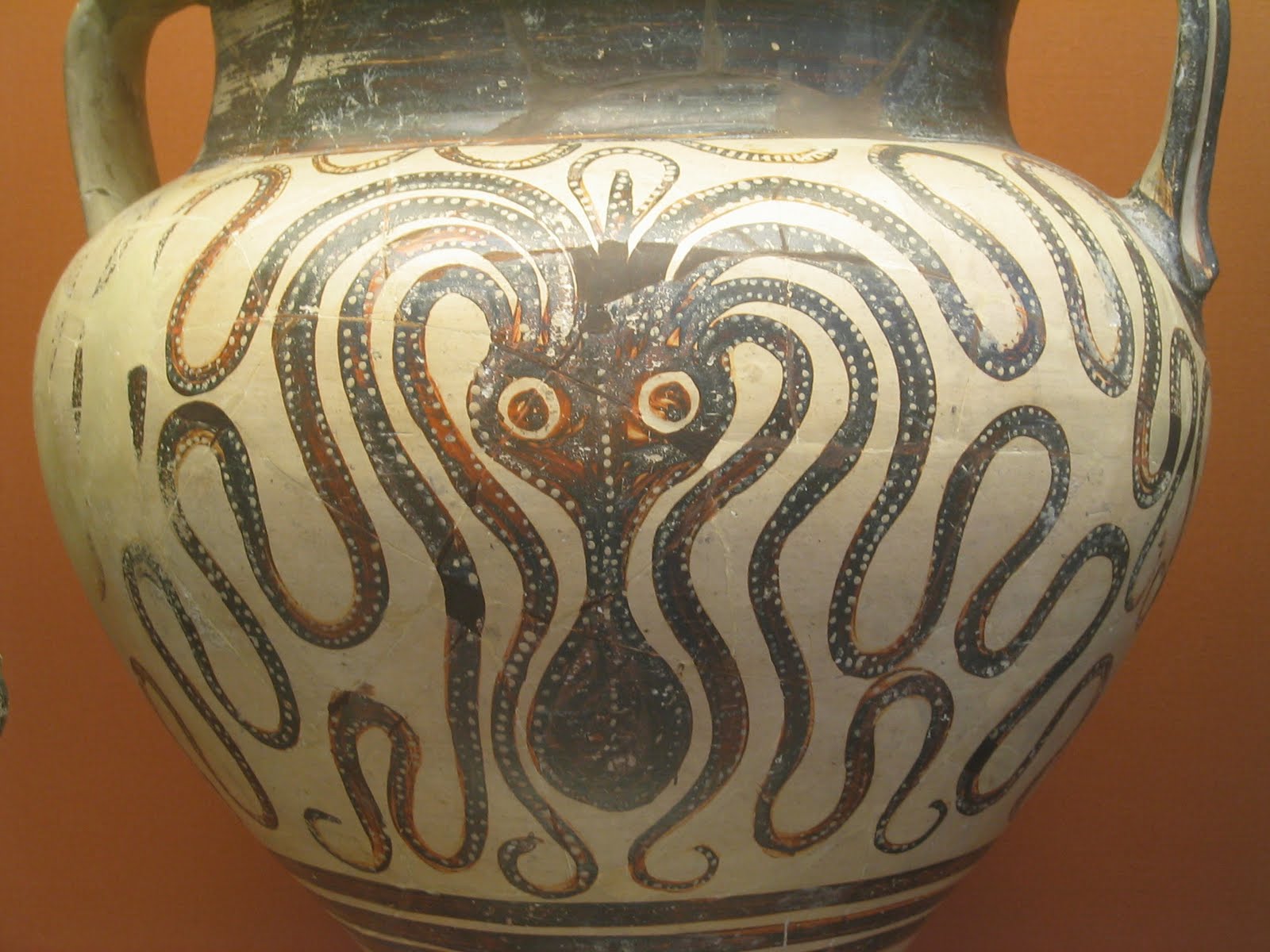
Placing the Old within the invisible depths of sea and land, Lovecraft semiotically places the aware/unaware psyche explicitly onto the seen/unseen parts of the landscape; for him, the visible world of sunlit fields becomes polluted when visited by objects (are these Things alive? or, merely appear to be so?!) The tentacular element has enormous visual appeal whilst harking back to the octopus cults of eastern Mediterranean, best exemplified by the Marine Style of pottery decoration popular in the Minoan.

Many artists and historians have noted the intense Aliveness of these designs, as if they still contain some of the creature that inspired them within the swirling shapes. Look too closely, for too long, and you find yourself sucked in to the staring, mad eyes… Ph’nglui Mglw’nafh Cthulhu R’lyeh wgah’nagl fhtagn

http://www.spiritofgreece.gr/minoan_octopus.html

Chaos Magicians seem to have homed in on the tentacles more than most, probably due to the eightfold symmetry they feel so at home with. In addition, the rather vague Elder Gods, dreamworlds and the experimental approaches of the characters to travelling to other dimensions with the aid of chants and actions such as lines drawn with chalk or string and mirrors, gives us accessible foundations upon which to construct a superstructure of whatever we want to without fear of contradiction.

Much as Baphomet works as an ancient sound, around which we can reframe a concept of a Nature deity on a global scale (because of the lack of mythology), the Mythos of Lovecraft works as a mythic cycle with echoes from ‘genuine’ history (filtered via second hand tales, books, drawings) and raw emotional responses twisted together to make a warp to which we can add concepts of the old ways as desired, as rediscovered, in an overtly fictional made up fashion. This last aspect is essential to understanding the visceral appeal of the Mythos; all history, all myth, is fictional. By embracing aand loving this element, we can delight in adding to a myth cycle. Moreover, the metaphor of creating anew where all was old and stagnant, bringing to life an alien culture that once thrived with technology from across the vasty depths of time and space, finds a chord with the current program of reworking our whole culture whether in myth, or in governance.

Old stories have a place, but we should not be afeared of adding to a mythos, or declaring the past fictional, of changing what it means, what we do with it. Lovecraft did not like the old, was in terrified awe of the scale of the universe, of what science, dreaming, and other people had to show. His reactions to these visions, seem quaintly naïve today, to those of us born after man stepped onto the fucking moon, whilst we simultaneously long for a world with mysterious ruins, and dusty tomes with clues to secret arcane knowledge…

…for this is the open secret of Lovecraft’s books and stories, bizarre and odd as they appear; because to the initiated, they have indeed tapped into a true stream of images embedded deep within our brains, dating from before we were human. Memories of subaquatic cyclopean cities, five-fold radial symmetry creatures, alien architectures, hark back to our primeval oceanic past. Evolutionary embedded knowledge possessed by all parts of the human species, wherever on the planet their descendants have reached now.

Most geographical regions have built upon these ancient structures within our bodyminds, with stories, ways of explaining our more recent history. For America though, the majority of the population only appeared a century or two ago, with mixed national cultures they were on the whole trying to escape from. Given this, we can now see that America is uniquely placed to construct an alternative mythology for itself direct from the source, the original emotional reaction of consciousness to finding itself as a self-aware phenomenon.

“Awesome”, I learned recently, is the stock response of an American to virtually anything. The initial meaning of this word was one of awe, terror/amazement, to the natural world.

I content that this provides further evidence of the hold which the Cthulhu mythos has on American society.

As with all successful blockbuster movies, it combines horror, action, comedy, and dread, with a simplistic human tale to carry the narrative trajectory.

While we can admire the project of these people in their endeavours, I see no reason why other places cannot follow the lead of these brave souls in heading off to uncharted worlds, in their quest for unknown .Åqix|ãùô≤∂¡«‘œŸ··ÞÁ‰þýðñÖwy{èìöº≠¬…À·þ„·‰ËþýÁþ·ýêÖÇïíô©∏¥Ã√⁄À”þ··Ÿ⁄Ï„‰ð·ÞñÖfë¢∞∫º¡ŒÂ⁄÷„‚‰„ÈÞÄ‚ÞôÖäö°∂Ã÷’ÿÞ‚ý·‰‰ÎÁÈÈËÈÁ„¤êÖß≥æ√∂ªπƒ¥÷Íæ«–◊Ã÷Œ«ÁÊÞìÖtà•¥¿Ωªß≈≥◊Óªª¡Œ∂“∆∂ý‚¤ìÖwçßܜՒ‘—‚ÿ÷÷¤Þ¤ð¤‰„ÿìÖêèû°¡÷ÿœÄÿ

[The manuscript ends here, with nonsensical symbols continuing for several lines before a long sequence of irregularly spaced dots. NW]