The Glastonbury Occult Conference was a sell-out event, and a great opportunity for the folk of the British esoteric scene to gather. I’d spent most of the weekend hanging out with my children, so I wasn’t able to attend on the Friday or Saturday (though judging by the smiles of those I spoke with, the celebrations on Saturday evening had been suitably Dionysian). My talk was the final slot on Sunday afternoon and I spoke about the future of magic. Something I’ve been thinking a lot about recently.
My talk covered lots of material: the emergence of Artificial Intelligence and the magical power of technology, the wider use of magical approaches (things like psychology, mindfulness practice and the placebo effect) in culture, and the development of entheogenic spiritual traditions in the West (from rave culture to the urban ayahuasca drinkers of Europe).

mine is the ecstasy of the spirit and mine also is joy on earth
I like to be a bit playful when I speak and so during the drugs bit I asked if anyone in the audience had taken ayahuasca. While there may have been people who didn’t want to say, the fact that from an audience of around 120 only 4 hands went up, is something I find really interesting (though not surprising).
Of course I work with many magicians who never use psychedelics in their Work. My Spiritual Friend Steve Dee (with whom I’ve worked closely for many years) never uses psychedelics in his practice (though his capacity for tea is unrivalled). While I think drugs can form a part of a very powerful technology for exploring the self, illumination, obtaining magical effects and more, many of the practitioners I work with prefer other methods of gnosis. So this low level of psychedelic drug use within the self-identified Pagan community does seem to be a real phenomena.
Another weekend, another conference, this time in Holland at the request of the excellent Pagan Federation International (PFI), I asked my audience a broader version of the question I’d asked in Glastonbury: hands up anyone that has taken psychedelic drugs? From an audience of again about 120 people, maybe 5 hands went up.
An interesting point with this is that I didn’t ask ‘who here has used psychedelics as an intentional part of their spiritual/magical practice?’. I know from conversations with folk that this would put some hands down. There are, for example, people who have dabbled with psychedelics; getting wired on acid at a festival when younger for example, perhaps with a couple of difficult experiences behind them, who are subsequently put off the whole business. Note that I’m talking about the ‘classic’ psychedelics in these conversations. Sure lots of people drink alcohol, smoke cannabis and use other substances, but even then few seem to make these materials part of an explicit ritual practice beyond the celebratory cakes & wine (…and tobacco and tea etc).

Cakes and Wine
The dearth of psychedelics as sacraments within modern Pagan and even more ‘hardcore’ occultural communities is in contrast to their increasing use in other religious and spiritual cultures. From the Santo Daime Church and ayahuasca ‘tourists’ (or ‘pilgrims’), through the Native North American Indian style groups and peer-led networks such as the Psychedelic Society (who, as well as acting as advocates for psychedelic culture, are also beginning to offer supported psychedelic experiences); in these spaces the reclaiming of the psychedelic spiritual tradition is well underway.
My hope (which I expressed in both lectures) was that our understanding of ceremonial practice is something that occultists and pagans can offer to the emerging entheogenic cultures, especially where these are developing outside the ‘traditional’ styles of Medicine Shamanism and new religious movements. I also hope for a return to a more psychedelic magic, with an increasing range and number of practitioners feeling moved to engage with these deeply magical substances. While not for everyone by any measure, when done in a safe, sane, consensual and most importantly esoteric context they are perhaps one of the most surefire ways to empower your magic. Drugs (especially psychedelics) are demonstrably a vital technology in many occult traditions, they played an important role in the occult revival at the beginning of the 20th century, they helped kickstart the vast social changes of the mid 20th century, even getting encoded into Wicca as one of the Eight Paths to Power.
The opportunity to meet Morgana Sythove at the PFI gathering, and to spend some time in her company, was something I really enjoyed. Morgana is a Gardnerian High Priestess of many years standing. It was great to attend the conference and fully appreciate her significance, as part of a coven and a network that has given rise to operating groups and solo practitioners across Europe (and indeed Russia). Her approach to the Craft remains refreshingly undogmatic, while her lineage is direct from the original inception of Wicca by Gardner and Valiente. Along with members of her coven, we discussed the actual meaning of the Hermetic principle of polarity (which is by no means a synonym for heteronormativity), and the notion of Wicca as a Mystery religion (rather than a system for collecting degrees in the way one might collect stamps).
Her role in the recently released film Witches in Holland (from Silver Circle Publishing), and her approachable and profoundly unprejudiced introduction to Wicca Beyond the Broomstick, presents a Craft that aims to help the witch achieve a dynamic balance within their practice, as well as a felt recognition of the axiom ‘As Above, So Below’ (which, like the process of acquiring siddhis, also handily leads to magical power).

World Tree
It was also interesting to be in the company of a practitioner who has helped grow a movement but hadn’t found themselves lost and fearful when their ‘creation’ grows up and goes beyond them.
History is of course littered with the wreckage of people who, while they may have founded a spiritual practice or community, have been unable to move from the Heroic archetypal style (which is necessary to develop a new school or style) into the adult role of Wise Sage (who accepts the changes and developments of what was once ‘their’ system).
The famous disagreement between chela Carl Jung and guru Sigmund Freud is a great example. Freud cut a new path through the understanding of the human mind (though of course he wasn’t actually original, but just a firebrand of a synthesist who was in the right place at the right time). Jung comes along and becomes the master’s favourite pupil. All is well until Jung starts to outpace Freud and goes into areas (such as the occult) that scare Freud silly. Freud becomes increasingly dictatorial and eventually they split. Jung goes on to develop what I think is one of the most interesting psychological models (especially for magicians), and of course the basis of many personality testing methods used today. Jung escapes the dour subconscious of Freud into the mythic wonderland of the unconscious. Jung also goes through some profound personal initiations (such as the illness that led to him ‘channelling’ The Red Book and his experience of having two partners) as part of this break-away process.
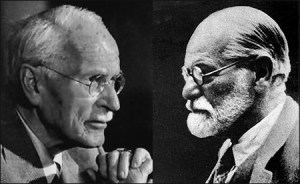
face off
Similar Oedipal (as Freud would say) patterns can be observed in the stories of many religious and esoteric groups. A great example comes from Mogg Morgan’s book Tantra Sâdhana. In an appendix he details some of the craziness that took place when AMOOKOS founder (Shri Gurudev Dadaji Mahendranath, aka Lawrence Miles) started to feel he was losing control of ‘his’ magical order (the chapter is brilliantly entitled When Your Guru Goes Gaga). Other examples include dear old Gerald Gardner himself. Feeling that ‘his’ Wicca was out of control he ‘discovers’ a set of Wiccan Laws to try to reassert his fading authority and significance.
This instability with teachers, while not ubiquitous, is something that happens fairly frequently and, perhaps when considered from a kind of Taoist magical perspective this is destined to happen. As the control of a group moves away from the leader, if their teaching has any value it needs to go beyond the confines of a particular school or style; becoming embedded in wider culture (or occulture). In some cases the explosion of the initial group may be necessary for this to happen. Popping like a seed pod, the creation is detonated, spreading personnel and ideas into wider society.

Fit to burst
A good example of this is Thee Temple ov Psychick Youth who, while a clearly collaborative organisation, had Genesis P. Orridge as a leading figure. As I understand it Genesis left and eventually did the usual thing of declaring the order dead or dysfunctional. But whatever the details, the fact is that the work of TOPY was, like the genie, out of the bottle and no-one, least of all their former leader, was going to control it. Modern iterations of sigil magic, body modification techniques, new primitivism and much more; TOPY material is now to be found informing many regions of occulture, uncopyrighted and unfettered.
Luckily, from what I’ve seen, Morgana is one teacher who isn’t suffering from gaga-guru syndrome. This may be simply because she is a more thoughtful and sensitive person than your run-of-the-mill inspiring, but somewhat socially dysfunctional, cult leader. It may also be because of the coven based organisational structure of Wicca; the lack of any (formal) wider hierarchy in the Craft (there is no Pope) and no written authority (no Holy Book). These factors may serve to reduce the likelihood of The Teacher (successfully) becoming The (would-be) Tyrant.
But perhaps it even simpler than that; a wise teacher realises, when their students go beyond what they themselves can offer, this isn’t a threat to their authority but rather the sign of a job well done.
JV


