Magic at the Core

Happy New Year to all our readers! I hope you’ve all had wonderful Yule festivities and have had some time to rest, relax, reflect and refresh yourselves.

As well as enjoying some time to hang out with family and friends during December, I was invited by Frater Isla for an informal chat which you can find on his podcast Right Where You Are Sitting Now. One of the things we spoke about was all those ‘hardcore’ esoteric practices; things that magicians do to face our demons, stir the cauldron of the unconscious, and shake us out of our day-to-day trance.

As I explain in the interview while I often write about the more dramatic approaches I use, these techniques are far from the whole story of my own magical work. In fact the majority of my practice consists of yoga and mediation.

I’ve done yoga for the last thirty or so years, through periods of more or less frequent practice. At the moment I’m a student of Adriene following her 30 days of yoga program. I went online to find a nice 30 minute yoga workout (since it’s helpful to have new input to keep one’s practice fresh) and happened instead upon this month long course which has been a delightful spur to my practice. (Check out the large number of excellent instructional videos by Adriene which include films on getting to grips with particular asanas, as well as yoga for particular bodymind intentions.)

Camp yoga

Meditation for me takes many forms. Sometimes it’s about sitting still and doing classic mindfulness practice (often at the end of a yoga session). At other times it’s about finding a focus, an anchor for attention (this could be music, mantra, an activity such as walking, carrying water or chopping wood), and encouraging my attention to rest in that activity. As other internal narratives arise (typically for me this means thinking about the future) I gently guide my awareness back to the focus of attention I have chosen. This approach allows me to segue meditation into a variety of settings beyond that of sitting on a zafu.

Both meditation and bodywork provide the steady drip-drip-drip of core practice. They are also the psychic lube that makes some of the more outré activities, such as entheogenic mummification ceremony, ritual piercing and situationist magic, more approachable.

So looking ahead to 2017: Next month I’m teaching at Treadwell’s Books in London delivering an evening lecture on Psychedelic Magic as well as a day long workshop on Baphomet. I’m also working on another pop-up exhibition by the Psychedelic Museum (we’ve got some exciting news about the museum coming soon, which I’ll post on the Psychedelic Museum site and reblog here).

I’ve also completed another two books that will be published this spring, one is another collection of essays and one my magnum opus about psychedelic ceremony.

Meanwhile 2017 will see the fourth manifestation of Breaking Convention, the most awesome psychedelics conference on planet earth. For details stay tuned to this blog and our Facebook page.

The Mother of all Psychedelic Conferences

The Mother of all Psychedelic Conferences

Nikki Wyrd and I are planning some further retreats and workshops this year, please check out our new page Deep Magic if you want to learn more.

So as the sun inches higher in the northern sky I’d like to take this opportunity to wish you all a fabulous journey through 2017.

And now back to the yoga and meditation…

JV

Surreal Christology (Part 2): The Mirror

It’s hardly surprising that mirrors get used a lot in magic; frankly they’re a bit weird. When we look at them they extend space, they reverse and they potentially distort. Whatever we think we look like in our heads, when we look into a mirror we are pushed into a dialogue between that internalised self-perception and the version of self represented in front of us. We may be delighted by what we see or we may become flooded by dysmorphia. Our dis-ease may be skin-deep or it may reveal deeper truths about who we want to be and how we wish to interact with the world around us. Whatever we think is driving us, if we see ourselves more fully we may be confronted by aspects of our daemon that are as likely to shock as they are to empower.

The magical use of mirrors can be manifold, ranging from aids for spirit evocation to scrying tools that allow the diviner greater access to their own unconscious processes. To explore a mirror nocturnally, via candle-light, is to journey to occult edges, and the practice of covering mirrors following a recent death alludes to a need to stabilise our environment in the midst of grief. Given the way they seem to play with the nature of time and space, it’s of little surprise that the Surrealists found them so fascinating.

hand_with_reflecting_sphere

Self-portrait in Spherical Mirror, 1935. MC Escher.

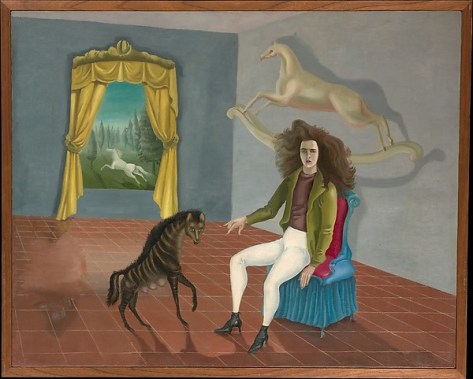
The Surrealists on occasion had mirrors explicitly within their art (often as puddles of quicksilver or mirrored melting clock faces) but more often their presence seems far more implicit. Via their use of depth of field and inversion, when we engage with surrealist art we can often feel that we are gazing at a reflection, with all the subtle strangeness innate to that process. Like the melting clock we are required to relinquish our hold on our sense of time and solidity; i.e. things get a bit wobbly and dream-like.

horse.jpg

Self-portrait: The Inn of the Dawn Horse, 1937-38. Leonora Carrington.

In many ways myth and mythic heroes can act as powerful mirrors for viewing ourselves. When we consider those stories or figures that we are drawn to, they can often reveal some significant aspects of who we are at both a conscious and unconscious level. While our initial attraction to a myth may reflect a need or a connection that seems quite obvious e.g. a promise of liberation or an exemplar of individuation, when we renew and revisit this process over time, arguably something subtler takes place. When we truly engage with and internalise these spirits, their strangeness starts to haunt and shape our dreams and outlook.

In terms of my own experience, while my initial flight into Christianity was largely related to my adolescent confusion about the fluidity of my sexuality and gender identity, the Queerness of mystery still managed to break through via my interactions with the myth of Christ. While recognising my personal projections onto the gospel narrative, I eventually uncovered in my reading of Jesus a blurry ambiguity that remains inspiring. Yes this was still the radical who threw over tables in the temple, but he was also the mother hen who wanted to gather the lost underneath his wings.

In a personal world where the versions of maleness, certainty and force made little sense to me, my own gnostic encounter allowed access to a gentler, more mysterious experience. This Christ became a mirror through which I could view myself more closely. Such looking can be far from comfortable, but over time it allowed me to engage with deeper truths about who I needed to become. For me this magical process of engaging with the Christ myth allowed me (somewhat ironically) to become accepting enough of myself that I no longer wished to call myself a Christian.

This Gnostic Christ seems to be asking me to both take more responsibility for my path, while at the same time doing less violence to the core of who I am.  This reflective process is most definitely a work-in-progress and has been far from tidy or pain-free. To walk a magical path requires that we “dare”, even when it means the willed deconstruction of those stories and heroes we hold as precious. This is a narrow road, but it holds the potential of liberty from the claustrophobia of childlike sentimentality.

Whichever mythic mirror feels most attractive to you, I would recommend revisiting it with a Zen-like state of beginner’s mind. Find some great art concerning these myths, or better yet create some art of your own. In my own recent explorations of the Queerer dimensions of Christ I have been inspired by some of the art on sites such as Kittredge Cherry’s  “Jesus in Love” blog. Often these creative explorations into the surreal and less-lateral aspects of ourselves provide us with gateways to discovery and the possibility of further evolution.

Find art that feeds your soul and allows greater insight into who you are and who you can become. Seek the Mysteries!

SD