I was asked recently, at one of my workshops at Treadwell’s esteemed premises, about what happens when a spirit/servitor is deconstructed at the end of its useful life. The person wanted to know, quite understandably, where the energy which made up the servitor went to, back to the general universal pool, or into the creator of the servitor, or where?
I must admit I had issues with trying to answer this question. I see each entity (including myself) as a temporary standing wave in the universal pool of energy/information, and so I don’t tend to distinguish between these as separate things. I had to ponder deeply on this matter…
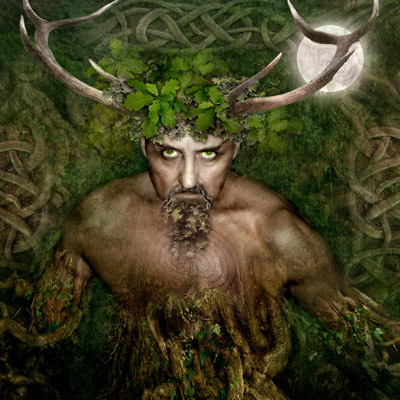
Some months later I found myself describing invocation at another workshop, and a similar kind of tension was apparent. Does the magician invoke the Deity or, does the Deity set things up so that it invokes itself into the magician? As a chaos magician I tend to cheat and hold both views simultaneously, certainly when a full on invocatory process has worked and I stand in the circle as a deity, I often find myself thinking that I, *insert spirit name here*, have decided to arrive at this place.
Make way for me!
In a world where cause and effect are often taken as the default mechanism for all things, tracking back to who did something has enormous weight when we conceptualise any action. It can in many cases prove productive; by finding the act which altered a course of events, we can see where the praise/fault rests. This can be terribly handy when attempting to replicate the act again in repeatable circumstances.
Magickal activity follows a similar pattern where we try to identify the point of pressure likely to lead to the result we desire (divination) then do something that changes the outcome (enchantment).
From a more philosophical perspective however, this can lead us astray into thinking we are the controller of the universe; when in fact, we are merely a conglomeration of stuff and events that have produced an effect in the world which may well be a result of another entitity’s desire way back when. Science, and magick, by drawing a circle round a specific set of events, artificially define a chain of events when reality has far more integrity to it, far more messy blurring between the fractal sets of physical nested events.
And this is why the chaos magician laughs after doing magick, at the absurdity of pretension involved in believing that one has ultimate power over anything.
We draw circles around our actions, in order to focus attention where we need it. To keep out bad spirits, influences we do not want to include in our sphere.
At the moment of focus, these circles hold firm, but to re-enter the world we must rub them out to merge the world of magickal endeavour with that of the mundane, the ordinary. We laugh at ourselves, we eat and drink, we remove the trappings of The Other that proved so powerful during the Magick.
Because, we live our lives in this mundane world. We enter into magick to affect the mundane, the proving ground, the arena of our daily lives.
Magick is not distinct from the rest of our activities. Just as millinery has had societal influence far beyond its obvious direct products, occulture has pervaded and affected so many aspects of how we see the world (from the origin of Science itself, to so much of that spooky stereotypical imagery we all know and love), that to talk of the occult as a separate thing outside mainstream society proves harder the closer one looks at the boundary (fractal disappearing acts recur). Which is not to say that the descriptor, ‘The Occult’, has no value; we all ‘know’ what that means, from our own perspective at least.
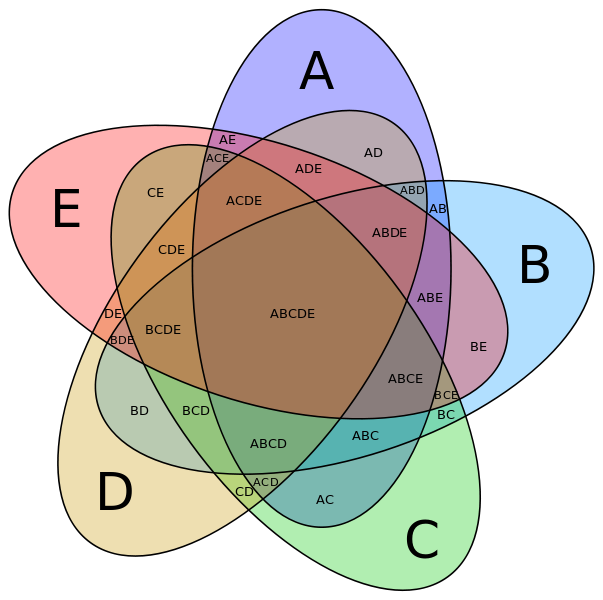
But as when using any group labelling terminology, we should bear in mind the continuum and overlap of the individual people, products, acts, and concepts with other, differently labelled currents.
The work of a Venn master
Linguistics forces us, necessarily, to treat of concepts/defined happenings as isolate objects we can pick up and examine, move in relation to one another, for this is how we interact with the physical world, and it is upon the scaffold of these neural structures we built our words. Yet when we think clearly, we see the way that objects are mere nodes in a far wider network, these apparent things that we reify, they really have existence only as snapshot frames in the flow of the material realm, and the events or spirits we conjure with when we talk similarly flow, emergent highlights from the ground of wisdom.
To ask where does a spirit’s energy return to, is linguistically possible, but when one looks at reality the question disappears, the meaning redundant as we enter that place beyond duality, paradoxical awareness of the neither-neither nature of Nature.
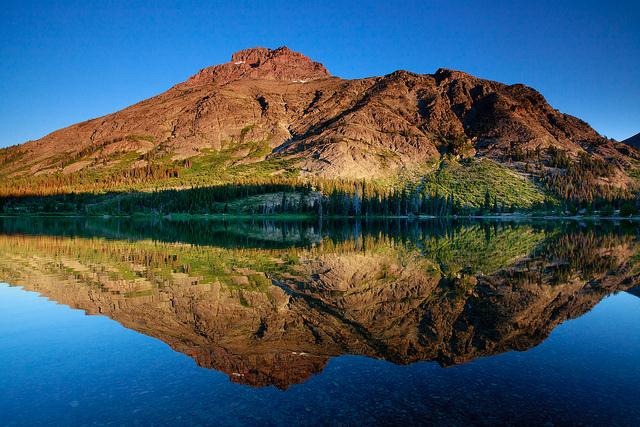
A mountain. A lake. A reflection…
Sometimes the process of asking such questions has immense value in itself though. After all without it I would not have written these words, nor would you have read them…
NW