Do you feel overwhelmed by the amount of data which is thrust in your general direction? Emails, texts, facebook and all the rest. Those pesky Youtube adverts, those annoying screens at the Post Office telling you about their latest service, posters, bill boards and all the rest?
I was chatting with a Sister recently and talking to her about a lecture I once attended which was delivered by Ramsey Dukes (Peace Be Upon Him). As part of his presentation Dukes produced two images. One of a modern day ‘data warrior’ some suited chap sitting in front of a bank of monitors providing him with stock exchange data, simultaneously using two telephones. This was contrasted with an image of Ramsey as a young muscular adept, standing alone in a forest glade (and looking pretty buff if I remember correctly). The point that Dukes was making with these images was that, although it looked like the stock broker was up to his neck in information, he was in fact data impoverished when compared to our dashing young sorcerer in the woods.
Streaming vast amounts of data
In a ‘natural’ environment, Dukes argued, when we are seeing, for example trees, there are many more colours in the tree than might be represented on our data warrior’s VDU. Then there is the way that the figure in the woods is receiving information in the form of smell, the complex sounds of the wind and of the nearby stream. There are the shifting patterns of warmth as the clouds occlude and reveal the sun. The buzzing and movement of insects, the kinesthetic sense of the uneven earth beneath the feet…you get the picture.
My Sister and I were talking about idea in terms of psychogeography, of getting out into the landscape. We were discussing how we make ourselves sensitive through the various techniques of interacting with landscape (some of which I’ve written about HERE). Being silent when we walk is one simple example. It’s often pleasurable to talk as we travel in the landscape but there are undoubtedly times when it’s a good move to shut up, to listen, to be receptive to the place rather than focus on expressing our internal dialogue through conversation.
As we fall silent we no longer need to attend to the narrow bandwidth of the human voice, and, since human interaction is a large part of what are brains are built for, this frees up plenty of processing power in our minds. We can then practice those lovely exercises such as seeing if one can hear five natural sounds (if walking in a rural or parkland environment) or seeing how many other conversations we can perceive (if exploring an urban space).
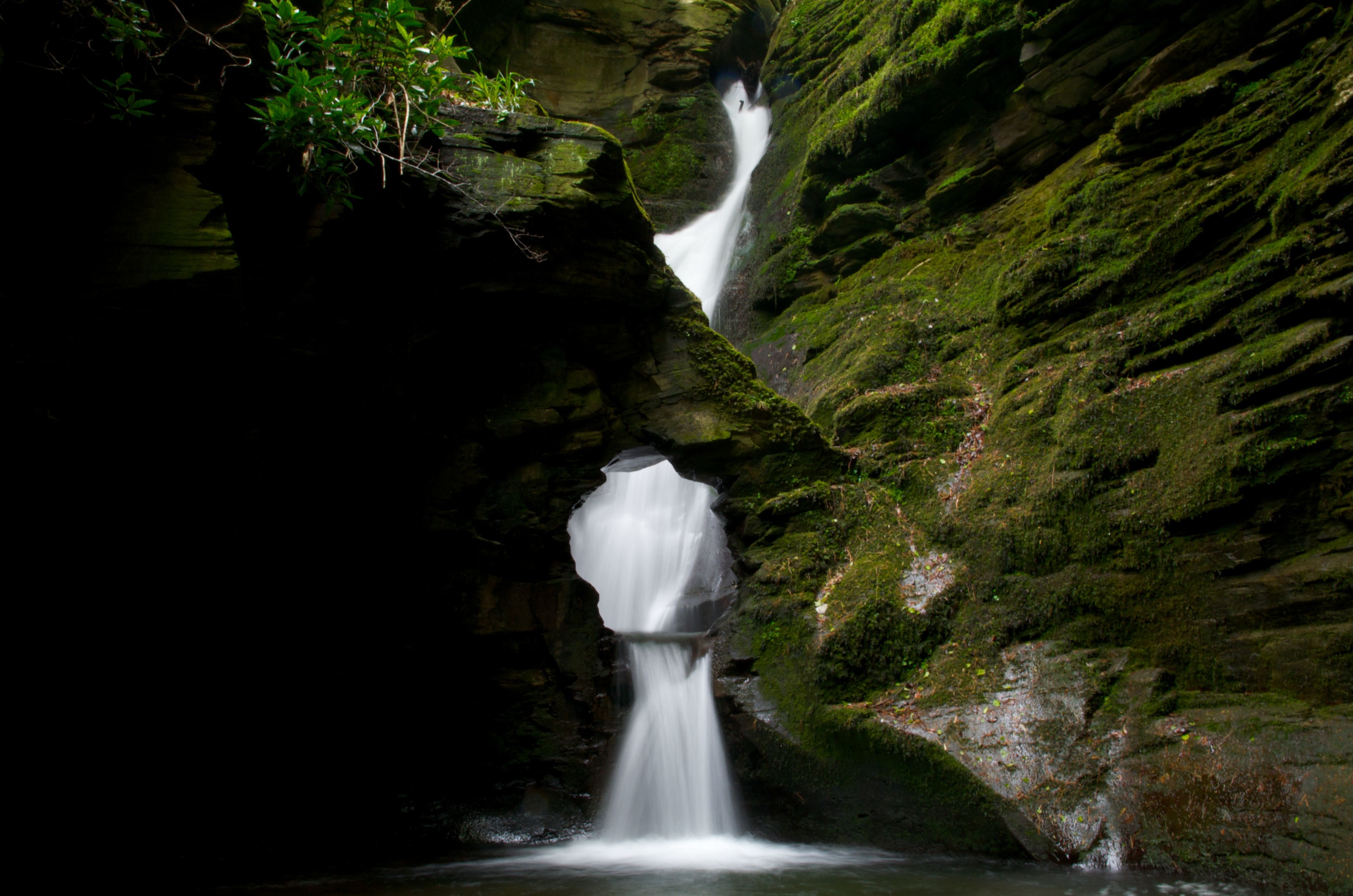
By becoming more open to outside impressions. Basking in the complex data flow of being, as I was today, beside a huge Cornish waterfall, we can open up not only our dominant senses (of sight and hearing) but we can open to the dark senses – the sense of barometric pressure, the ionisation of the air, even the scientifically measurable but (for most people) exceedingly subtle senses we have of geo-magnetism and of the lunar phase (if you want to know more about the dark senses the classic text is the one HERE).
A couple of days previously I was working with some academics from The University of Exeter. We were having a conversation, via Skype, with some game designers in London. When we’d done the lecturer explained to me how she’d spent almost the whole day in her office, doing on-line meetings. She described how she felt ‘blinkered’. Being tuned into the one channel of communication how she’d forgotten even to eat properly that day (a half munched apple lay on her desk). Here was another example of how we get tuned in to a particular channel (in this case video conferencing) and that actually causes a reduction in the amount of information we receive (remember, food is both fuel and information). Her abandoned apple represented a loss of gustatory data in her day.
Now this isn’t exactly a bad thing. Humans need to be able to focus on a given task and be persistent in their attention. Trance techniques (from drumming to TV) exist as ways to focus us even further into a very narrow band of attention. This is useful for many things including of course many types of magickal work
Thing is that in entering a trance we may loose, at least for a time, our global sensitivity to our environment. We don’t notice the world, and, if we do this too often, selecting only one channel of experience, we slip into information poverty.
What may seem odd then is this idea; that today many of us are actually not overwhelmed by information (like all those emails) but seriously under whelmed by it. And what’s more this relative paucity of information may be the thing that may make us less sensitive to the range of environmental data that’s always around us (whether we are inside or out).
There are practical consequences of this. Wikipedia teaches that after the 2004 Indian Ocean earthquake and tsunami:
Anthropologists had initially expected the aboriginal population of the Andaman Islands to be badly affected by the tsunami and even feared the already depopulated Onge tribe could have been wiped out. Of the six native tribes only the Nicobarese, who had converted to Christianity and taken up agriculture in place of their previous hunter-gatherer lifestyle, and mainland settlers suffered significant losses. Many of the aboriginal tribes evacuated and suffered fewer casualties.
Perhaps in the light of the suggestion above the aboriginal people of the Andaman Islands simply had more data at their disposal and, as a result, were more sensitive to the impending disaster than their neighbours who had abandoned their traditional practices. Unlike many of the victims from elsewhere in the region ‘something’ told the Onge tribe to take to higher ground. I suggest this may have been because they had so much data at their fingertips in the form of a receptive engagement with the environment. They were able to notice subtle clues which, when correlated with cultural memory (of previous tsunamis) or perhaps emerging simply as a gut feelings, got them out of harm’s way.
So if you want to deal with your email backlog successfully, and indeed to work smarter (as they say) the best strategy is probably to go for a walk. To get out into that sea of data that is the landscape, open all the channels and max out on geosphere and biosphere bandwidth. And it may be the case that, if you want to write that article which has been in your brain for several days, you just need to go get some nature and fill up on living information. Then have some nice homecooked food, turn up the tunes and, in just a couple of hours, you can have (what I hope) are 1169 interesting words to share.
JV
 The Blog of Baphomet