
One of the three treasures of Buddhism is the Sangha. This is the community of practice. Those people around us who support us in what, in western magick, we might call The Great Work or perhaps the process of Illumination. As someone who thrives on close collaboration (the majority of the books on which my name appears are co-authored texts) and communal activity (since the age of fifteen much of my esoteric work has happened in groups) the Sanhga is essential to me. Of course it’s not like that for everyone; some folks really thrive on working alone, or perhaps with just one other person. More accurately, most of us (even gregarious me) will have periods in which we need solitary practice and other times when we want to come together with others.
I’ve been fortunate to work within many organisations over the years; ranging from The Order of Bards, Ovates and Druids, Wiccan covens, native shamanic settings, AMOOKOS and, for the last ten years (though not to the exclusion of those other groups) with The Illuminates of Thanateros. While the style and focus (though perhaps not the ultimate project) of these groups is pretty diverse, there is a shared commonality of function in that they are all designed to support and nurture the people within them. And as part of this support there also has to be a compassionately critical process at work too; where we help each other to unpick our difficulties and to transcend our own (often self-created) problems.

- A wrathful deity this morning…
All these groups necessarily share culture; signs, stories and in-jokes. This is part of what makes a community. There is the need not only to build up the group mind or egregore, but also to figure out how people are admitted to and indeed excluded from the group.
Policing of the boundary of a group is something that different communities deal with in different ways. What becomes apparent to anyone who spends time in any human society (esoteric or otherwise) is that exclusion is often a painful process. Human beings are (mostly) highly socialised creatures so kicking someone out of a group isn’t usually an easy thing. But in these situations, remembering a few Buddhist insights can be helpful. Even if those people we exclude have done harm to our community, or indeed are likely to still cause trouble when removed from our immediate orbit, it is compassion which we should deploy when presented with these situations.
‘Compassion is the vice of kings…’, writes Crowley in his Book of the Law. One interpretation of this is that ‘kings’ (ie people engaged with the discovery and pursuit of their True Will, the heroes or vira of tantrism) can afford to have genuine compassion. When we take a decision, even a hard and difficult one, a king will do so in a way that is free from vindictive malice and is instead predicted on a desire to see all parties liberated (or illuminated or whatever).
Compassion is something that, possibly more than any other behaviour in my view, marks out the successful and engaged magician. Not some wishy-washy sympathy for others but a genuine lived concern for the well-being of those around us, even, and sometimes especially, for those difficult people. One of the top techniques I know for this is Tonglen practice. Cultivating compassion plugs us into bodhichitta, explained nicely in Sam Webster’s book HERE, empowering our magick in part by making us viscerally cognisant of the Hermetic view that all things are, in essence, one. A lack of compassionate capacity, and the subsequent sense of the world as full of ‘the (evil) Other’, as well as that hoary old chestnut ‘lust of result’ goes a long way to explaining why angry and malicious people are rubbish at magick, spending their time flinging curses at the world that simply don’t work.
The esoteric traditions of the Himalayas are pretty hardcore when it comes to expressing compassion (showing us that being compassionate certainly doesn’t look like being an interpersonal doormat!). There are all kinds of fearsome forms of the Buddha that are about destroying the obstacles which stand between us and Enlightenment, and acting swiftly to liberate us from suffering. This liberation can be a hard and painful process. If we are ill we may need the poison drained from us and that’s best done fast, fully and with care. The insight of Buddhism (the drive towards compassion), is balanced what one might describe as a Tantric view; that we should aim to accept the world as it is, recognising the divine in all things, without falling into aversion. The poison may need to come out but both it, and the pain that attends its removal, it is also part of the sacred totality.
The blending of these elements is especially important in group contexts. We aim to interact with each other in a compassionate way, and also we realise that the world is as it is, and even in those things we find difficult we should aim to find the sacred, and through those things opportunities for Illumination. These two pillars of practice mean that as we enter challenging situations our compassion is fed by our recognition of the sacred moment of the Now just as it is (warts and all).
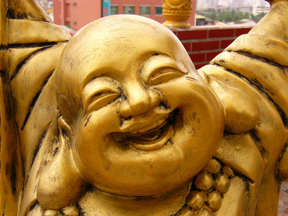
Smile, and remember Buddha loves you!
This recognition, of presence of the sacred in every moment, allows compassion to arise even for those people who we find difficult. It allows us to act (albeit sometimes to painfully prick the poison boil) without feelings of hatred or the need to take refuge in a (suffering-tastic) de-humanising attitude. Our orientation to events changes, so while we may still feel that something is a bad situation we don’t so much rise above it but engage with it in a way that betokens a caring motivation, a stance that nourishes rather than depletes our psychic reserves. This allows groups to flourish and develop a culture of mutual respect and empowerment (both internally and in their relations with others). It also helps them successfully adapt to inclusion and exclusions, to develop what has been called collective wisdom, which in magic-speak is the empowerment the communities egregore.
In the face of the slings and arrows of fortune, and the vicissitudes of human nature, working magick in communities can be a huge challenge (as well as being, for folks like me, greatly rewarding). So let us have compassion for ourselves too, and practice the wry grin of the bodhisattva. After all nobody said The Great Work, or indeed our refuge in the Sangha, was going to be easy!
JV

 The Blog of Baphomet