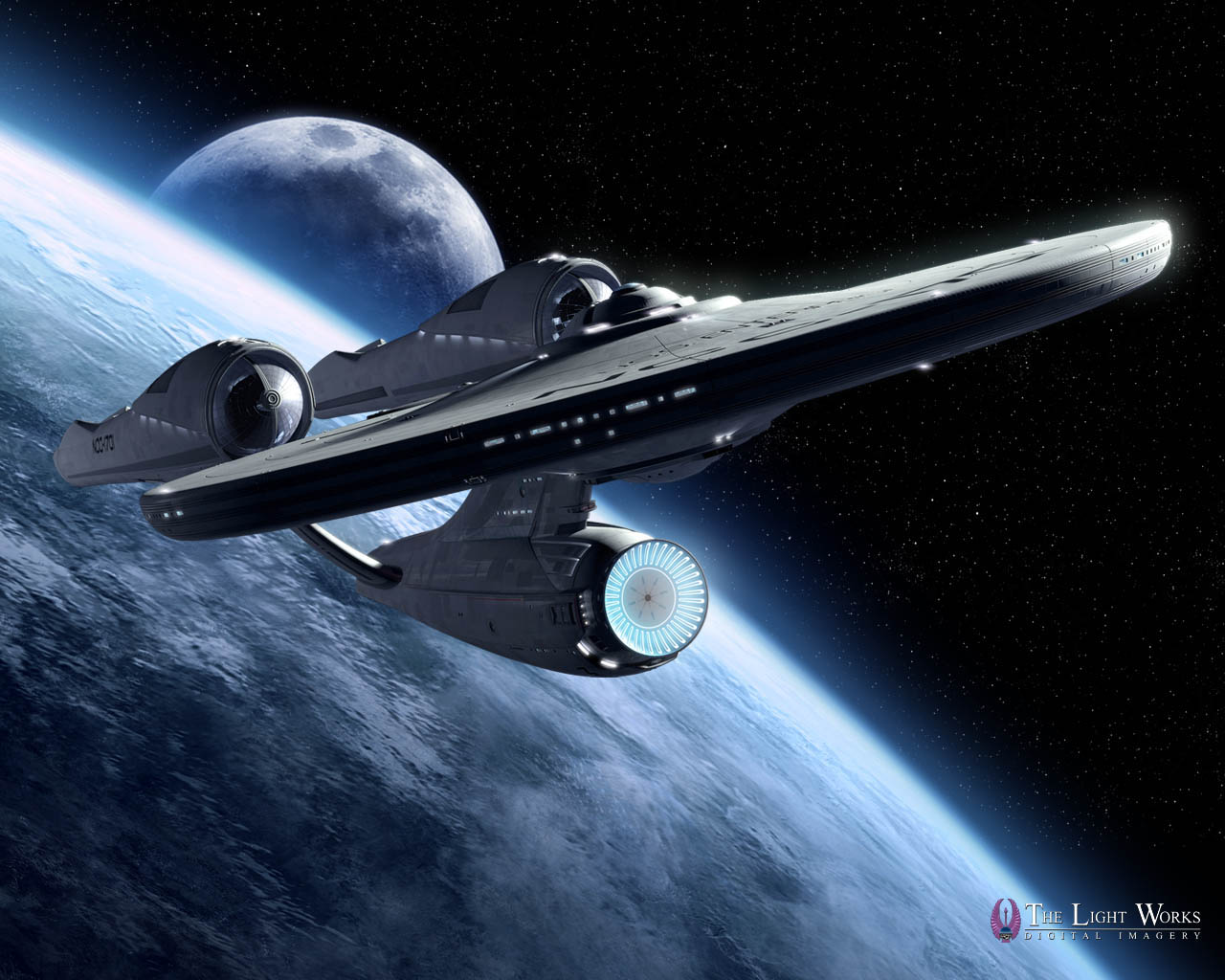
The late, great pagan author Isaac Bonewitz once mused that he thought that Druids would be the chaplains on the U.S. Enterprise. This always appealed to my inner geek as I visualised a heady mash-up of ancient priests and warp-drive technology; the myths of the ancestors forced to throw new shapes as their archetypal force meets new realities.
As Pagans, Gnostics and other magical types we have some interesting conundrums to engage with as we seek to locate sources of authority and inspiration. On one hand many of us struggle with mythic sources being given some sort of scriptural authority (the Edda, Parzival, the first Star Wars trilogy), and yet many of us want to anchor our spirituality in something more substantial than new age whim or consumerism.
In search of space…
The Romanticism that seems to be key to our current perception of the past arguably runs throughout the majority of contemporary religious traditions. Everything from “the early church did it like this….” to the imagined sabbatic activities of the Witch cult rely to some extent on the projections and agendas of those engaging with the material. Personally I don’t feel that this is a bad thing, merely something that needs to be acknowledged. As a good Jungian and Process theologian I thrive on the idea that religious expression is an emergent manifestation of humanity’s engagement with nature and consciousness – such engagement will inevitably contain our fears and foibles as well as our highest aspirations.
Most mythologies hold within them the unfolding dance of a culture’s evolution: chaos versus order, transcendent versus imminent, the corporate need versus the individual’s awakening. As we look back to the ancestors so as to understand how we have arrived at where we are now, we need to realise that this is a process in which the dynamics of conflict and resolution continue still. Some may wish to idealise the past as some static wholegrain utopia, but the types of conflict present within much mythology represent the dialectical process of evolution where new realities are forged and then in turn challenged themselves.
Myth is important because its reinterpretation represents a subtle re-imagining of how we in the present engage with shared dilemmas that are endlessly repeated. In blending the historian’s observation with the artist’s flare, myth provides us with a less linear gateway for discovering truth, what Joseph Campbell called “metaphors of spiritual potentiality”. In contrast to dogma or isolated philosophical ascent, the dream-like impressionism that myth often evokes allows us to access something deep and mysterious within ourselves. The fuzzy edges of mythic thinking allow us to burst the bubble of perfectionism and rigid certainty as we revel in their multiple perspectives and imprecision.
Whatever aeonic schema or eschatological end-game we choose to buy into, the unfolding evolution of a mythic narrative often reflects the subtle shifts and changing needs of a culture. Whether we are sitting ring-side watching Set and Osiris slug it out or viewing the smoke rise from an ever repeating Ragnarok, the interface between these deep myths and our daily experience inevitably forces our gods to remanifest.
It is of course critical that we engage thoroughly with the best source material available so that the “heart-wood” of our spirituality allows us to be both strong and flexible, but equally we must be wary of concretizing our perception of lore in some sort of pagan fundamentalism. The sustainability of these subtle mutations will probably be best served by adopting a “Slow” model of development. We will need to be awake to our contexts and also the sense of “fit” as we explore new ways of working with mythic realities. We will need a relationship with the spirits of this material so as to ensure a true depth of evolution rather than a short sighted wish-fulfillment.
In pondering the future of myth and how our deep stories will change in the future, it is my view that we as Gnostics and magicians with be at the experimental front-edge of this process. Those myths with a fuller history may rightly be slower to evolve; the degree of consciousness directed toward them giving them a greater archetypal density. Other stories however may be more flexible!
In The Book of Baphomet, Nikki and Julian put forward the idea that part of Baphomet’s suitability as a god of our age is primarily due to hir being a glyph or image in search of a mythology. This is part of hir appeal as a deity for those of us who choose to work with hir-we sort through the scattered fragments of back-story trying to make sense of our experience viewed through the lenses of Levi’s infamous depiction and our own ritual experimentation. This sense of mythic fluidity and shape-shifting is arguably why ze proves to be such a vital patron for those of us undertaking magickal exploration. The chaotes are not alone in this endeavour, other brave imaginings are also at work within occulture; be it the re-birth of Lucifer via the twisting paths of traditional witchcrafts, or the re-visioned role of Beelzebub as awakened cosmonaut seeking out bold, new transmissions. While such experiments may be at risk of faddishness, these more recent embodiments of the collective unconscious are often strange attractors for the aspirations of culture.
For the druid on the Enterprise, Cernunnos may be the Lord of the inter-dimensional space travel and their Ogham may also include extra-terrestrial flora. Our gods are alive and in living they change – how could it be otherwise?!
SD