“How random is random?” asked William Burroughs thirty years ago, on a record that was playing in my bedroom while I earnestly cut up pages from the Bible, the proto-queer zine Square Peg and some old pathology text books appropriated from a Nursing Hospital that I’d been employed in as a temp to “rationalise space” (i.e. clean out cupboards.) It’s a question that’s stayed with me. Currently, the question has mutated into a genetic variaton; “how can you introduce genuinely random events into magickal ritual?” In turn this has led me to wonder if randomness actually exists – a debate that has raged in philosophical forums such as this one and math geek computer freak forums such as this one.
The word on the (virtual) street in answer to the question of the existence of randomness is “it depends”. I’m a Bell’s Theorem kind of magician and like to think in the words of one contributor to the debate that “ all is random, and there are no underlying deterministic mechanisms and variables, even if our brains just cannot accept that. Think of determinism as a conceptual illusion, analogous to optical illusions that can fool the brain in the visual area.”
brain illusions
So, from a quantum physics point of view (if there ever can be a singular ‘point’ of view) determinism is in itself an act of neurological magick – a triumph of belief (and neural networks) over reality. But then you already knew that didn’t you? That’s why you practice chaos magick n’est ce pas? Superposition and entanglement are second nature to you, and all that stuff in Chapter 5 of The Apophenion fits you like a replacement skin, yes?
And yet…and yet… if all is random how do we string together acts or gestures in ritual to create an intentional narrative? What holds it all together to make (non)sense for the participants? Is it something connected with the collective act of “doing” something at the same time (in a group)? Or is it something to do with the wave-like impression we make or leave behind on/in space and time as it continually collapses in/on itself? After all some of the things we do in ritual are just plain silly (for example I’m currently adapting the Cthulhu mythos for The Clangers – Froglets and Soup Dragon and The Cloud replacing the Old Ones; tentacles with blue string…sky-moos and Iron Chicken instead of Shub-Niggurath and Yog-Sothoth,) Yet the things we do can carry a very strong affect. Something happens, but we’re not always sure what it is. Is Tiny Clanger really becoming-me?
How I’ve been trying to get my head around this is by working with ideas drawn from the Open Source movement. Whereas the Open Source Religion movement has explored the ideas associated with “making public” that which was previously secret – for example the Open Source Order of the Golden Dawn: think Wikileaks but with more squiggles – instead I’m more interested in the idea of the ways in which Open Source coding develops breaks and then forms tributaries or forks away from the source code itself. As Julian and Nikki would put it, something to do with the fractal qualities of information itself – as you zoom in you also zoom out, one territory or plateau opens or unfolds out into an eternal other. A Baphometic incompleteness that defines and eludes itself. Erik Raymond refers to this more pragmatically as “Homesteading the Noosphere” in his compelling account of Open Source culture “The Cathedral and the Bazaar” available here.
Open Source coding draws upon shells and kernels to create space for the mutations and variations of the source code. In the same way in magick there are certain kernels we use – the circle, the spiral, the elements, the metaphors of time, space and the universe itself contained within the space and emerging from that space. Let’s try and explain what this means in practice…
“Holy fuck”, I look up and realise that seven other people are waiting for something to happen. We’re in a low ceilinged cellar and the lights are out. The source code is running – the circle is cast and the participants have synchronised their breathing, we are grounded. On a table nearby, an image of Papa Legba, some chillis, apricot brandy, red body paint, red candles, a knife and matches. What are the kernels here? Movement, contemplation, stillness, frenetic hysteria, harm, love, anger, rage, powerlessness, fear. By my side some scribbled notes on paper and a sigil. I’m powered up on caffeine and sugar – invoking the molecules of amphetamine, cocaine and crystal meth…. the spells of the binding, the spells of the spinning, the spells of the linking.
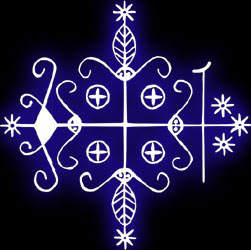
bon veve
“I don’t know what’s going to happen or what we’re going to do.” I say and there’s some laughter, but I really don’t. Even my explanation of the ritual is a bit haphazard; “dancey bit, quiet bit, bowing bit.” We jack into metaphysical cyberspace with a statement of intent, and the ritual unfolds – the drumming from another culture blasts out of the speakers and the rudimentary instructions I gave about crunk dancing and Thorn Coyle’s sacred movement trigger a Mexican wave of twitching and shaking. It’s then, that I know I/we am/are in. Inside the data flow, inside the pansychophere: everything is coming up in a volcanic blast. Yes you, skeletal greasy haired ghost-girl sourcing ecstasy at the Ministry of Sound: 21-09-1991 your sunken eyes here in the room in 2013. Holy fuck. Dead slave ghosts rising from the Black Atlantic. Legba coalesces inside the data flow- the memesphere punches into my chest – I am speaking French….
In the near darkness one participant meets me eye to eye, neither of us back down, I sense his resistance and flow around it – physically I move outside the circle and smear his head with red glitter gel. He capitulates. Peaches sings “you can’t fuck with me, you can’t fuck with me.” I am inside all these bodies. I am outside my own body. We perform war.
First fork: “he’s getting all up in my face” the drumming stops – the participants are flagging, sweating, uncertain – I anoint them with red paint – they are blooded – fox tails torn from their bodies and smeared on the faces of the hunt masters children. “I see you, I see you, I see you” who sees who? “I’m not in right now, please leave a message at the sound of the tone..”
Second Fork: swig this, swig this, nobody argues. They glug the apricot brandy. Legba’s energy is in the room; burning our throats and entering our bodies. The churnings of the anthrosphere, biosphere and geosphere. Holy fuck this is getting scary. I love it. No knives in reach. Luckily.
Abandoned nodes – red papier mache skull given to me by a Jamaican woman I worked with who said she was being torn apart by spirits
Abandoned nodes – chilli peppers to be eaten, rubbed into the skin. Thank Goth.
Abandoned nodes – getting people to write their intentions on the sigil – FORK – we scream out words and burn the sigil instead.
Abandoned nodes – Box Energy by DJ Pierre to soften the mood. FORK – I talk us all down from the window ledge. “Breathe”
***NEW FORK*** – Legba transformed by Joanna Macy’s switchback ride – Bowing to Our Adversaries – hope out of despair; Legba’s death instinct and Joanna’s life instinct. Thanateros.
***NEW FORK*** – Dissipating the “red mist” of anger via the base chakra and out through the body. We collectively vomit peace as we bow down to our enemies.
Return to source Code – grounding and banishing – eating salty Pringles and impersonating Homer Simpson: Doh! Triple Doh! Triple jewel. Buddha, Dharma, Sangha. Body, Speech, Mind.
Then it’s over and the subroutines melt back into the source code. We are shaken, ecstatic, surprised.
We have created a story out of randomness. Meaning from chaos.
“Each time as magicians we move from state to state, trance to trance, we destroy a world.” The Book of Baphomet p.166
“Ouvrir la partition/Ouvrir la porte/la vie devient la mort….un serpent se deplace le long de ma colonne vertebrale/Je vous suis/Vous etes moi…”
esc/end/end/esc/esc/esc
TP808


