Playing with Queer Cut-ups

I’m sitting in Julian’s front room and I’m surrounded by a multitude of artefacts from past rituals and hours spent in meditation. While the wood burner and main altar space provide a natural centre piece, today my eyes are drawn to the array of cut-up collages that deck one of the walls. These are not elaborate or overly wrought attempts at occult art; rather they represent raw, psychic high-dives in order to explore fragments of self and the processes that unfold as we try to explore darker, stranger terrain.
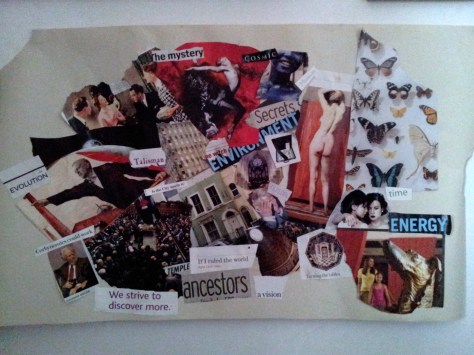
2016-08-18 09.13.37.jpg

Cut-up

Having recently read and enjoyed Queer by Meg-John Barker and Julia Scheele, I started reflecting on the possible connections between how cut-ups and Queer dynamics might interact in our process of exploring Self. I have already written a post reflecting on how cut-ups might interact with aspects of ego psychology, but their book got me to wondering further about how cut-ups might represent a highly queered and magical form of expression. As I observed back then:

“Like collage, cut-ups seek to use existing material in new ways that often involve the combining and juxtaposition of words and images so as to create new insight and meaning.

In tracking the lineage of cut-ups as an approach, from the surrealism of the Dadaists, Brion Gysin, Burroughs and Genesis P-Orridge, we can begin to see the depth of magical thinking embedded in this technique. As we seek to engage with and manipulate reality, the cut-up not only embodies the desired efficacy of our sorcery, but also the fluid shape-shifters that our arte forces us, the magician, to become. If our magic has any real depth, then our ego must undergo a similar process of reassembly.”

Cut-ups for me are a potent means of challenging our attempts at fixed certainty and polarity. Ideas and images that we previously kept apart are cast together in potentially abrupt disruption. These cut-ups don’t allow for tidy answers or for a buttoned-up, linear sense of self, rather they represent a bubbling up from the unconscious that may reveal as much about the dynamic tensions at work as they do potential answers. Apparently unconnected images are juxtaposed with stark headline text and so new meanings and connections are made. To me this dynamic process feels potentially unsettling and hugely creative and thus quite Queer:

“Queer is by definition whatever is at odds with the normal, the legitimate, the dominant. There is nothing in particular to which it necessarily refers. It is an identity without an essence. ‘Queer’ then, demarcates not a positivity but a positionality vis-à-vis the normative.” David Halperin  Saint Foucault: Towards a Gay Hagiography

The Queer self is one that has a profound connection to the constructed and performed. As an outsider position it has had to survive by being magpie-like in pulling together those jewels and glimmering half-truths that help make sense of what it means to live with a greater sense of magic and power. Others may dismiss its rag-tag approach for its lack of coherence, but like the trickster or the holy fool it holds up a mirror to those parts of culture whose attempts at control appear all too reliant on dusty outdated certainties.

For me the playful complexity of Queer identity is one that disrupts my attempts at locating my sense of self in fixed descriptors and concrete identities. Any attempt to side-step curiosity and open-handed questioning is unlikely to withstand Queer’s rainbow-laser side-eye. This type of awareness asks that we acquire and develop skills that allow us to more effectively tolerate process, journey and uncertainty.
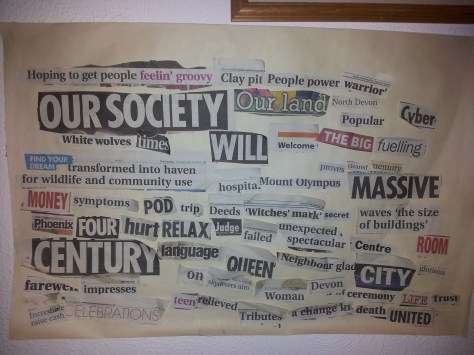
2016-08-07-00-30-32

Wild words

Similarly the process of the cut-up requires vulnerability as we step-back, allowing patterns and (potential) meanings to emerge. Techniques such as cut-ups and automatic writing/drawing are certainly more towards the artistic end of the “Art and Science” dialectic, but such creativity shouldn’t be mistaken for laxity. Ironically it often seems that as we seek to make use of approaches that are less linear and apparently chaotic, that we have to exercise a more focused sense of awareness in gaining benefit from them. It may be that those people who are drawn to more scripted workings do so because it provides them with a greater sense of security and control.

One of the primary reasons that I was drawn to the magical path was its sense of collaboration and play. World views and metaphysics that declared absolute certainty were no longer viable but I was still hungry to explore the mystery of consciousness and the glimpses of awakening that were coming in and out of view. Techniques like cut-ups and collage can provide us with potent and creative means for accessing new insights regarding the paths we are seeking to walk. They are rarely complete answers, more often they are snapshots of a work in progress that we may need to slow down and wait for, rather than rushing to a sensible, adult conclusion.

SD

The Agnostic Gnostic

I count myself fortunate to have a small number of close friends who can ask me challenging questions in a respectful but fairly direct manner. One such friend having read my recent book A Gnostic’s Progress had some pointy inquiries about how could we really know anything, and whether the pursuit of such occult know-how was ultimately a distraction from the real business of the here and now. He wondered whether, given the various twists and turns that my spiritual journey has taken, would I want an answer to my seemingly endless questioning? Would I even know what an answer looked like if I arrived at one?

These are great questions and while I may not have great or immediate answers, I thought it would be of value to reflect on them. What follows is less an attempt at direct wrestling and more an Aikido like wiggle slightly out of the way so as to move with the energy of the challenge they may represent.

The Gnosis of Not Knowing

“Well if you are a Gnostic then shouldn’t you know stuff?”

Now this is a good question and you might rightly wonder why anyone would pursue a gnostic path if they didn’t end up knowing more. Paradoxically however, when I try to compare the nature of what I know now, compared to what I thought I knew when I was following a faith based path, I am fairly sure that I am less certain about a whole range of things!

Part of my ongoing fascination with the Gnostic current is the way in which it seeks to grapple with the unknown. Its vivid myths are replete with alien gods and mysterious realms that defy description. As human beings look up at the night sky or plumb the depths of dark seas, we are confronted (and potentially terrified) by mystery. Of course we can aspire through our science and art to gain greater understanding of the hidden dimensions of what’s out there (or indeed in here), but this process of self-reflection and wondering is arguably an essential part of our experience of consciousness.

cute_cthulhu_by_unseeliechylde

Confused by alien gods?

I have written previously about the dangers of “unsafe certainty” i.e. a type of certainty based on absolutes that struggles with new information and insights. Often it feels that my great moments of Gnosis or Insight relate to the potential limits to what I can and can’t know. While the historic Gnostics were somewhat renowned for their complex cosmologies with multiple layers inhabited by a multitude of beings, the value for me of such perspectives is far less about adopting weirder world views and far more about using them to help access a greater sense of cognitive liberty. My own experience of trying to work with the Gnostic myths has had some similarity to Zen koan study i.e. the difficulty in trying to comprehend these schemas intellectually, has driven me towards a sense of knowing that seems to occur at a deeper, more integrated level. The gaining of such insight is rarely a straight line, once-for-always experience; rather it is a spiralling process where one has moments of internal spaciousness that come in and out of view as we live our lives.

Famously, the Zen practitioner seeks to engage in their endeavours with “Great Faith, Great Doubt and Great Courage”. Given that Zen Buddhist practice is generally less preoccupied with externalised metaphysical preoccupations, the emphasis on Great Faith is often seen as relating to faith or belief in the process of our own practice in relationship with both teacher and Sangha (community). My own journey into working with the Gnostic tradition has similarly been focused on strengthening or cultivating my ability to receive new information while simultaneously using doubt and questioning as tools to unburden myself from perspectives that are now outdated. This is also where Great Courage comes in! If we no longer believe in the certainties of a given orthodoxy and we seek to place greater value on the process of personal spiritual insight, then quite radically we are asking people to take far greater responsibility for themselves. Some people frankly can’t handle this, especially if they experience their faith-based certainties as being an effective means of protection from life’s messiness.

Gnosis: So What?

In thinking about contemporary Gnosticism, I have already written about the need for the spiritually adventurous to move beyond the role of being an endlessly ranting rebel (not saying it can’t be fun for a while!) What this radical embrace of “safe uncertainty” seems to necessitate is a greater awareness of both what is arising in the moment as well as our need for relationships that nurture. In short, if belief in dogma no longer carries evidence of insight, we may need to be more discerning/demanding  of what behaviour you would hope to see (for both yourself and others) if such revelation has occurred.

In reflecting on the current shape of those groups and organisations that are claiming connection to historic Gnosticism, it seems significant that many of these bodies have a greater emphasis on the use of either sacraments or collective ritual practice. In contrast to cultures shaped by  a Protestant emphasis on intellectual ascent to the dogma of creedal statements and scriptural authorities, those groups have a greater emphasis on the lived practice of ritual activity to provide both containment and guidance for their gnostic experience. For the flame of radical subjectivity to be nurtured and sustained, these shared rites arguably provide communal markers through which experiences can be triangulated and matured.


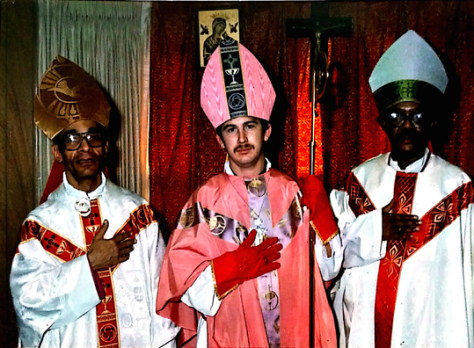
Some Gnostic Brothers

Some Gnostic Brothers

Perhaps this emphasis on practice and relationship gets closer to the heart of what it means to really know. Gnosis is just the beginning, a spark if you will that then needs to be tended. A good fire needs not only a source/spark, but also fuel and oxygen. For the Gnostic explorer to experience their insight as more sustaining, the spark of insight needs to be used and fed. This is a circular process in which we offer something to others and also acknowledge our need to receive. This reciprocal dynamic may entail the making of meals, the creation of Art, spending time listening, and so the list goes on. I can have endless amounts of weird shit going on in my head but unless I use it to do (for both myself and others), then we would be right to question its ultimate value.

SD