One of the concepts that exists in the left-hand path occult philosophy of groups such as the Temple of Set, is the idea of the ‘non-natural approach’. This idea is similar to the notion of involution, which appears in some tantric texts, where the process of raising the kundalini, or of Tantrism as a whole, is seen as stepping outside of, or reversing, the ‘natural’ order of the universe. To obtain union with the divine the tantrika must retrace the steps through which the universe has become manifest. There’s something similar going on in the technology of the magickal Qabalah. We start at Malkuth and count down, rolling back towards the ineffable zero of Kether.
Of course the non-natural thing for the ToS crew isn’t about being re-absorbed back into the white light of Prime Mover or the suffocating bosom of Mahakali. For them the approach is non-natural in that it’s deeply and uniquely human, it’s about striking out on ones’ own, becoming an ‘isolate’ self and not seeking to be re-absorbed by anything thank you very much. However when we consider the apparent philosophical distinctions between these left-hand-path-isms we soon find them evaporating in a puff of onotological topology. Whether it’s an isolated self that is coming into being and extending it’s dominion in the world, or a heroic self that is turning against conventions of social restriction in order recognise its own divinity while in the body – when scrutinised closely it all starts to look very like an argument about whether the glass is half-full or half-empty. As a chaos magician a more important consideration for me is the techniques that are suggested for experimentation. One method that links many left-hand path traditions in terms of stepping outside of ‘natural’ convention might be called ‘the perverse’. For instance, the contrary nature of tantrism is well known, with its rejection of caste divisions and other taboo breaking practises.
When we think of perversity we tend to associate this word with sexuality. The subtext is that non-reproductive sex is not normal, not what sex is supposed to be for. But in left-hand path occultist the rejection is not simply of ‘family values’ but more broadly of the idea that sexuality is a utilitarian process solely for reproduction (with limits codified by a Big Beard in The Sky). Whether it’s sex in which orgasm (particularly male ejaculation) is withheld or BDSM style erotic exploration – most styles of left-hand path magick are pretty kinky. In this respect ‘perverse occultism’ adapts sex (which is allegedly for making babies) and re-purpose it for esoteric ends. There are of course parallels with some styles of Gnosticism in which non-reproductive sex was encouraged and indeed one might argue that the celibacy of many priesthoods is itself ‘perverse’.
Of course even in this modern Godless age the idea of sexuality as something ‘for’ reproduction generally holds sway. Our politicians witter on about ‘hard working families’ (the new sacred cows of our culture) and we all enjoy learning about just how debauched civilisations (from the Romans to the Victorians) got before they got their just deserts and it all went bad. But what’s also happening, thanks to the determined work of both scientists and queers, is that ideas about sexuality are becoming broader. Scientists have been documenting what really goes on in (non-human) animal sexuality, and from gay elephants to queer penguins we now know that sex certainly isn’t only about reproduction. Of course this hasn’t been an easy process. When film showing bonobo chimps was first shown to primatologists some protested that the film had been doctored, and of course Disney is full of such peculiarities as monogamous lions and deer. Meanwhile queer people have been bravely asserting their presence in culture. First a black President, next maybe a Mormon one – it’s surely only a matter of time before the USA has a lesbian in the White House.
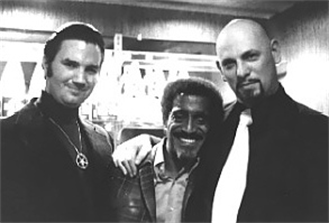
Black Brothers
It may be the case that, for many people, the ‘natural’ state is what Gurdjieff would have described as ‘sleep’. In tantrism this is Pashu or ‘animal’ rather than heroic ‘Vira’ consciousness. For Setians the idea that the mass of humanity are without the ‘black flame’ is pretty similar to this model, as the Thelemic view where there are Kings/Queens and Slaves.
While these them-and-us models do serve some useful functions they can lead to a confusion between individuals and states of consciousness. So rather than saying that Mr Smith is (to use the Thelemic vocabulary) ‘a slave’ it might be more useful to talk about Mr Smith exhibiting ‘slave consciousness’ (at a given time). This subtle change of emphasis helps to prevent elitist language being used as an excuse for simple racism or for demonising those who are deemed less evolved or enlightened or whatever. It also serves as a reminder that the process of breaking out of the strictures of what appears to be ‘human nature’ is itself (in the grand scheme of things) a natural process. We cannot say with any certainty who will become enlightened (or filled with the ‘black flame’) or illuminated or whatever, and who will not. Moreover it may be the case that, to preserve the social integrity of our species, only a few humans can be heroic at any one time.
Personally I’m very happy to include ‘the perverse’ in Nature – a big capital ‘N’ Nature that allows for the diversity of human experiences and expressions, rather than a little ‘nature’ which seems to be a lowest-common denominator view of what it means to be human. And while it may be intresting to strut around defining our magickal elitism and looking down our noses at those who simply don’t get it I am reminded of one of my favourite paradoxes – that there are two sorts of people in the world: those who think there are two sorts of people and those who don’t.
JV
 The Blog of Baphomet