I think it’s fair to observe that I spend a lot of time thinking about God. This has been going on for some time (probably the last 35 years) and I don’t imagine it’s going to stop anytime soon.
A friend of mine who I play lots of music with asked me whether I “believed” in God, and while I’ve made some valiant attempts at doing so in the past, I felt unable to answer conclusively. Famously when asked this question, Carl Jung answered that he didn’t believe that there was a God rather he “knew” there was. Familiarity with his biography enables us to know that Jung was a fairly seasoned Gnostic explorer at the point he made that comment, and based on his reception of “The Seven Sermons to the Dead”; it is unlikely that his deity of choice was of an orthodox variety.
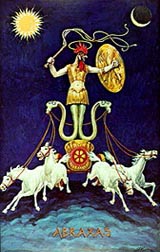
In contrast to either creedal formulations or some distant “unmoved mover”, for Jung the God that seemed to encapsulate the endeavour of the Gnostic explorer, was that strange bird Abraxas. Abraxas like Baphomet is one of those Gods whose queer visage keeps popping up in esoteric lore, while at the same time being very difficult to categorise. Research will provide some insights into the roles that he played/plays within a whole host of occult traditions-this strange cockerel (and sometimes lion) headed being with its serpentine “legs” is viewed as an Aeon by some and as an Archon or the Demiurge by others. Both his number (using Greek Gematria) being 365 and his association with the seven classical planets, connect him to both the round of the year and the physical cosmos.
For Jung, Abraxas represented a movement beyond dualism. No longer is the divine image split into a good Lord and an evil Devil; rather the mysteries of godhead are held within the complex iconography of Abraxas:
“Abraxas speaketh that hallowed and accursed word which is life and death at the same time. Abraxas begetteth truth and lying, good and evil, light and darkness in the same word and in the same act. Therefore is Abraxas terrible.” The Seven Sermons to the Dead

Terrible Cock God
When one meditates on the more common cockerel headed form of Abraxas, we cannot but be struck by the bizarre chimera-like quality of the image. The body of a man is topped by the head of a solar cockerel (possibly symbolizing foresight and vigilance), while from under “his” concealing skirts; strange chthonic serpents come wriggling forth. This cosmic hybrid seems to be holding together the transcendent and immanent, solar and night side. Viewed through my late-Modern lens I am both awed and unsettled by the sense of internal tension that this God seems to embody.
My own attraction to strange gods is hardly new territory-that monstrous hybrid Baphomet has long been jabbing at my consciousness as I’ve sought to make sense of life’s dissolving and coming back together. For me both Abraxas and Baphomet represent something of the core paradox that many of us experience in trying to make sense of the world.
Most attempts at constructing “big theories” (metanarratives if you like) are designed to make sense of the universe that we live within. The success or failure of any such world views seems to largely determined either by their ability to manage nuance and complexity or conversely the naivety of those willing to block out new information. For those of us however who are seeking to promote some form of cognitive liberty, it seems inevitable that at some point we are going to have to develop deeper strategies for managing complexity, paradox and the types of uncertainty that such realities often give birth to. (See also this.)
In previous posts we have considered the way in which the duality and tension that exists within many Gnostic myths potentially trigger the awakening of consciousness and in many ways these iconic images of Abraxas and Baphomet are little different. The juxtaposition of apparent opposites and the sense of movement that they contain speak to us of dynamism and process rather than fixed Platonic certainties. Whether via weird cosmologies or shape-shifting iconography, these gnostic riddles push us to the edges of comprehension and certainty. In seeking to engage with such material we often experience a profound unease and yet for the intrepid explorer such discomfort can trigger the types of “strange loops” that arguably enable the evolution of consciousness (for more on this check out this great article by my friend BK).
Cocky movements
This circular, iterative use of myth and paradox leads us away from certainties that cannot bear the weight of new insight, rather we are asked to engage in an unfolding process of becoming of both ourselves and our perception of the numinous.
I will conclude with the brilliant aeonic litany contained within the Mass of Chaos B, which provides us with a vivid example of how such evolution continues to occur:
“In the first aeon, I was the Great Spirit.
In the second aeon, Men knew me as the Horned God, Pangenitor Panphage.
In the third aeon, I was the Dark One, the Devil.
In the fourth aeon, Men know me not, for I am the Hidden One.
In this new aeon, I appear before you as Baphomet.
The God before all gods who shall endure to the end of the Earth!”
SD

 The Blog of Baphomet