Magic in the Darkest of the Seasons

The Wheel of the Year spins, towards the darkest phase of the year here in the far north (i.e. Britain) .

Yesterday I was at a funeral in the local crematorium, to say goodbye to someone that I’d known in the course of my museum work. Within that garden of well-trimmed yew hedges, punctuated with sober brickwork structures, I stood out of the rain in the tiny waiting room. Drinking the vending machine coffee, and feeling emotions rising in me. This time last year I was swept up in that surreal swirl of organisation which attends the end of a human life. My Dad having passed away after a brief illness, I went with my Mum to speak with funeral directors, to make formal registration of the event. I helped her enter data into Governmental web forms.

A midwinter spirit

A midwinter spirit

It is during the winter months that most people in Britain die and, while some of this may be put down to infections, most of those deaths are not, at least overtly, directly caused by the darkness and harsh weather. Yet the correlation between death and the winter has remained true for hundreds of years. It is this fact that gives the death and rebirth of the solstice added poignancy. Thus there are those bitter sweet stories of the relationship between sacrifice, death, winter and spring, from The Lion, The Witch and the Wardrobe to The Selfish Giant.

Christmas, or Yule, or Mithrasmas (or whatever you like to call this feast) is the pivot point of the sun’s journey. It is overflowing with symbolism; there is the iconography of everything from the Messiah through to the Krampus; there are stories of hope and redemption, gifts brought at midnight by an aerial shaman, and ghostly tales from Christmas past.

The actual human deaths that occur in the deep midwinter enrich the symbols we absorbed as children; the Christmas tree, singing auld lang syne, then singing about the birth of magical child here to bring peace – as we mature as people, our reading and relationship with these symbols becomes deeper and more complex. Christmas becomes bitter sweet; an assertion of life and joy in the face of pain and heartache, but (if we are fortunate) we can continue to see the underlying message of renewal, of transformation and hope. Opening our-selves up to that Midwinter spirit, with all its sadness and joy, its blend of longing and elation, can be a difficult thing. For many people the black dog of depression follows them about in this season; echoing the outer darkness within their mindscape.

Given my own story at this time of year I can fully appreciate some recent writing by Anglesey Druid Kristoffer Hughes about the death of his Father, John Hughes, on the 11 of December:

This day, 10 years ago, was a dreadful day. We sat and we waited for the edges of forever to open and allow him respite and freedom from the pain of cancer. It is a day that none of us will readily forget. As twinkling fairy lights lit the streets beyond the hospital, as carolers took to singing, my Dad turned his face from this world and ventured into mystery.

The mystery of life and death was the subject of recent meditation I shared with folks at The Psychedelic Society of London (where I took part in a collaborative ritual event).

Psychedelic supper time

Psychedelic supper time

After an excellent evening of food and simple, highly accessible ceremonial practice, one participant asked whether, as an occultist, I had special powers. Where had all my years of magical ceremony, gnostic states and spiritual adventuring really got me? Could I leap tall buildings in a single bound, or perhaps control the weather with my mind? What was the kind of power that magic provides to those who practice it successfully?

There are lots of potential answers to this perfectly legitimate question. But one special ability many magicians aspire to, is to be able to live this life fully. To engage and connect intimately with the universe in which we find ourselves. This is the work of living a fully human authentic life (and the praxis of magic is a great way to approach this process). Come this time of the year, this time of death and of tinsel, this authenticity for me is about being able to hold the paradox of midwinter, to be empowered by it, and to express that insight in relationship with others (as Kristoffer did in sharing his writing about his father).

We can describe this aspiration (or, to the degree we manifest it, this ‘special power’), to be authentic, fully alive, in terms of doing our (True) Will, manifesting our inner nature, being in tune with the web of wyrd and all that (should we wish it to sound properly esoteric).

Of course, in answer to the question about ‘special powers’ one might offer stories about the many and varied ways that magic works. I’d claim magic is capable of making all kinds of transformations in the world (from things that look like applied psychology, through to proper parapsychological and synchronistic effects). However if the Great Work of Magic is really that, Great, it has to be about more than gaining skills in spells that increase the probability of accomplishing some simple desire.

But are such Taoist musings simply a cop out because sane people generally don’t claim to have any demonstrable superhuman abilities? What’s the use of doing magic if you can’t do literalist Harry Potter style spells? The difficulty is that real magic, outside of the imaginal world, does not often look like ‘special powers’. Magic is much more subtle and indeed far-reaching, which is why it is so difficult (and often meaningless) to empirically test. Any magician worth their consecrated salt is also aware that there are always multiple ways of reading any event in the universe. (Even something as ‘nuts and bolts’ real as the brain structure changes that appear to be the result of mindfulness and other practices). The most effective of magicians generally hold lightly to their accomplishments, not because they do not believe in their agency, but rather because they believe that ‘as above, so below’, and they know that the simple cause-and-effect/linear chain-of-events view of reality is only a partial truth.
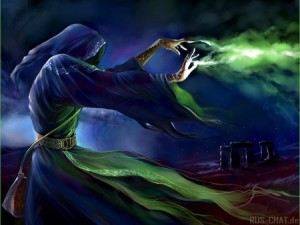
What magic looks like (in your head)

What magic looks like (in your head)

Moreover when we are faced with human scale reality, for example the inevitable death of those we love, this is where our magic needs to be at its most powerful. Not in trying to hold back the tide of reality, like some kind of death-defying comic book character, but rather to learn how to flow with the way the world is; with grace, kindness and strength. To use the challenges we meet as humans in our work to make our soul.

So what might the star-following, wise magus want for Christmas? What gift of siddhi or mystical insight might we hope that the Santa Shaman might present to us? (Especially if we’ve been good all year; done our meditation and body work, done Priest work for others, deployed our magic in day to day acts of sorcery, undergone powerful initiatory journeys etc etc…)

For myself I’d like the power to enter that Mystery of the Darkness (a mystery glyphed in the Chaos Craft system by octarine). To fully know, at all parts of my self, the potential and power of transformation possible at the time. To pay attention to, and be inspired by the stories of this season; in myself, in the landscape, in the communities I meet; and to communicate that wonder to others.

At a human psychological level this darkness works its magic by transforming the loss I feel when I think of my Dad. Instead I am thankful for the fact that these feelings arise because I loved my Dad and he loved me. I notice the loss, the darkness, acknowledge it. Then I become aware of that tiny, but bright light of hope. This is my gratitude to the universe for having this good man in my life. I reach out through the web of wyrd to those others who sit with loss at this time of the year and wish that they too can find their own light in this long night.

At the end of his writing Kristoffer likewise goes beyond this own sadness into an affirmation of his connection to his father; a clear act of magic:

“…I sense that part of the Universe that holds his experience of being Alan John Hughes, my father…
And that for today, is enough comfort for me to hold his memory close and know that a part of him lives on.”

Christmas is a time for magic. Part of the magic of this time is that we come together, friends and family and share our company and stories. We feast in the darkest of seasons, we shine the light of our humanity through our communities and this illuminates us all. As magicians we seek to place our attention into this time, for ourselves and the liberation of all beings, we step into the octarine unknown of the new year. We tune in to the tides within the micro and macrocosm and use these to empower our Great Work of transformation, in whatever way makes sense for us. Not as superheroes but as fully realised (and ‘realising’ – it being a process) flawed, mortal, fabulous humans.

Seasonal Shiva; Yuletide intervention by Number One Son

Seasonal Shiva; Yuletide intervention by Number One Son

May you be blessed with the magical gifts of this midwinter spirit; with peace, delight, joy, empowerment, transformation, and may these manifest in your life in the way that serves your unique humanity in the best way possible.

JV
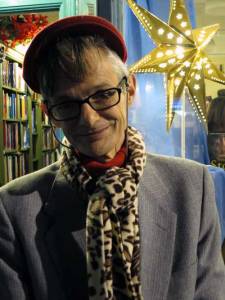
 

An Audience with Jake Stratton-Kent

Could you give us your superhero backstory please? How did you get involved with occultism?

It was very spontaneous, hanging out with some guys in a log cabin one of them said ‘Jake, you’ve got the soul of a warrior’. This was a life changing catalyst from out of the blue, and I rapidly hunted down a magical manual; luckily enough the first one I found was Huson’s Mastering Witchcraft, and I balanced research and practice from then on, never assuming moderns knew better on an a priori basis. As the saying goes, I’ve never looked back.

Goetic Adept

Goetic Adept

Could you tell us a little about your work with the English Qabalah and the Thelemic current more generally?

When Ray Sherwin handed over ‘The New Equinox’ I contacted the editors, particularly the late Jim Lees (attended his funeral recently, complete with jazz band, a good send off). English Qaballa (there’s reasons it is spelled that way) rocked my world: it was very modern, assumed nothing on the basis of previous systems (including the numeration of letters, which wasn’t decimal but serial) and was extremely productive. The approach was radically different from the GD/AC qabalah; if there is a Hebrew analogue it’s more Abraham Abulafia (who connected so called ‘literal kabbalah’ with *practical* Kabbalah rather than mere number crunching. Other affinities range from Dee (who saw cabala as universal rather than limited to Hebrew, see Hieroglyphic Monad) to Austin Spare’s practical use of the English Alphabet. It was majorly focused on esoteric exegesis (deep immersion in scripture, which is dangerous but properly conducted very powerful too). From these ‘interpretations’ various magical formulae were derived, leading to revolutionary approaches to astrologically timed ritual. Some of this work broke the old rules, for example not avoiding the ‘unfortunate’ Via Combusta (the Moon’s  transit between particular degrees of Libra/Scorpio), but using it. The 93 Current was understood to be destructive, and SCORPIO=93 in EQ. Solar conjunctions, also traditionally avoided, were a strong focus of this work also, often with ecstatic ‘Tantric Worship in English’, which, with astro-timing a given, was essentially the definition of magick within this paradigm.

It didn’t hurt that the group concerned included several scientific types and was very capable and practical: making swords, growing herbs and test driving all manner of plants, even making their own paper – an intense and highly educational period. Had no resemblance to Edwardian Lodge magic either, which also helped!

You’ve written extensively on goetic magic, what is it about this approach to spirit work that appeals to you? What would you say have been the key discoveries from your historical/applied research and how have they informed your practice?

There’s another approach? <grin>

It’s been a while but a couple of things kicked it off, other than my long standing interest in the grimoires, and the Grimorium Verum or True Grimoire in particular.

One was the dawning realisation that the darker grimoires tended to involve more ‘primal gnosis’ and were closer to the ancient approaches as in the papyri and elsewhere. There were historical aspects to this, the shift in Western magic from images (often involving animal forms), to words and particular ‘sacred alphabets’ was a given to me from my reading of Frances Yates &c. This initial insight only deepened and widened as I proceeded.

Another was my response to Ron Hutton shooting down modern witchcraft’s pseudo history; balanced with his rider that it also had a real heritage: the ritual magic tradition. Another spontaneous statement by a friend provided the final spur in the right direction. Oddly enough she has the same surname as the friend whose words kickstarted my magical career. Anyhow, she mentioned the connection between the Idaean Dactyls and goetia (a reference to them in ancient Greek is the first mention of goetia in the literary record).

So I worked my way through the process of the Grimorium Verum very thoroughly, making more pacts than is strictly necessary or sane. Much of this ‘overkill’ was necessary to better understand the system and its pantheon, which is essentially how I view a ‘spirit catalogue’. Also wrote a commented reconstruction of the grimoire based on my interest, experience and so forth. Much of this work took place in England, but some large scale group rites in the US played an important role. My appreciation of the ancient background of goetia was developing rapidly during this intense work phase. Ultimately what began as an intended appendix to the True Grimoire turned into a two volume sequel detailing the origins of ALL Western Magic in ancient goetia!

Connecting goetia with necromancy, a connection it never shrugged off even when actual work with the dead diminished in the Middle Ages &c, was a critical insight. From there it is a small leap to realising that ideas about the Afterlife  eschatology in short – are and always were connected with our ideas about spirits.

It is this which always provided a context in which spirits and magicians have a basis for working with one another which is mutually beneficial. Rather than the modern but dated ‘unpaid shopkeeper’ approach which is lacking in depth in a big way. Mugging an entity to supply your wishes is so philosophically unsatisfying, but with modern Western Magic being largely from a secularised Protestant culture, it doesn’t occur to most of us how inadequate this perspective is. The briefest possible definition of magic is in fact ‘practical eschatology’; it is interesting how much explanation such an obvious point requires sometimes!

Allowing for whatever secrecy is required by your practice, could you share what techniques do you tend to use in your magick? (ie the predicable chaos magic question ‘what do you *do*?’)

It varies. I started out with a similar toolkit to everyone else, have worked the IOT curriculum solo and with a mentor, as well as the GD/AC stuff etc etc.

On the other hand, I’ve generally had an eye on ancient methodologies as well as what little an English lad could learn about New World Traditions in 70s England onward.

One of my major bendings of the modern toolkit is definitely worth mentioning. Assumption not of godforms but animal forms (bestial deities &c or ‘theriomorphs’ to coin a term).

That always packs a punch for me, and I’ve worked it in a variety of ways with consistently good results. In the process I’ve adopted ‘animal alphabets’ connected with particular constellations and lunar mansions. Originally the magical images of the decans were of a similar type, before getting ‘laundered’ and made more human and/or allegorical.

Warping myself or my ‘astral body’ into the appropriate animal or beast headed deity &c to – say – consecrate a talisman, connects with deeply primal magical currents. It also works a treat, which is the main issue.

Could you explain your current understanding of what a spirit is (or ‘does’)?

I’ve found working with them as autonomous entities is the most straightforward and effective method. I remain largely agnostic as to the hows and whys.

Yes, as a fairly sophisticated Westerner I’ve pondered possible scientific explanations. Coming from an EQ background, or my take on it anyway, I find a ‘psycho-linguistic’ model provides a possible ‘scientific’ explanation. With leanings toward Chomsky & Monod; no Cartesian dualism involved!

Language is the vehicle of consciousness and culture, and has always been deeply linked to magic. Whether this model explains everything or not, it at least shows that the ‘Jungian archetypes’ are only one possible take, and one with more dodgy overtones. Gods, heroes, myths and spirits are present in every aspect of normal life; especially the media: sport, politics, war, drama & the arts, and our responses to them. Essentially though I’m an Instrumentalist philosophically speaking, the autonomous entity model works best and also shuts off the cop out clause. Once you begin a relationship with a spirit you have to see it through; a ritual is much more than a quick fix to some problem or other and then forget your partner in crime.

You’ve been doing this magick lark for some considerable time. Do you think esoteric practice/culture has changed since you first picked up a wand, and if so in what ways?

Yes and no – while the more aware practitioners who keep up with their peers have definitely opened new directions or rediscovered stuff the early Revival neglected or got wrong. Meanwhile, the same old same old is never hard to find. I still occasionally have to tell people goetia is not just the name of a book Crowley pinched from Mathers.

That aside, some of the fuddy duddy stuff has definitely slackened off, but there’s still plenty of market led consumer magic around.

How do you see the relationship between (your) occultism and wider culture (eg politics)?

There is no shortage of elitist, right wing & self-centred takes on magic; it isn’t anything like the whole story. Hecate – the archetypal witch goddess – was patron of the poor, and *need* is one of the most potent drivers and amplifiers of magic. I rarely do magic for personal gain, unless there is some experimental purpose to be served. Politically I’m wary of the State and lean more towards anarchism among the modern political philosophies. I don’t particularly like socialism, and certainly don’t glamourise communism, but while they may not be the solution, unbridled capitalism is still the problem. Both socialism and capitalism have their problems, but in a democratic society balancing the two makes a deal of sense. In practice I vote against the Tories consistently, and see the world trying to drift towards corporate fascism and a less free world than the one I grew up in, Cold War notwithstanding. Hopefully the ‘inevitable’ triumph of the Right will prove to be as illusory a tunnel reality as the old Mutual Assured Destruction was.

What current projects are you working on?

A couple of things in the writing line, one of which will compare the spirit hierarchies of several major grimoires. One purpose is to clarify the identities behind the seemingly wildly different names. Also to shift the view from text and apparatus towards the real stars of the show, the spirits; who have represented magic far longer than any of us have been involved in it.

Thanks again for your time Jake, really appreciated.

JV

You can find more information about Jake’s work here, here and here.