Could you give us your superhero backstory please? How did you get involved with occultism?
It was very spontaneous, hanging out with some guys in a log cabin one of them said ‘Jake, you’ve got the soul of a warrior’. This was a life changing catalyst from out of the blue, and I rapidly hunted down a magical manual; luckily enough the first one I found was Huson’s Mastering Witchcraft, and I balanced research and practice from then on, never assuming moderns knew better on an a priori basis. As the saying goes, I’ve never looked back.
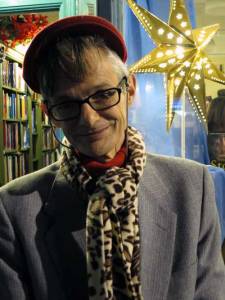
Goetic Adept
Could you tell us a little about your work with the English Qabalah and the Thelemic current more generally?
When Ray Sherwin handed over ‘The New Equinox’ I contacted the editors, particularly the late Jim Lees (attended his funeral recently, complete with jazz band, a good send off). English Qaballa (there’s reasons it is spelled that way) rocked my world: it was very modern, assumed nothing on the basis of previous systems (including the numeration of letters, which wasn’t decimal but serial) and was extremely productive. The approach was radically different from the GD/AC qabalah; if there is a Hebrew analogue it’s more Abraham Abulafia (who connected so called ‘literal kabbalah’ with *practical* Kabbalah rather than mere number crunching. Other affinities range from Dee (who saw cabala as universal rather than limited to Hebrew, see Hieroglyphic Monad) to Austin Spare’s practical use of the English Alphabet. It was majorly focused on esoteric exegesis (deep immersion in scripture, which is dangerous but properly conducted very powerful too). From these ‘interpretations’ various magical formulae were derived, leading to revolutionary approaches to astrologically timed ritual. Some of this work broke the old rules, for example not avoiding the ‘unfortunate’ Via Combusta (the Moon’s transit between particular degrees of Libra/Scorpio), but using it. The 93 Current was understood to be destructive, and SCORPIO=93 in EQ. Solar conjunctions, also traditionally avoided, were a strong focus of this work also, often with ecstatic ‘Tantric Worship in English’, which, with astro-timing a given, was essentially the definition of magick within this paradigm.
It didn’t hurt that the group concerned included several scientific types and was very capable and practical: making swords, growing herbs and test driving all manner of plants, even making their own paper – an intense and highly educational period. Had no resemblance to Edwardian Lodge magic either, which also helped!
You’ve written extensively on goetic magic, what is it about this approach to spirit work that appeals to you? What would you say have been the key discoveries from your historical/applied research and how have they informed your practice?
There’s another approach? <grin>
It’s been a while but a couple of things kicked it off, other than my long standing interest in the grimoires, and the Grimorium Verum or True Grimoire in particular.
One was the dawning realisation that the darker grimoires tended to involve more ‘primal gnosis’ and were closer to the ancient approaches as in the papyri and elsewhere. There were historical aspects to this, the shift in Western magic from images (often involving animal forms), to words and particular ‘sacred alphabets’ was a given to me from my reading of Frances Yates &c. This initial insight only deepened and widened as I proceeded.
Another was my response to Ron Hutton shooting down modern witchcraft’s pseudo history; balanced with his rider that it also had a real heritage: the ritual magic tradition. Another spontaneous statement by a friend provided the final spur in the right direction. Oddly enough she has the same surname as the friend whose words kickstarted my magical career. Anyhow, she mentioned the connection between the Idaean Dactyls and goetia (a reference to them in ancient Greek is the first mention of goetia in the literary record).
So I worked my way through the process of the Grimorium Verum very thoroughly, making more pacts than is strictly necessary or sane. Much of this ‘overkill’ was necessary to better understand the system and its pantheon, which is essentially how I view a ‘spirit catalogue’. Also wrote a commented reconstruction of the grimoire based on my interest, experience and so forth. Much of this work took place in England, but some large scale group rites in the US played an important role. My appreciation of the ancient background of goetia was developing rapidly during this intense work phase. Ultimately what began as an intended appendix to the True Grimoire turned into a two volume sequel detailing the origins of ALL Western Magic in ancient goetia!
Connecting goetia with necromancy, a connection it never shrugged off even when actual work with the dead diminished in the Middle Ages &c, was a critical insight. From there it is a small leap to realising that ideas about the Afterlife eschatology in short – are and always were connected with our ideas about spirits.
It is this which always provided a context in which spirits and magicians have a basis for working with one another which is mutually beneficial. Rather than the modern but dated ‘unpaid shopkeeper’ approach which is lacking in depth in a big way. Mugging an entity to supply your wishes is so philosophically unsatisfying, but with modern Western Magic being largely from a secularised Protestant culture, it doesn’t occur to most of us how inadequate this perspective is. The briefest possible definition of magic is in fact ‘practical eschatology’; it is interesting how much explanation such an obvious point requires sometimes!
Allowing for whatever secrecy is required by your practice, could you share what techniques do you tend to use in your magick? (ie the predicable chaos magic question ‘what do you *do*?’)
It varies. I started out with a similar toolkit to everyone else, have worked the IOT curriculum solo and with a mentor, as well as the GD/AC stuff etc etc.
On the other hand, I’ve generally had an eye on ancient methodologies as well as what little an English lad could learn about New World Traditions in 70s England onward.
One of my major bendings of the modern toolkit is definitely worth mentioning. Assumption not of godforms but animal forms (bestial deities &c or ‘theriomorphs’ to coin a term).
That always packs a punch for me, and I’ve worked it in a variety of ways with consistently good results. In the process I’ve adopted ‘animal alphabets’ connected with particular constellations and lunar mansions. Originally the magical images of the decans were of a similar type, before getting ‘laundered’ and made more human and/or allegorical.
Warping myself or my ‘astral body’ into the appropriate animal or beast headed deity &c to – say – consecrate a talisman, connects with deeply primal magical currents. It also works a treat, which is the main issue.
Could you explain your current understanding of what a spirit is (or ‘does’)?
I’ve found working with them as autonomous entities is the most straightforward and effective method. I remain largely agnostic as to the hows and whys.
Yes, as a fairly sophisticated Westerner I’ve pondered possible scientific explanations. Coming from an EQ background, or my take on it anyway, I find a ‘psycho-linguistic’ model provides a possible ‘scientific’ explanation. With leanings toward Chomsky & Monod; no Cartesian dualism involved!
Language is the vehicle of consciousness and culture, and has always been deeply linked to magic. Whether this model explains everything or not, it at least shows that the ‘Jungian archetypes’ are only one possible take, and one with more dodgy overtones. Gods, heroes, myths and spirits are present in every aspect of normal life; especially the media: sport, politics, war, drama & the arts, and our responses to them. Essentially though I’m an Instrumentalist philosophically speaking, the autonomous entity model works best and also shuts off the cop out clause. Once you begin a relationship with a spirit you have to see it through; a ritual is much more than a quick fix to some problem or other and then forget your partner in crime.
You’ve been doing this magick lark for some considerable time. Do you think esoteric practice/culture has changed since you first picked up a wand, and if so in what ways?
Yes and no – while the more aware practitioners who keep up with their peers have definitely opened new directions or rediscovered stuff the early Revival neglected or got wrong. Meanwhile, the same old same old is never hard to find. I still occasionally have to tell people goetia is not just the name of a book Crowley pinched from Mathers.
That aside, some of the fuddy duddy stuff has definitely slackened off, but there’s still plenty of market led consumer magic around.
How do you see the relationship between (your) occultism and wider culture (eg politics)?
There is no shortage of elitist, right wing & self-centred takes on magic; it isn’t anything like the whole story. Hecate – the archetypal witch goddess – was patron of the poor, and *need* is one of the most potent drivers and amplifiers of magic. I rarely do magic for personal gain, unless there is some experimental purpose to be served. Politically I’m wary of the State and lean more towards anarchism among the modern political philosophies. I don’t particularly like socialism, and certainly don’t glamourise communism, but while they may not be the solution, unbridled capitalism is still the problem. Both socialism and capitalism have their problems, but in a democratic society balancing the two makes a deal of sense. In practice I vote against the Tories consistently, and see the world trying to drift towards corporate fascism and a less free world than the one I grew up in, Cold War notwithstanding. Hopefully the ‘inevitable’ triumph of the Right will prove to be as illusory a tunnel reality as the old Mutual Assured Destruction was.
What current projects are you working on?
A couple of things in the writing line, one of which will compare the spirit hierarchies of several major grimoires. One purpose is to clarify the identities behind the seemingly wildly different names. Also to shift the view from text and apparatus towards the real stars of the show, the spirits; who have represented magic far longer than any of us have been involved in it.
Thanks again for your time Jake, really appreciated.
JV
You can find more information about Jake’s work here, here and here.