
Heretic Heroes (Part 2)

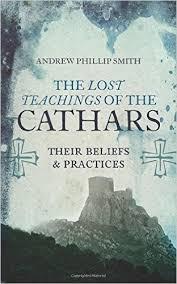
Book Review: Andrew Phillip Smith The Lost Teachings of the Cathars, Watkins Books 2015

It’s easy to get overwhelmed when trying to get your head around a religious movement. The moment we get beyond catchphrases and pop culture references, the ideas and experiences that lay behind words like “Tantra” or “Gnosticism” can quickly result in the need to have a bit of a lie down in a darkened room.
lost-teachings

Given the potential complexity of such terrain, it always comes as a relief when you find an author who is able to maintain the precarious balance between factual accuracy, readability and contemporary relevance. In the realm of Gnostic studies Andrew Phillip Smith has consistently been such a voice. Not only has he been editor of the fabulous journal The Gnostic but he has also penned a clutch of super-helpful volumes such as The Secret History of the Gnostics and A Dictionary of Gnosticism. In The Lost Teachings of the Cathars, Andrew has now turned his attention specifically to the issue of how the Gnostic religious impulse has continued from antiquity into the medieval period and beyond.

The first part of the book provides us with a well-written account of the Cathars as a religious movement, and their likely connection to other groups such as the Paulicians and Bogomils that pre-dated them. While there are a number of other books out there that cover similar territory, Smith’s account reads like a lively travel journal that incorporates both his own travels through regions such as the Languedoc, and his insights regarding what we know about Cathar teachings and their connection to earlier forms of Gnosticism.

While the Cathars can rightly be viewed as exemplifying a heroic attempt at religious freethinking, their story is ultimately a tragedy. The period between the 11th and 14th centuries in which they flourished in southern France and northern Italy was continually beset with conflicts with the orthodox Roman church, which they viewed as corrupt and in thrall to a false understanding of both God and salvation. Although there was variety and complexity in what we know of Cathar belief, it is generally agreed that they were dualists who viewed the realm of matter as being the product of a lesser god.

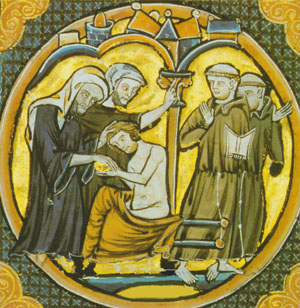
What Andrew’s book does more fully than most studies of Catharism is to closely consider their practices and their likely significance within the community of believers. He explores the available material that we have regarding their primary sacraments such as the consolateum and the apparellamentum, as well as the purpose behind the celibacy and vegetarianism adopted by the group’s adepts (the Perfecti). He also examines the manner in which their radical reinterpretation of Christ’s teaching ultimately brought them into such violent conflict with both civil and ecclesiastical authorities. Whatever one makes of their dualist theology, it is hard to remain unmoved by the devastating holocaust that was inflicted upon them at Montsegur at the culmination of the Albigensian crusade.
Brother on Brother Action

Brother on Brother Action

Most of the previous books that I have read on the Cathars have tended to end here, trying to make sense of these peace-loving mystics who fell foul of a corrupt church so desperate to hold on to its ability to control. Here though, what Smith does next is consider the way in which the last embers of the Cathar tradition have been revived by various teachers and groups in subsequent centuries. Like so many traditions that produced few written documents to define their teachings, the Cathars have become a screen onto which all manner of groups and writers can project their own desires and agendas.

From here it gets both weird and interesting as we get to dig into some more recent history.  Otto Rahn’s imagining of the Cathars as the custodians of the Grail brought him to the attention of Himmler and the SS  (Indiana Jones anyone?) and probably contributed to his early demise. Also we have the French Gnostic Church getting revived  (in 1889) via disembodied Cathar Bishops turning up at séances, and perhaps most spectacularly we have a mass Cathar reincarnation occurring in Bath, England. This latter story of an English psychiatrist being convinced by a patient that both of them were reincarnated Cathars, illustrates something of the way in which they have become a conduit via which the aspirations of our Aquarian age have been funnelled.

While lesser authors (and cynical chaos magicians) might take cheap shots at the nature of these explorations, Smith examines such efforts in a spirit that is at once critical and yet generous in understanding them as part of our shared human attempts to find meaning and identity. Such generosity is to be applauded and to my mind reflects a tolerance that the Cathars themselves would have welcomed.

Highly recommended.

For a chance to see Andrew and myself co-presenting about the Gnostics at the Occult Conference in Glastonbury, here’s a link! http://www.occultconference.co.uk/schedule/speakers/exploring-gnosticism

SD

A Fondness for Snakes – the Art of Marchesa Casati

Imagine that you are invited to an astonishing, opulent house. In the property’s winter garden, near the west wing, dwell fabulous beasts; scaled and feathered marvels. On entering the building you are greeted by a mechanical stuffed panther, moving and growling, its eyes flashing feline fire. You are escorted by exquisitely liveried footmen into the bedchamber of the lady of the house. A woman with kohl ringed eyes dilated with belladonna extract, and wild flame-red hair. She is one of the richest woman in Europe (you have been transported back to France in the 1920s ).

Admitted to the bedchamber you discover your hostess; “…enveloped in white tulle and crowned by an upside-down silver flower pot, adorned by a single white ostrich plume…sat on a vast green carpet made to resemble a grassy lawn.” However the lady is not pleased by the inclusion of felt daisies in the weave of her indoor sward and asks you to join her in snipping off these disagreeable blooms. There are gilded scissors to do the job along with, “…foie gras and champagne served from a picnic basket presented by a black youth in fancy dress”.

027

Images of the Marchesa Casati courtesy of Ryersson & Yaccarino and The Casati Archives

This isn’t some baroque hallucinatory event but one of the many real, utterly fabulous, moments in the life of the Marchesa Luisa Casati who, in the early 20th century, was one of the most outlandish, shocking and remarkable figures of the age.

I’d only briefly encountered the Casati story so it wasn’t until reading two wonderful books that I came to appreciate both the significance and astonishing flamboyance of this woman. Infinite Variety: The Life and Legend of The Marchesa Casati by Scot.D.Ryersson & Michael Orlando Yaccarino is a wonderful biography, meticulously researched and a real page-turner of a read (the quotes above are from that volume), and The Marchesa Casati: Portraits of a Muse, a lavishly produced, image rich, large format book by the same authors.

There is a tale of a brief meeting between Casati and Aleister Crowley and it appears they didn’t get along too well. Were history to have unfolded differently in that respect we might already have Thelema as mass global religion (which may or may not be a good thing…) since the Marchesa was easily as much an incarnation of Babalon as Crowley was of the Beast. Like Crowley, Casati shocked the high society of la Belle Époque and the fin de siècle decadence, as nations cranked themselves up for the first century of industrialised warfare. Naked beneath furs, great strings of pearls dragging on the floor, leading her cheetahs on diamond studded leashes, Casati adorned and scandalised the age. She had the money to do so, a vast fortune which, like all interesting people, she blew on sex, drugs, art, parties, and magic.

Though details are obscure Casati was an occultist, with magnificent rooms dedicated to magical pursuits in her various houses. These were spaces of rare esoteric tomes, divinatory equipment, heavy incense and yet more exotic pets; ritual spaces that would undoubtedly have made Crowley as green as the Marchesa’s large eyes, with envy.

The stated (magical) intention of the Marchesa Casati was “I want to be a living work of art”, and this she did. Reading the list of artists that chose her as their subject is like reading a Who’s Who of 20th century European Art: Picasso, Man Ray, Epstein, Augustus John, Alberto Martini, Romaine Brooks… the list goes on. Costume (often outlandish, frequently revealing or otherwise transgressive, sometimes genuinely dangerous), sculpture, photography, painting and  more were enriched by the Marchesa as muse and by her financial support of numerous avant-garde artists.

The Marchesa with her crystal ball

The Marchesa with her crystal ball

Of course like any magical figure Casati managed, in a sense, to disappear. That is, while her money and eventually her body gave out (she died in 1957 and was buried in London, ironically beneath a monument that records her name incorrectly), she was reborn (much as Crowley has been) as an cultural icon. She is ground zero for many of the experiments with identity and style of the late 20th and early 21st century. Madonna, Lady Gaga, even Robert Smith of The Cure and Tim Minchin are (knowingly or not) the aesthetic children of the Marchesa. To quote one online article that explores her legacy; “the Marchesa is possibly the most artistically represented woman in history after the Virgin Mary and Cleopatra– her influence is all around us.”

Perhaps it is fitting, as we head towards Halloween, that I’ll soon have the opportunity to visit Luisa’s final resting place. Beneath the London earth, wearing her black and leopard skin finery and a pair of false eyelashes, Casati is interred with one of her beloved stuffed pekinese dogs. Halloween is of course the season where we celebrate the sign of the Scorpion (emblem of magic, money, sex and death) and seek to commune with our ancestors. Money was undoubtedly a vital ingredient in the story of the Marchesa Luisa Casati and my visit to her grave will coincide with  a spot of collaborative ‘Money Magic’. In the words of one of our conspirators “…a group of independent artists, magicians, pagans, druids, and media workers…plan to hold a series of ritual events in the City of London…Our aim is to bring the subject of money creation to public attention using ritual as our symbolic tool. We say that money is a sigil, a magical symbol which enters our lives on the most fundamental level, as desire. Money represents the fulfillment (or lack) of all desire in the current world and we carry it about on our persons, in our wallets and our purses, in our pockets and handbags, allowing it to control us on the most intimate and secret of levels.”

The Machesa Luisa Casati, like Crowley, displayed a fascinating relationship with money; she went from being one of the richest women of her age to having debts of over $25 million, and ended her days in a one room apartment. Yet according to many commentators she retained an irrepressible joie de vivre even in her most impecunious periods. Casati managed to dispose of her fortune in pursuit of her desire to become ‘a living work of art’ much as Crowley broke the bank with his Will to become ‘the Prophet of the New Aeon’. In both cases their money was used in the service of their ‘highest ideal’, their self-absorbed and yet self-transcending intention. This is an approach to life, to money and wealth, that goes beyond ideas of individual ownership, that spurns the hoarding up of capital for its own sake, and even now, still manages to shock the bourgeoisie.

JV