A Fondness for Snakes – the Art of Marchesa Casati

Imagine that you are invited to an astonishing, opulent house. In the property’s winter garden, near the west wing, dwell fabulous beasts; scaled and feathered marvels. On entering the building you are greeted by a mechanical stuffed panther, moving and growling, its eyes flashing feline fire. You are escorted by exquisitely liveried footmen into the bedchamber of the lady of the house. A woman with kohl ringed eyes dilated with belladonna extract, and wild flame-red hair. She is one of the richest woman in Europe (you have been transported back to France in the 1920s ).

Admitted to the bedchamber you discover your hostess; “…enveloped in white tulle and crowned by an upside-down silver flower pot, adorned by a single white ostrich plume…sat on a vast green carpet made to resemble a grassy lawn.” However the lady is not pleased by the inclusion of felt daisies in the weave of her indoor sward and asks you to join her in snipping off these disagreeable blooms. There are gilded scissors to do the job along with, “…foie gras and champagne served from a picnic basket presented by a black youth in fancy dress”.

027

Images of the Marchesa Casati courtesy of Ryersson & Yaccarino and The Casati Archives

This isn’t some baroque hallucinatory event but one of the many real, utterly fabulous, moments in the life of the Marchesa Luisa Casati who, in the early 20th century, was one of the most outlandish, shocking and remarkable figures of the age.

I’d only briefly encountered the Casati story so it wasn’t until reading two wonderful books that I came to appreciate both the significance and astonishing flamboyance of this woman. Infinite Variety: The Life and Legend of The Marchesa Casati by Scot.D.Ryersson & Michael Orlando Yaccarino is a wonderful biography, meticulously researched and a real page-turner of a read (the quotes above are from that volume), and The Marchesa Casati: Portraits of a Muse, a lavishly produced, image rich, large format book by the same authors.

There is a tale of a brief meeting between Casati and Aleister Crowley and it appears they didn’t get along too well. Were history to have unfolded differently in that respect we might already have Thelema as mass global religion (which may or may not be a good thing…) since the Marchesa was easily as much an incarnation of Babalon as Crowley was of the Beast. Like Crowley, Casati shocked the high society of la Belle Époque and the fin de siècle decadence, as nations cranked themselves up for the first century of industrialised warfare. Naked beneath furs, great strings of pearls dragging on the floor, leading her cheetahs on diamond studded leashes, Casati adorned and scandalised the age. She had the money to do so, a vast fortune which, like all interesting people, she blew on sex, drugs, art, parties, and magic.

Though details are obscure Casati was an occultist, with magnificent rooms dedicated to magical pursuits in her various houses. These were spaces of rare esoteric tomes, divinatory equipment, heavy incense and yet more exotic pets; ritual spaces that would undoubtedly have made Crowley as green as the Marchesa’s large eyes, with envy.

The stated (magical) intention of the Marchesa Casati was “I want to be a living work of art”, and this she did. Reading the list of artists that chose her as their subject is like reading a Who’s Who of 20th century European Art: Picasso, Man Ray, Epstein, Augustus John, Alberto Martini, Romaine Brooks… the list goes on. Costume (often outlandish, frequently revealing or otherwise transgressive, sometimes genuinely dangerous), sculpture, photography, painting and  more were enriched by the Marchesa as muse and by her financial support of numerous avant-garde artists.

The Marchesa with her crystal ball

The Marchesa with her crystal ball

Of course like any magical figure Casati managed, in a sense, to disappear. That is, while her money and eventually her body gave out (she died in 1957 and was buried in London, ironically beneath a monument that records her name incorrectly), she was reborn (much as Crowley has been) as an cultural icon. She is ground zero for many of the experiments with identity and style of the late 20th and early 21st century. Madonna, Lady Gaga, even Robert Smith of The Cure and Tim Minchin are (knowingly or not) the aesthetic children of the Marchesa. To quote one online article that explores her legacy; “the Marchesa is possibly the most artistically represented woman in history after the Virgin Mary and Cleopatra– her influence is all around us.”

Perhaps it is fitting, as we head towards Halloween, that I’ll soon have the opportunity to visit Luisa’s final resting place. Beneath the London earth, wearing her black and leopard skin finery and a pair of false eyelashes, Casati is interred with one of her beloved stuffed pekinese dogs. Halloween is of course the season where we celebrate the sign of the Scorpion (emblem of magic, money, sex and death) and seek to commune with our ancestors. Money was undoubtedly a vital ingredient in the story of the Marchesa Luisa Casati and my visit to her grave will coincide with  a spot of collaborative ‘Money Magic’. In the words of one of our conspirators “…a group of independent artists, magicians, pagans, druids, and media workers…plan to hold a series of ritual events in the City of London…Our aim is to bring the subject of money creation to public attention using ritual as our symbolic tool. We say that money is a sigil, a magical symbol which enters our lives on the most fundamental level, as desire. Money represents the fulfillment (or lack) of all desire in the current world and we carry it about on our persons, in our wallets and our purses, in our pockets and handbags, allowing it to control us on the most intimate and secret of levels.”

The Machesa Luisa Casati, like Crowley, displayed a fascinating relationship with money; she went from being one of the richest women of her age to having debts of over $25 million, and ended her days in a one room apartment. Yet according to many commentators she retained an irrepressible joie de vivre even in her most impecunious periods. Casati managed to dispose of her fortune in pursuit of her desire to become ‘a living work of art’ much as Crowley broke the bank with his Will to become ‘the Prophet of the New Aeon’. In both cases their money was used in the service of their ‘highest ideal’, their self-absorbed and yet self-transcending intention. This is an approach to life, to money and wealth, that goes beyond ideas of individual ownership, that spurns the hoarding up of capital for its own sake, and even now, still manages to shock the bourgeoisie.

JV
Heretic Heroes and Queer Lenses

Having spent some recent posts thinking about Queer theory and how it can shape aspects of magical practice, I thought it might be worthwhile considering the way in which Queerness impacts on the way we may choose to read and use history in finding inspiration for our spiritual journeys. I have always been a bit of a history geek and was in a definite minority as a theology undergraduate in wanting to dig into the way in which personality and politics intersected in the human attempt to find religious meaning. While others may have viewed the early Gnostics or the pre-Whitby Celtic Church as dull, I dug deep into these ecclesiastical detective stories as they provided such a rich means for understanding the questions that I was personally engaged with.

The reading of any text is a complex process in which the information provided is inevitably shaped by the world view of the reader. This awareness of how our own perspectives or “presupposition pool” influences our interpretation is central to the field of hermeneutics. While hermeneutics originally developed in relation to the understanding of biblical and other sacred texts, its insights were eventually adopted in a broad range of human sciences, and its philosophical implications were explored by philosophical figures as august as Heidegger and Hans Georg Gadamer.  We are all engaged in hermeneutics, and our own biases and contexts inevitably shape the pair of glasses or ‘lens’ through which we seek to make sense of something. What hermeneutics has been hugely helpful in making historians more aware of, are the dangers that our readings might face if we are less conscious of how our own biases and contexts impact on our explorations.

In my recent explorations of Gnosticism, and religious freethinking more generally, I have been increasingly aware of my own lens as a person who identifies with many aspects of Queer identity. When one is trying to comprehend how a person’s Queerness might shape their process of interpretation we have to acknowledge that we are already contending with a highly fluid concept that defines itself by its ability to defy easy categorisation. That being said, the experience that I have as a reader of religious history is one in which my own experience as a sexual and gender outsider sensitises me to similar themes that I empathically sense within the narratives with which I am engaging.

Now this all sounds very heady, so it might be helpful to provide an example of how something has recently inspired me and how my context has shaped the themes that have emerged for me.

Beguines and Beghards

20130511_blp508

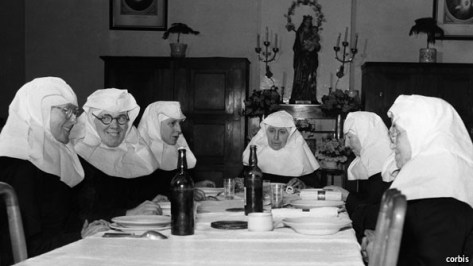
Not nuns

I’ll start by stating that the spiritual movement of the Beguines—and their male counterparts the Beghards—is impossible to summarise succinctly given the diversity of their geographical contexts and the historical time span during which their movement was most vibrant. For more information check out the wiki entry, and books such as Beguine Spirituality by Fiona Bowie, and the more recent The Wisdom of the Beguines by Laura Swan.

In summary, the Beguines were a network of predominantly female lay communities that sought to pursue their own sense of vocation outside of formal monastic rules and orders. The golden age of the Beguines was between the 12th and 16th centuries, and their communal houses (Beguinages) thrived most readily in the Low Countries of Europe i.e. the area including Belgium, the Netherlands, and bordering on France and Germany.

While the Beguines were devoted to the monastic ideals of celibacy and simple living, each house was free to evolve its own rule, and these communities were noted for their continued involvement in commerce (especially the textile trade) as a means of supporting themselves. They were noted mystics who placed a high value on visionary experience, and some scholars have noted the influence of the troubadour and courtly love traditions in relation to their passionate longing for union with the beloved.

As with so many radical and visionary groups in the medieval period, the Beguines aroused a decidedly mixed response from those in authority. While they were initially seen as embodying a high level of piety, the rate at which women joined the communities was often seen as a threat to male power and control. The Beguines had not submitted a common rule for Papal approval and their emphasis on mystical experience almost inevitably drew accusations of heresy. They received Papal condemnation in 1311 and in the previous year, one of their most outspoken leaders Marguerite Porete was burnt at the stake for failing to renounce her visionary work The Mirror of Simple Souls. Despite their devout lives, church authorities often saw connections between the Beguines and more overtly antinomian groups, such as the Brethren of the Free Spirit.

In subsequent centuries the Beguines underwent several waves of renewal and rehabilitation, but the Reformation, and the decline of the textile trade (their main source of income), eventually contributed to their numbers diminishing. While the anti-monastic agenda of the Reformation inevitably impacted on the Beguines, their continued involvement in health care and education provided them with an important social function; Beguine communities continued in Belgium until the early part of the 20th century.

Queer Readings

My Queer reading of this history occurs at a number of levels and undoubtedly has considerable intersects with both Feminist and Anarchist readings of Beguine history. While my own lack of Christian faith may inevitably create some metaphysical distance between my and their spiritual experience there is still much that I connect with. Here are a few banner headlines:

  1. Organisational liberty. The Beguines inspire me in their determined rejection of centralised authority. While they situate themselves firmly within the pre-Reformation Catholic faith, their desire to shape their own paths at a local and communal level has many connections to the way Queer activism challenges us to pursue social change.
  2. Personal gnosis. While the religious language of their society was still core to Beguine experience, in the face of male dominance in the Priesthood and other Ecclesiastical domains they found power and self-definition through visionary experience. Similarly, Queer identity—while using the language of culture regarding orientation and gender—retains the right of the individual to blur and play with these concepts in order to locate a ‘best-fit’ version of self.
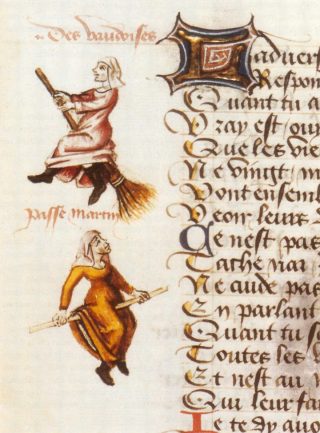
  3. Rejection of heteronormativity and an increase in Female Power. The Beguines freaked the church out. These women found a collective means for self-definition and a rejection of potentially endless, life-threatening reproduction. Themes around an increase of female power were also vital to Gnostic groups such as the Cathars during the same period, and the threat that both groups posed to male dominance was a likely catalyst to the later witch trials of the Early Modern period.
broomwitches01-720x975

Beginning to do it for themselves

Such reflections are far from definitive and are presented as serving suggestions as to how Queer (or other) lenses might be employed. The conscious use of such approaches can be hugely inspiring, and my own engagement with groups such as the Beguines are part of my own personal explorations of themes as diverse as New Monasticism and the impact of Christian heresy on Witchcraft traditions. The viewing of old history with a fresh set of eyes can often provide us with rich veins of new material.

SD