“Do you know yourself, do you know the others? Can you pull the weight that rides on another’s shoulders? Once you’ve lost yourself to the acceptance mask, well could you find yourself, it’s not a simple task. Self-inherence, freedom. Comes from within. Take a different track. It’s time to see what you are made of. Can you expose yourself? Can you peel away another layer? Will you make the time, the time to take control? Because only you can save yourself, only you can save your soul….come on, can you let go, can you, be you?”
Caboose by Snapcase (1997 Victory Records)
One of the criticisms that I often hear levelled at Druidry as a path is that it’s a bit polite! Having spent a fair amount of time hanging out with Chaos magicians, Thelemites and Left-Hand Path folks, when I discuss my connection to the Druid path, the question is often asked about what it has to offer in terms of methodology beyond its very public rituals and solar orientated aesthetics. In circles where darkness, intensity and the spilling of bodily fluids are potential measures of commitment, it could be easy to dismiss Druidry as being overly ordered and lacking in changed focused techniques. In my view such a reading is superficial and fails to account for subtle currents of inspiration that allow for a slower more sustainable form of personal evolution.
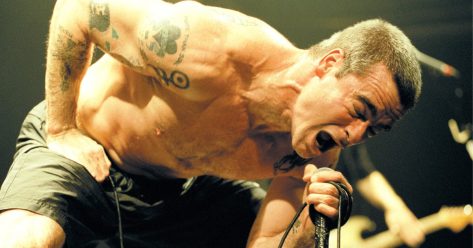
A Hardcore Bard at Work
While works such as Ronald Hutton’s excellent The Druids highlight the struggle that modern Druids might have in uncovering what their ancient forebears actually did, we still have a rich body of both Celtic lore and the last two to three hundred years of reconstruction to draw from. While some may look down on the pseudo-masonic and Christian influence on the Druid revival, I personally feel that it holds some truly rich examples of the human spirit seeking to explore Mystery beyond the confines of the prevailing religious orthodoxies.
One of the aspects that I love in most forms of reconstituted modern Druidry is the way in which the grades of Bard, Ovate and Druid are seen as interacting with each other. While most contemporary Druids view these roles as being a progressive hierarchy, it is important to acknowledge that some present-day adherents elect to remain as a Bard or Seer (Ovate) if they feel that this best captures their calling. For me the adoption of this three-fold scheme is less about moving through a stage in order to reach the next level, and more about an essential group of experiences that make the stage of the journey possible.
The work of the Bard often involves a reconnection to the spirit of creativity. The three drops of inspiration (Awen) that Gwion Bach ingested from Cerridwen’s cauldron, catalysed a process of alchemical change in which he eventually became the great poet Taliesin. Gwion’s transformation was far from easy as he was forced to adopt multiple animal and even vegetable forms in order to escape the pursuit of the dark Goddess in the form of Cerridwen.
The process of re-contacting our inspiration and creativity often involves a descent into the roots of our unconscious. Without this journey into the rich loam of our dark dimensions, our art and creativity risks a thinness that robs our work of its true magical potential. As I considered in my last post, we need to utilize the mirror as a tool for self-examination in meeting the challenge to “Know Thyself!” Our dreams need to be attended to and I have gained much benefit in revisiting old magical journals in order to comprehend the repeating patterns and ideas that revealed the deep drives that were shaping my magic.
In thinking about Bardic inspiration one could easily lapse into the stereotype of a harp-strumming longhair wandering through sun-dappled forests. As awesome and evocative as such images are, my own reconnection to Awen took a far noisier form. Dear reader I confess that I was a childhood metal head and that my own desire for increasing musical heaviness drove me into the sweaty tattooed arms of hardcore punk.
Any attempt to define musical genres will always be fraught with purism and border skirmishes, but broadly speaking, hardcore Punk (especially in its North American form) tends to integrate the rebellion and aesthetics of Punk while also capturing the heaviness and speed of more extreme Metal. Alongside its distinctive musical style, Hardcore often sought to convey a message of positivity, self-actualization and a desire to question societal norms regarding the food we eat, the drugs that we take and the things we consume.
Within the world of Hardcore, themes connected to the spiritual search are rarely far below the surface. Whether in the Heathen brutality of bands such as Neurosis or the Krishna-based longings of Shelter or 108, the desire to find both discipline and vision have driven artists down some intriguing by-roads.
As with any musical movement advocating change, there is often a distance between these ideals and the actual scene that espoused these goals. Although Queercore and the Riot Grrrl movements have gone some way in challenging the homophobia and misogyny within the Hardcore scene, it would be naïve to deny their presence. At it’s best however bands such as Fugazi, Quicksand and Neurosis have been able to maintain integrity and the evolution of their musical sound.
Each of us will have our own aesthetic styles and artistic media from which we can draw the waters’ of inspiration. As much as I love musical heaviness, regular readers of this blog will also be aware of my passion for both dance and Surrealist visual art. What feels important is that we give ourselves permission to embrace a holism in which the sacredness of all things is allowed to disrupt any secular/spiritual dualism. For me as a Postmodern Bard, my own journey to find inspiration, vision and discipline has enabled me to appreciate the way in which Hardcore at its best embodies these qualities and plays an important role in sustaining the flame of alchemical transformation.
I’ll end with some with some great lyrics from the Neurosis’ track “Burn”:
“You lie in the snow, cold but not dead
Stare into the sun, long since its last heat
Feel the freeze burn skin
Salt your open wounds
A burning desire clears your eyes
A willful air fills your lungs
You choke your first breath of wildfire and oceans depth
Climb out of your hole, see your spirit take form
This world of cold stone gives nothing in return
To those who sleep while the restless burn
There are those few driven to flame
Most are content to drown in the wake of dreams
The trail lies overgrown
Across the years fade out of light
Ever growing dim to an age in the dark
Grasp from your soul and don’t let them steal your eyes”
From The Eye of Every Storm Neurot Recordings 2004
Steve Dee


 The Blog of Baphomet