I hope you’re having a wonderful May! Having not long got back from running the very first retreat at St.Nectan’s Glen I’ve now got the opportunity to share some really excellent books that I’ve recently added to my library.
Heart Vision
Tarot’s Inner Path
Michael Orlando Yaccarino
Book ended with a foreword by tarot guru Rachel Pollack, and afterword by novelist and Egyptologist Normandi Ellis, Heart Vision comes with an impressive pedigree. Michael Orlando Yaccarino is perhaps best known for his engaging and exhaustive biographical works on the life of Luisa Casati (written in collaboration with Scot D.Ryersson, who also created illustrations for Heart Vision)). As per his books on The Marchesa, in Heart Vision Michael draws our attention to the work of another, sometimes overlooked, female creative. In this case it is Pamela Coleman Smith, the artist responsible for producing the compelling designs of the so-called Rider-Waite tarot deck. It is through the imagery of this quintessential deck that Yaccarino explores each of the arcana.
As Heart Vision unfolds Michael skillfully guides us through the deck, deftly bringing our attention to the hidden, the background imagery and the ‘veiled aspects’ of each card. But it’s not all about the iconography: A comprehensive range of spreads are given, with some very interesting variations. There are also examples of readings that demonstrate how the interpretative process unfolds.
Little gems of wisdom are scattered through the pages, culled from Yaccarino’s clearly extensive reading and conversations with contemporary practitioners. This is an excellent introduction to the tarot, and an enjoyable and illuminating text for the seasoned reader too. Available from Mandrake of Oxford.

They Shimmer Within
Cognitive-Evolutionary Perspectives on Visionary Beings
Bruce Rimell
This is a very cogent, well cited exploration of why it is that we humans see things; things like ghosts and pixies, spirits and aliens, gods and, of course, entities when we are high (especially when we are high on Salvia, NN DMT and ayahuasca).
This book is grounded in both personal experience with visionary psychedelics and contemporary scientific models of neurological evolution. They Shimmer Within builds up the case that the beings we see (whether we are high on drugs or anxiously wandering round a haunted house) arise because our minds are primed for the detection of intelligent agents.
As well as exploring the wider lore of disembodied entities this volume also engages with topics such as those invasive alien surgeons summoned by DMT (frequently encountered when the psychonaut is injected by Dr Strassman in a hospital setting, weird eh?) and the nice summary of those ‘are the machine elves real?’ discussions as articulated by David Luke. The deep phenomenology of the ayahuasca experience (Shanon) and the modular nature of the mind (Mithen) also have a role to play in this masterful exploration of this curious and contested territory. My own copy is now full of marginalia (some of Bruce’s ideas are very similar to those I’ve written about previously) I’ve certainly been informed and inspired by this excellent text. Available via Amazon.

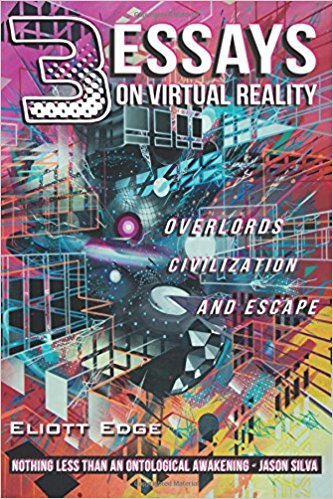
3 Essays on Virtual Reality
Overlords, Civilization and Escape
Eliott Edge
It is true that in every age people have used technology to frame their thoughts about how things work. The human mind for example has been variously imagined as a loom, a hydraulic engine, a radio antenna, and of course, a computer. Elliott Edge’s book stands within that tradition, here virtual reality (VR) is the cutting edge metaphor of choice through which we may (virtually) peer at ‘the wiring under the board’ of the universe.
Discussions about whether we are living in a (computer) simulation have existed in occulture for a number of years (notably in the work of Lionel Snell aka Ramsey Dukes) and years later exploded into mainstream society in the movie The Matrix. What Edge does in his work is move the conversation on, with a range of nice thought experiments and observations delivered in an engagingly rigorous yet conversational style.
For each generation there are those who who remind us that ‘the map is not the territory’. Using the language of VR Edge analyses the world-views or reality tunnels we inhabit and reminds of this perennial (multiple) truth. 3 Essays on Virtual Reality does not fall prey to solipsism but instead addresses the very real consequences of simulated reality theory. Edge points us to paranormal studies, shamanism and magic (as well as psychedelic drugs) as agents that may allow us to examine the architecture of the reality studio, and perhaps even reconfigure the inevitable VRs in which we live. Download these essays into your VR helmet here.
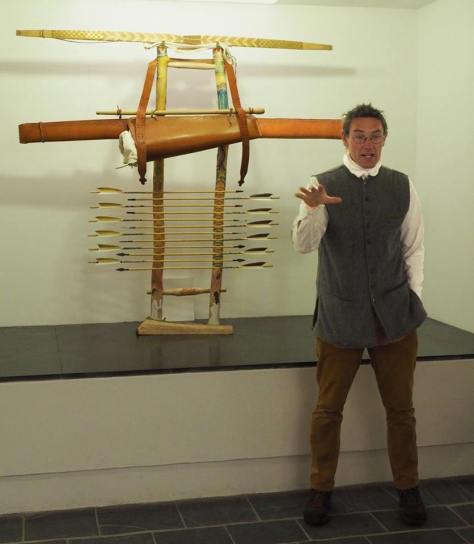
The Devon & Cornwall Pagan Federation Conference
A delightful conference that has been going for 20 years was held again in March of this year. I was invited to make the first presentation of the day on the theme of Paganism past, present and future. I had to pack my talk into less time that I initially thought available but still managed to get a few gags in.
The key point of my presentation was that while there may be a slow down in the number of people who identify as ‘Pagan’ (at least in UK census data) there are many, many more people who do pagan things – paganing as a verb as it were.
The great increase in the numbers of people creating autonomous spiritualities, of those involved in entheogenics and many others paths, perhaps means that the practices of Paganism have gone beyond the limits of identities such as ‘witch’, ‘heathen’ and all the rest.
Next year this conference will be back, but this time as part of the Pagan Phoenix South West. More details as these unfold but for now, enjoy!
(With thanks to the wonderful Damh the Bard for his contributions to this talk and to our own Steve Dee for the metaphor of the ‘Monsters of Rock’.)
If you want to check out details of forthcoming events please have a look at this page.
Hail the Queen of the May!
Julian Vayne
PS Don’t worry if you can’t access the article Keeping the Doors of Perception Open, all will be revealed soon…;)


 The Blog of Baphomet