
Stars of Ego Magick

The Ego (as Rob Dickins  pointed out in his brilliant presentation at Breaking Convention) often gets to be the villain of the piece. It’s something to be smashed, to be transcended – it’s a psychic structure that gets us caught up in petty social processes and leaves us grasping at attachments.

Yellow/Gold magick – the bright light of Midsummer time, encourages us to engage with this aspect of ourselves. What does it mean to be who we are? For this season, rather than trying to go beyond the self, let’s have a respectful look at what it means to be us – right here, right now.
Golden magick

Golden magick

Eight people were present at our meeting, including a new participant who had predominately worked within the Ordo Templi Orientis. His presence mirrored delightfully the nature of the Work during this meeting. The Illuminates of Thanateros  and OTO are quite different beasts in structural terms, but they are both, to use a rather lovely analogy, ‘Organs in the body of God’. There are things the OTO structure (let alone anything to do with magic itself) allows it to do (hold public liability insurance for example) which, in certain settings can be really helpful. Meanwhile the IOT approach means that some things are trickier for that group whereas other processes (eg not requiring any payment of membership fees and therefore being accessible to people irrespective of their financial situation) may have benefits in other respects. So these two Orders (as structures), unsurprisingly, just like individual people, have things they are well suited to, and things they find more challenging. The same is true of us as people, we’re social beings and therefore while we might want a broad base of education and experience, we don’t all need to be or do the same thing. And, assuming our social relations with many others suggest that we’re successfully part of society as a whole – there are undoubtedly things that, as individuals, we should be proud of. (We’re also really lucky with our group in that not only do we have contributors from the IOT and OTO but also folk who are not part of those structures but come from Wiccan, Zen and other backgrounds.)

Celebrating our individuality, our uniqueness, is what our Midsummer meeting was all about. This was done using a variety of techniques such as this; the ‘Yellow Magick Chaos Craft Ritual by me, Nikki‘.

Sitting in a circle Nikki laid a packet of cigarette rolling papers and a gold pen neatly in front of her. The purpose of the ritual, she explained, was to explore our own magical names. Each person took a paper and wrote their name in gold on it. Licking the gummed edge of the paper it was then stuck on the forehead, so that each person could see each others name.

Participants were then given the opportunity to speak to another person about the meaning of their chosen name. Each person also had a chance to listen (to a different person than the one they explained their name to).

Following this process of explaining the naming of ourselves, and listening to the story behind the name of another, it was time to seek out a new insight from our name. To achieve this we simply take the rolling paper and crumple it up, swallowing it with a few mouthfuls of the lemon barley water from the ceremonial chalice (the sacrament used in our earlier round of introductions at the start of the meeting).

In doing this, in the style of ancient Egyptian magic, we are absorbing our name and asking for a new insight into its meaning. We sit together each person silently repeating their own name until trance and then insight happen, guided gently by a few words from Nikki.

A simple practice like this, framed perhaps with a banishing practice and maybe a formal Statement of Intent, is sometimes all you need. The magic is in the attention the participants bring to the practice (our group members are all experienced magicians) and the skill of the ritual leader (which in the case of Ms Wyrd, having done ritual magick for quarter of a century, is considerable).

But some rituals are more about ‘bells and smells’, and require other paraphernalia. Other items used during this meeting included a vacuum cleaner (an underused ritual tool in my opinion, after all what do you actually use to banish stuff you don’t want hanging around?), a Yellow Troll Zen teacher and internet connection to the teachers’ wisdom HERE, a composite ‘exquisite corpse’ creation made from three of our ‘subpersonalities’ (or other egos), a smoke machine, lasers, strobe lighting and the brilliant ritual music used by The Temple of Set HERE.

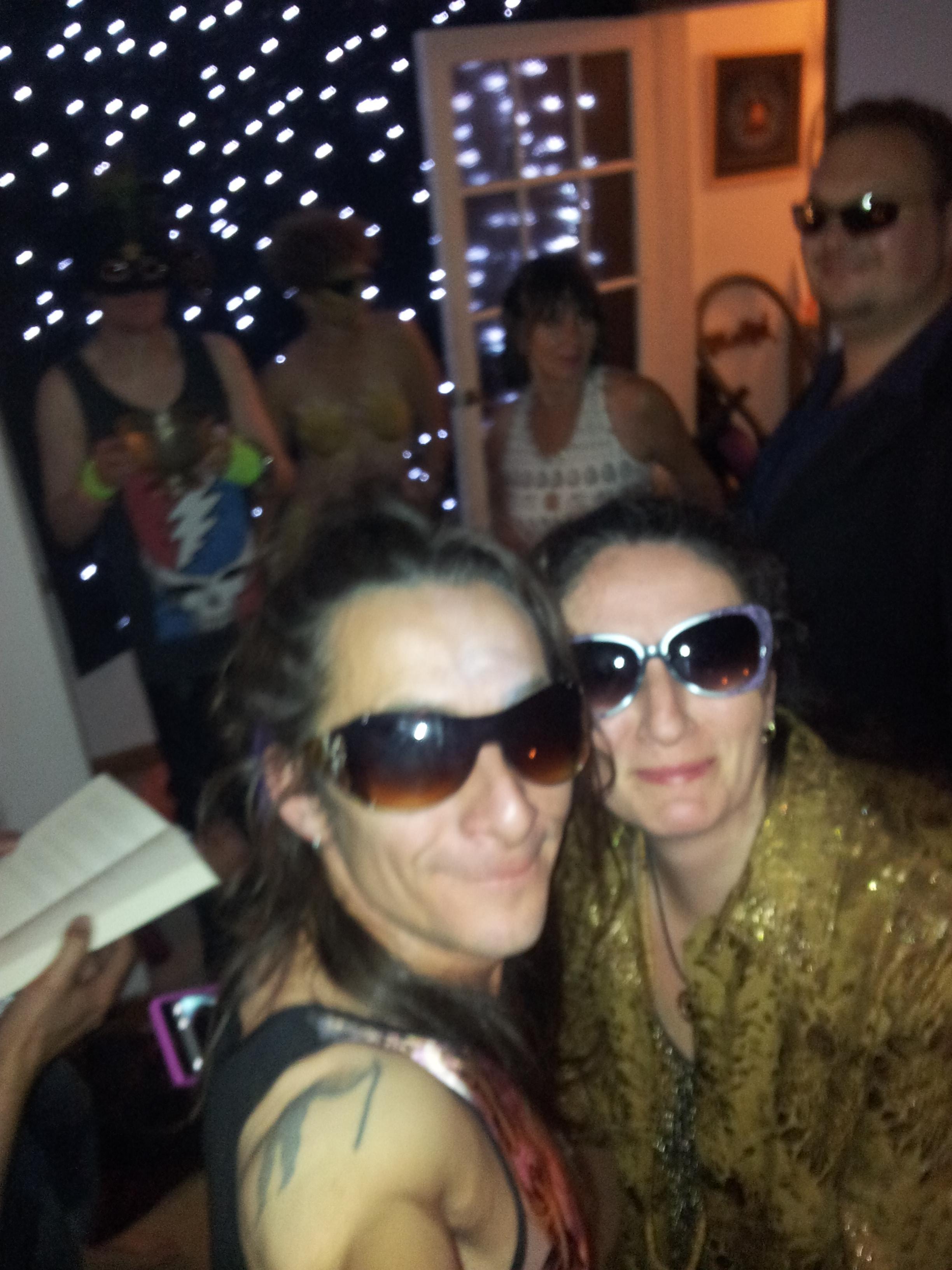
For the final rite we invoked Set, the principle of the isolate intelligence, the separate sense of self and of being-in-the-world (see p133 HERE). Then, emerging from the darkness into the light of the sun god Ra, we each put on an outfit we’d brought especially for the purpose. There were sharp suits, feathered masks, leopard print high heels, gold body paint and much more besides! There was dancing, mutual admiration and a photoshoot!
Stars in their eyes

Stars in their eyes

Celebrating our unique individuality and ourselves is something that, particularly perhaps in Britain, people get uneasy about. We don’t want to seem big headed which is fair enough. However we need to recognise that it’s okay to celebrate in this way, and that to big ourselves up doesn’t mean we have to put someone else down. Quite the reverse – in fact, for as my OTO Brother might remark; ‘Every man and every woman is a star’.

Some sounds for Yellow Gold magic HERE, HERE and HERE – enjoy!

JV

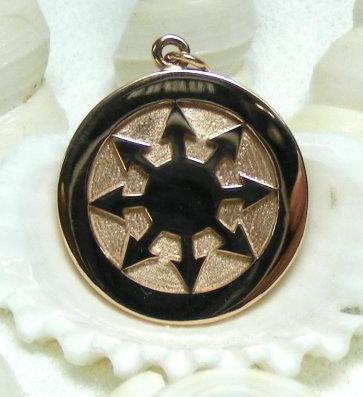
Picture of the gold chaosphere pendant owned by Nikki Wyrd courtesy of the artist Russell Lownsbrough @ http://www.whaleandsmith.co.uk/
Spiritual Knighthood

The challenge to find meaning in the midst of our lives can at times feel as elusive as a search for the Grail. Not only are we struggling to find out the location of such a desired relic, but we are also troubled by the suspicion that we are not sure whether we would recognise it if we did stumble upon it! In the midst of such uncertainty it can be tempting to abandon the quest as we feel overwhelmed by the multiplicity of paths on offer and their competing truth claims.

The desire to take up such a quest often indicates the beginnings of our awakening. As our dissatisfaction with the “answers” provided by family and society grows stronger, the hero within needs to separate themselves from the anesthetising effect of such dominant discourses. Some will be upset by our distancing behaviour and others may rage at our rebellion, but when we feel the inner-flames of purpose ignite, we know that psychic atrophy will result if we fail to pay heed to such stirrings.

Whom does it serve?

Whom does it serve?

I have recently been reading Lindsey Clarke’s excellent modern adaptation of Wolfram Von Eschenbach’s Parzival, and within I have found deep wells of insight for those of us seeking to cultivate spiritual heroism. In the tale, Pazival’s mother seeks to protect her son from the demands of the world and the allure of knighthood by keeping him in state of naive ignorance. When he eventually meets three knights from Arthur’s court, he is so overwhelmed by their radiance, that he mistakes them for Gods. He is awakened by the brilliance of the sun reflected upon their armour and even the grief of his mother fails to divert him from his desire to pursue his destiny.

This idea of spiritual knighthood is an interesting one in that it offers helpful paths of transformation while also being fraught with dangers if not understood with considered subtlety. History is strewn with examples of groups and misguided individuals who have used the martial, combative focus of the knight in an externalised fashion. The recent horrors in Norway at the hand of Anders Breivik provide a sobering example of what happens when concepts of “honour” and “defence” are appropriated by the fearful or psychopathic. If we fail to see that our sword strokes need to focus on our own ignorance, then we may be prone to projecting our fear of ourselves onto some scapegoated “other”. Some may feel that the martial focus of knighthood is innately unhelpful, but it could be argued that our need to both attack and defend are so primal, that we need a means for transforming such desires.

As Parzival journeys along the road he finds that his certainties and self-perception are repeatedly challenged as he seeks to find the meaning of true knighthood and what it might mean to be worthy of the Grail. When he begins his quest, the literal and the masculine provide him bench-marks for how he should be in making sense of his universe. His first guru Gurnemanz is more than adept in teaching him the use of the lance and shield, but when considering matters of the heart and deep pain he is sadly lacking. It is this “stiff upper-lip”, don’t ask questions attitude that causes his initial failure when confronted by the wound of the Fisher King.

In keeping with the longings of the troubadours and the idealisations of courtly love, Von Eschenbach views the embrace of feminine wisdom as being critical in the transformation of our hero. The story of Parzival is full of wise female voices, and his struggle to integrate their insights is central to his endeavour to become a true Grail knight. Such transformation can be a far from gentle process as Parzival encounters women as wise-equals rather than as a protective mother. When he seeks to minimise his initial failure at the Grail castle, his cousin Sigune’s reproach of him opens up a sense of despair that drives his initiatory purpose deeper.

This process of seeking balance and necessary complexity is mirrored within the development of Tantric and Sufi traditions at similar points in history. The parallels between these traditions and the Grail mythology could be framed as a shared emphasis on psychological alchemy and a more nuanced understanding of gender roles. Time, hardship and mimetic evolution may have lead to the development of gender identities that are increasingly subtle and congruent with our inner yearnings, but I believe that the validity of these stories remain as expressions of how the dance of perceived polarity gets worked out.

Knights come in many forms

Knights come in many forms

In the same way that Parzival must contend with the repeated deconstruction of his self-perception as a knight, so his understanding of the divine must be abandoned and reborn.  Parzival must take leave of his naive perception of how God intervenes in the world and embrace an apparently dark world where he walks alone. He must move from his child-like certainties and embrace the adolescent energy of the adversary. Only as he exercises the existential bravery of staring into the void can he begin to experience the numinous in a new way. Sitting with the mystery or “Runa” and letting it speak to our own depths in its own terms may feel challenging, but the pursuit of true knighthood will allow little else.

I don’t want to completely spoil the ending, but it behoves me to observe that as the Grail itself represents something at once subtle, mysterious while holding great powers of healing, so the very pursuit of it seems to demand the development of such qualities in its seeker. In these times of existential confusion, the development of our own internal poise can feel like one of the few means of making headway. Even if old certainties no longer ring true and we feel driven on by the longings of our souls, we can still walk a path of spiritual heroism: here we acknowledge the limits of our knowledge and yet still choose to live and act in good faith.

SD