Curses, Invocations – The tactical deployment of Red War Magick

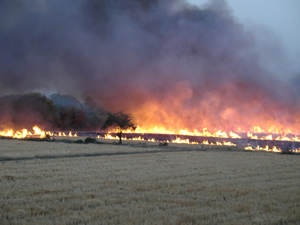
The first iteration of our Chaos Craft Wheel of the Year ends with Lammas, the festival of the cutting of the corn. In my landscape this is around the time of the first grain harvest. Red fruits appear (in my garden that means cherries, raspberries and red currants). When I was a kid in Hertfordshire this was also the time of burning the fields. The sky would darken with the smoke of smouldering stubble and we would occasionally gather at the edges of the fields and race the flames as they ate their way across the blackened earth.

Lammas is the time for cutting, for breaking, for reaping and engaging with the necessary destructive elements of ourselves, our cultures and the cosmos. We prune back the summer growth, and burn what is no longer needed.
Burning down the house

Burning down the house

For our Red Magick meeting to begin we acknowledged our groups’ inspiration from The Craft, passing around a chalice of red wine as our introduction. This wine had first been consecrated as the living witch-blood, an evocative idea that turns up in the Cultus Sabbati material and in that awesome grimoire Mastering Witchcraft by Paul Huson. We each hand the cup round the circle, drinking with the words ‘my blood’ and offering to the next participant with the words ‘your blood’. Bound symbolically by this blood pact we enter an evening of Red rites.

Curses are tricky beasts and worth considering before we rush in wands blazing. Who do we curse and why?  Of course even to swear at someone is a curse. In that situation, by the visceral power of taboo words, we may attempt to harm, to upset. In more explicitly magickal contexts we may try all kinds of operations; against individuals, against organisations, against ideas. When we consider curses we need to think deeply about what we’re doing.

In a Chaos Magick group on Facebook I recently responded to someone who was asking if members thought it was cool to curse someone who’d pissed them off:

“When considering curses, of which of course there are many types, (and indeed any act of magick) I’d suggest that you contemplate what the ritual/approach will do to you. “Battle not with monsters, lest ye become a monster, and if you gaze into the abyss, the abyss gazes also into you.” like Nietzsche says. Consider how you can act to increase compassion, transformation and healing in the situation rather than the violence and distrust that has motivated your thoughts. This more subtle approach might help you not get trapped in a me vs them dichotomy and is likely to leave you more empowered rather than less. You’ll also undoubtedly win ;)”

So the curses we laid on our night of Red Magick were against not people but aimed at the transformation of certain situations. This is delicate magick. The injunction not to ‘Battle with Monsters” from Nietzsche doesn’t mean not to do anything where there is a problem we should address. Rather it points to the idea that if you demonise your opponent you run the risk of becoming like them or of losing your own humanity.

There are certainly situations that demand our opposition, but we as magicians must be intelligent in this, and use our Skilful Means when faced with these difficulties. Lots can be learnt from writers such as Sun Tzu and Miyamoto Musashi.  (The quote of Sun Tzu’s The Art of War, “Build your opponent a golden bridge to retreat across.” has great relevance in terms of proposed military intervention in Syria but that, as they say, is another story.)

Look into the eyes of the Dragon...

Look into the eyes of the Dragon…

Of course a curse against the project of fracking in the British Isles, for example, isn’t a curse necessarily against any particular person. It’s against a method for extracting energy from the earth that is supported by a series of very short-sighted values and intentions. Naturally this type of Work must also combine with supporting the various other levels of opposition to these projects. In that moment we summoned the dragon to rise up, through the land and the people, to oppose fracking. Of course the earthquake the next day could have been ‘just coincidence’, and the announcement by prospecting firm Cuadrilla, that they might be on unsafe ground legally to continue their work (pun intended), might simply be ‘one of those things’. We certainly did not ’cause’ these events, however our magick was part of the network of Wyrd (of actions by many people at many levels)  that, for the moment, has resulted in this company withdrawing its application for more drilling.

A naive view is to imagine that Cuadrilla is ‘the enemy’ and that the enemy is bad, not ‘of us’, something we must destroy. Whereas in fact by acknowledging our connection (if nothing else as energy consumers) to what we oppose, we find our own power.

After an evening of several Red rituals where else can you go with the playlist but to a little Petro Voodoo? Asking for the presence of the Loa, dancing and chanting we enter the space of war, of violence, of conflict and again look for the transformative potential of these most difficult experiences.

Here in our underground temple we deploy a technique from the Feri Tradition of Craft. We bow before our enemies, for they remind us of what we hold dear. We acknowledge that they remind us that there are many views of the reality. We bow before them as they inspire us towards greater compassion and creativity. We bow before them and remind ourselves that we are fighting for them and their children, and in doing so became stronger in the Work that we do.
Final Red Magick spirit jar filled with ash from our rituals. Jai Ganesha!

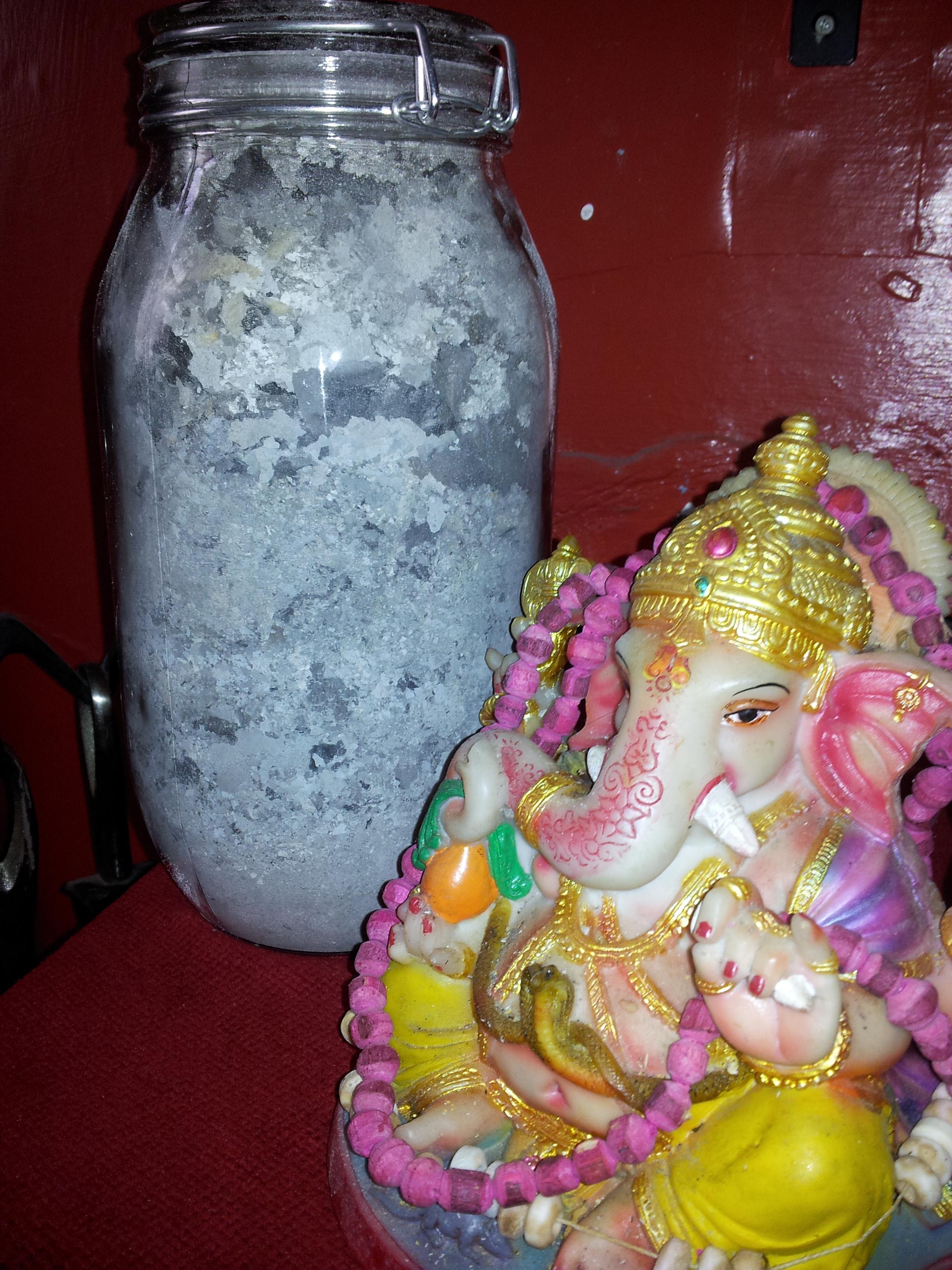
Final Red Magick spirit jar filled with ash from our rituals. Jai Ganesha!

Back from the underground, our final act of Red Magick isn’t a curse but is still about breaking stuff, this time obstacles. Ganesha’s favourite colour is red and, while he’s (mostly) a jolly god that likes sweets, he’s also a fierce ally. Making our 108 salutations to this gigantic, powerful deity we transform the Red of War into the living Red of healthy, circulating blood; our witch-blood, my blood, your blood. As we say in the Chaos Craft; “from the heights of the heavens, to the depths of the earth, we are one heart -connected. Blessed Be”.

JV

Death of a Chaos Magician

Magicians are generally those interested in exploring the terrain of the psyche and body rather than rushing toward union with the divine. Experimentation and reflection create an interactive process where the Self becomes a lab from which working hypotheses can be derived and refined. Such reflection can be about our sex life, the food that we eat or what we think about death. Death used to hold no fear for me.

Certainty provided me with a set of blinkers that blocked off the messy realities of a world that didn’t fit my faith. That faith (a Christian one) is now long gone but the tenets of the Nicene Creed are not the only victims. The death of that identity came via a very painful existential crisis that nearly cost me my mind. From the furnace of that testing I came face-to-face with a realisation about myself: I could no longer allow myself the comfort that belief claimed to offer. I was on the hunt for gnosis.

Hunting for gnosis

Hunting for gnosis

The search that compelled me to seek means for shifting consciousness eventually brought me to the door of Chaos Magic. Its heady melange of anarchic creativity and punk rock pragmatism sought to give the rather stuffy halls of western magic a good spring-clean. Undue reverence was no longer given to a batch of half-baked theosophical dogmas as the new magi sought to grapple with the joys of fuzzy logic and Post-Structuralism.

Generally I feel that such a paradigm shift has been positive, and yet after working with this approach for well over a decade I began to feel troubled. I began to wonder whether its over-referenced hipness and self-conscious flippancy provided answers to what it truly means to live and die as a magician. If I can no longer cling to certainty with regards the Summerland or some mapped out process of rebirth, could Current 23 help me deal with the big questions?

In his excellent “Prime Chaos” Phil Hine contrasts two of the primary paradigms with which the chaos tradition has played: Discordianism and the Cthulhu Mythos. Discordianism (or Liber Nice as Phil calls it) represents the irreverent, playful face of Chaos Magic. Inspired by anarchist Situationism, the spirit of Eris invites us to joyfully embrace the absurdity of both life and death. Our attempts to control and predict are laughed at by the non-linear nature of realities. Now when faced by the loss of those people, things and ideas dearest to us, laughing may not be on the agenda. Yet the holy fool of Discordianism encourages us to half-smile into the face of grief and to hold on to things with an open handed lightness. I would highly recommend the video interviews that Robert Anton Wilson did as his own death approached- one can’t help but be moved by the sense of spaciousness and compassion that are palpable as he struggles with his pain and impending departure. Hail Eris! Hail RAW!

Ia! Ia! Cthulhu Ftagn! The Cthulhu mythos (Liber Nasty!) presents us with unredeemable vision of cosmic horror. In his seminal Liber Koth Stephen Sennitt maps out an eight spoked path working via which the Adept can engage with these dark denizens. Azathoth, Nyarlathotep and their colleagues inhabit a qliphotic realm of dark, really dark and pitch black. To work with “the mythos” means engaging with such hazardous realms and the sense of psychic compression that such adventures bring.

Ia! Ia!

Ia! Ia!

Why do we like this stuff? It’s like a cosmic car crash that we can’t look away from, but does it have significance beyond our fetish for heavy metal aesthetics? For me the world of Lovecraft embodies our sense of horror in response to the Universe’s vast uncertainty. The monster-gods of the mythos provide us with a potent set of shadow archetypes that can be sat with and glanced at side-ways. This is not easy work, but if handled wisely the mythos gives us a vehicle via which we can channel our all too real terror of death and non-existence.

Ecstasy as rehearsal
One of the most positive aspects of Chaos Magic as a style of working has been its emphasis on the Dionysian. Trance states; whether they be those of ecstasy/excitation or inhibition have been one of the primary technologies that it has utilised as a tradition.

Its forefather Austin Osman Spare was critical in rescuing the Magical tradition from a dusty and over-linear style of working. His work stressed the use of the non-linear and the unconscious. The use of sigils, automatic writing/drawing and the death posture all ask us to let go of our attempts to control. The lust for results must be swamped by the dark flow of Kia.

Much has been made in contemporary shamanisms about the role of initiatory death and dismemberment- the Shaman is destroyed by the realm of the Spirits so as to be remade. Such may also be the experience of the Chaos Magician. Whatever remanifestation our selves will take when our physical body conks out; the states of ecstasy sought by the work of magic provide us with a dress rehearsal. The type of belief-shifting that the Chaotic approach employs often leads to a sense of loss, disorientation and jarring weirdness. Too much of this will lead to psychic burn-out, but more judicious application can be both entertaining and informative. This approach, with the potential uncertainty that it creates can feel like a little death for the psyche-arguably good practice for what’s ahead.

What's ahead?

What’s ahead?

So does this leave us stuck in some trendy but ultimately futile spiritual dead-end street (pun intended)? Hopefully not. If we are able to ride the currents of the zeitgeist in such a way as to open up greater freedom and possibility, then Chaos Magic may help us in developing inner poise. This is not the certainty of faith, but a sense of knowing based on practice. Yogis, mystics and sages have spent millennia experimenting with the Self. What can we learn for ourselves about life and death if we follow a similar path? My own journey continues to be an exercise in developing curiosity. If I work with these states of ecstasy and the expansion of Self that they represent, where am I left in facing the ultimate mystery of death? I find myself in a place of openness – sitting with my own uncertainty and fear, but also open to the possibility of a further becoming and remanifestation that even the Vale of death cannot contain.

SD