
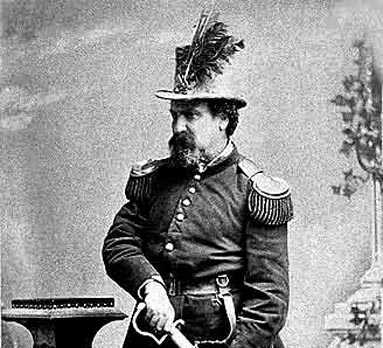
An official patron saint of Discordianism
September 17th 2013 marked the 154th anniversary of the inauguration of Emperor Norton I.
Joshua Norton was born in England in 1818 or 1819 and was raised in South Africa. He came to San Francisco in 1849 during the gold rush with a large inheritance, which he used to invest in land holdings, making him a successful businessman and respected member of the community. In the early 1850’s, China was facing famine, and enacted a ban on exporting rice. Seeing this as an opportunity to corner the market, in 1852, Norton sold all of his land holdings and used the funds to buy an incoming Peruvian ship, loaded with rice. Unfortunately, within a few days, two more rice-laden ships appeared, dropping the market value and subsequently bankrupting the budding entrepreneur. He tried to back out of his contract with the ship’s owner, but in 1857, the Supreme Court of California ruled against him. In 1858, he declared bankruptcy and disappeared.
Norton wouldn’t be seen again until September 17, 1859, when he marched into the offices of the San Francisco Daily Bulletin and demanded they publish the following decree:
“At the peremptory request and desire of a large majority of the citizens of these United States, I, Joshua Norton, formerly of Algoa Bay, Cape of Good Hope, and now for the last 9 years and 10 months past of S. F., Cal., declare and proclaim myself Emperor of these U.S.; and in virtue of the authority thereby in me vested, do hereby order and direct the representatives of the different States of the Union to assemble in Musical Hall, of this city, on the 1st day of Feb. next, then and there to make such alterations in the existing laws of the Union as may ameliorate the evils under which the country is laboring, and thereby cause confidence to exist, both at home and abroad, in our stability and integrity.”
For some reason, the Daily Bulletin printed the decree, and they continued to publish the many exploits of the Emperor and all of his pronouncements.
Norton became something of a celebrity in San Francisco, whose inhabitants were not only amused by the madman, but seemingly deigned him worthy of their respect. The city issued him a uniform, a blue military dress with matching plumed beaver hat, and a bicycle as form of transport. They even allowed him to conduct a yearly review of his troops at the nearby military academy. He was allowed to eat at the finest restaurants for free, and had a reserved seat at the theaters of the area. When he began to issue his own currency to pay for his debts, it became accepted throughout the area as legal tender. The U.S. Census of 1870 listed his occupation as “Emperor.”

Emperor Norton I’s inventive response to bankruptcy
He was once arrested for vagrancy, and was immediately released following public outcry, along with a formal apology from Police Chief Patrick Crowley, who wrote, “he had shed no blood; robbed no one; and despoiled no country; which is more than can be said of his fellows in that line.”
The Emperor made many progressive pronouncements during his reign, which included giving women the right to vote, allowing blacks to attend public school, and a call to increase the wages of the Chinese. He ordered that Congress be dissolved, the disbanding of the Republican and Democratic parties, and proposed the banding of a “League of Nations.” His most profound directive, though, would take nearly sixty years to be realized; his plan to build a suspension bridge, spanning from Oakland Point to Goat Island, and then to Telegraph Hill. The Bay Bridge began construction in 1933. There have been campaigns to rename the bridge in honor of Norton I, which have, so far, been unsuccessful.
Joshua Norton died on January 8, 1880. There were over 30,000 mourners at his funeral, and he was buried in the Masonic Cemetery at the expense of the city. Every year on the anniversary of his death, the Imperial Court System (a gay rights group), pays homage to the Emperor at his gravesite.
The Emperor Norton I has been one of my magical heroes for years. An official patron saint of Discordianism, he embodies an idea that I’ve been obsessed with for some time; that lies, hoaxes, and fiction (“myths,” in other words) can have actual effects on the external world, erasing the line that separates reality and fantasy. Norton decreed changes in his nation that were considered mad at the time, but many have become realities since his death. He was no prophet foreseeing these eventualities, but rather their orchestrator, causing them with his will and proclamations alone.
But most important to me was his ability to create a persona and fully become it. By declaring himself Emperor and compelling the acknowledgement of his peers, he points out the fallibility of belief in a central Self. His actions argue that we are not the sum of our experiences, nor the products of history, but are whatever we choose to be.
This is similar to the argument made by many Existentialists, who say that there is no essential quality of being, rendering the universe meaningless. But unlike their gloomy interpretation of these findings, Norton’s story illuminates the freedom inherent in this situation. If existence is meaningless, then we have the opportunity to create meaning in this vacuum and decide what universe we will live in. Joshua Norton has become an example of our own potentiality, and has given us all the chance to claim the title of Emperor, ourselves.
Frater Isla


