I recently had the pleasure of presenting a class on “The Gentle Art of Rune Magic” for the Calix Sanctus OTO Oasis in Glastonbury. The general theme that its body master Sef wanted me to touch upon was how Runes might be used as a form of “Visual Magick”. How might one use Runes in the construction of talismans or “Tines” and how might this differ from more Spareian forms of sigilisation?
Alphabet of Desire
When presented with time constraints and the group’s palpable sense of tiredness (the class coming after both a number of initiations and the Gnostic Mass) it can be difficult to know where to begin. I began with Silence.
Following a brief introduction about myself I lead the group in 5 minutes of quiet sitting meditation. Perhaps this sounds a bit strange and unlikely to energise, but there was a method in my madness! As practising occultists we can be a bit prone to gathering cognitive clutter. Most likely born from our attempt to inject esoteric meaning, we evolve elaborate Theosophies in order to both comfort and explain. While understandable, I wonder if they actually get us any closer to the Magic.
The rationale for my using silence was to model the act of co-creation. In many cosmologies, the divine realm speaks a “Word” into a primal emptiness in order to make:
“In the beginning God created the heavens and the earth. 2 The earth was formless and void, and darkness was over the surface of the deep, and the Spirit of God was moving over the surface of the waters. 3 Then God said, “Let there be light”; and there was light.” (Genesis 1:1-3)
These “Words” vibrate air and rattle the body; they are embodiments that bring things into being. When they are spoken with conscious intent they bring the possibility of change for both the speaker and those who hear. Such words are incarnational in fleshing out the realm of ideas: the noosphere if you will.
Runes provide us with a language for such expression. They are whispers or “mysteries” that help us wrestle with and access the unknown. As the High One puts it:
“I know that I hung on a windy tree
nine long nights,
wounded by a spear, dedicated to Odin,
myself to myself,
on that tree of which no man knows
from where its roots run.
No bread did they give me or drink from a horn,
Downwards I peered;
I took up the runes, screaming I took them,
Then I fell back from there.”
Havamal 138-139

One eyed bandit
The Rune alphabet like those of Greek and Hebrew are not exclusively magical; their meanings seek to capture the world view of those forging an existence in the north-lands. They represent our human need to create, to understand and to express. In seeking to pry them from the realm of the deep unconscious (“the roots”) Odin screams or roars as he takes them up.
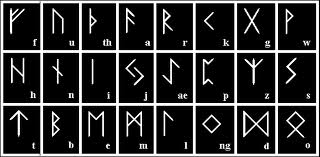
The constraints of time and energy caused me to focus our attention on the magical use of the Elder Futhark of 24 runes and the work of esoteric rune giants such as Von List, Marby and Edred Thorsson. Some of the techniques such as “Rune Stadhr” or Rune Yoga may be modern conjecture based on historic hints, but used creatively they can still be employed to powerfully channel the intent of our workings.
The process of making magic is often as transformative as the gaining of some desired outcome. As our small gathering experiments with the carving, singing and empowering of bind runes, my hope is that these mysteries will get internalised rather than merely becoming yet another thing we know about. Such transformation can be difficult: “sacrificing self to self” as Odin puts it. When we seek to engage with mystery, that being we thought of as ourselves, becomes the fuel to forge the more expansive sense of “self” that we might become.
In the creation of our bind runes we are mirroring the Gods of consciousness in using desire and intention to shape from the primal chaos of the universe. Michael Kelly articulates this well in his work Apophis in which a vital feedback loop exists between Apep, Set and Babalon (Chaos, Consciousness and Desire). When we shape our consciousness in pursuit of desire, the process itself transforms us and potentially the thing we think we are seeking.
As well as being a potent means of spell-craft, a well constructed bind-rune provides the Gnostic explorer with what Michael Bertiaux would call a “Magical Machine”. Like a Yantra or Rosicrucian engraving, the bind-rune provides us with a portal through which we can access the numinous.
Whatever the insights that we might gain via our explorations, the mysterious dimensions of “Runa” warp and disrupt any claims that we might make to full revelation. Like the Zen practitioner wrestling with koans, the aspiring rune wizard is given a doorway to a type of gnosis that ultimately transcends language. As we stare into the dark place of sustained practice, we realise that we not only look into the void, but the void looks back! The visions that you win via such questing will inevitably be through your own unique lens, but the call of your future, deep self will whisper of what you might become.
“Dark Matter flows through Gnostic machinery
Metaphysical truths
Now patent absurdities.
Strip it back
Strip it right back,
and Journey into Space
Remembering your true Self,
Seeing your original face”
SD


