My wife had to explain to me that “muggle” is from Harry Potter. She claims she was reading it for the benefit of a friend. I’m not convinced. But don’t worry. The divorce papers have been filed.

It came up because my Facebook feed was filled with this video, last month. “Muggle” was being thrown around like whatever they throw around in that Harry Potter game. I know it as internet slang for those nerds who don’t know about magic. Christians and accountants, mostly.
The video is a short report from Colorado’s 9 NEWS, concerning the finding of an “occult altar” in a deceased man’s backyard shed. Amongst the paraphernalia was found human bones. Most likely, it was connected to Palo, a Cuban magical tradition.
The video contains a clip from Dr. Max Wachetel, the station’s on-call psychologist, answering the question, “What draws people to the occult?”
“Usually, somebody will turn to that when they are an outcast from society. They already don’t fit in. Maybe they – maybe they’re actively trying to not fit in, so they’re trying to do something shocking in order to push other people away. Other times, you know, maybe from their childhood, they’ve been pushed away by others, and this is their way of kind of reconciling that in their minds.”
This gross generalization, of course, had many commentators spitting mad, letting anyone within shouting distance know that they are absolutely not what Dr. Wachetel described, and that he is obviously one of those dumb muggle bastards, always trying to make the rest of us look like weirdos.
But then I remembered something that happened a little while back. I was at the Albuquerque Pagan Pride festival, a gathering in the park where pagans of all walks come together to enjoy the sun, listen to live music, and sell their wares in an environment of love and openness. While killing time, walking around and hoping to find a story to write about, I overheard someone talking about me.
“Jesus Christ. Look at this idiot.” I was wearing a suit and tie, which is apparently a major faux pas, if you ask the guy wearing a plastic viking helmet and hand-sewn version of Mickey Mouse’s robe from Sorcerer’s Apprentice.
The rest of the day was full of sideways glances and a general sense of suspicion whenever I talked to someone. I felt like an undercover cop.
I also remember the time I was in a New Age shop in Houston, browsing some books on Vodoun, when a skinny albino man tapped me on the shoulder and very earnestly said to me, “Bro. You do not want to fuck with Voodoo. That shit will mess you up.”
He then struck up a conversation with the woman at the cash register, shouting her name and making sure that everyone knew what good friends they were.

Dr. Wachetel’s words suddenly stopped sounding so dismissive. In fact, when I started thinking about it, of the handful of occultists I’d met in real life, nine out of ten (a figure I just made up) were just like these two goofballs: escapists with chips on their shoulders, desperate for attention and power that they obviously couldn’t get through normal channels.
And I was actively searching these people out, unlike Dr. Wachetel, who has probably only met one or two in passing. Is it really any surprise that all he found were antisocial malcontents “actively trying to not fit in?”
What a hate-mongering simpleton. An ignorant, intolerant jerk.
A goddamn muggle.
Howard Bloom was right. It’s the same old Us versus Them tribal dance. We’re watching superorganisms dueling it out to see who gets that most coveted spot: king of the hill.
In The Lucifer Principle, he said that all the fighting, stealing, murder, and subjugation, everything we call “evil,” are just by-products of cultural evolution. One tribe must view all others as “the enemy” and recognize otherness as a source of contamination if it wants to make its way to the top. It’s evolution by way of Capitalism and zero-sum gaming.
And this mentality has served us well, so far, creating what we recognize as “culture.” While the most atrocious acts of war and slavery are byproducts of this system, the transmission of cultural memes is another. When one group exercises control over another, it must inoculate against that group’s infectious ideas, an inoculation that always fails and inevitably leads to cultural dissemination.
The Us versus Them model always falls in on itself, tending to lean toward integration.
With tools like the internet at our fingertips, the differences between groups is becoming fuzzier with each passing day. We’re starting to recognize that every other person in the world is the same as us, only in different circumstances. And that should go for occultists and muggles, as well.
After all, the world is becoming more like us, everyday. Ke$ha’s got pentagrams and James Franco’s got Kenneth Anger. Culture is catching up pretty quickly, and soon, there won’t be any Them left to roll your eyes at.
And many occultists now view magic as a type of technology, anyway, drawing from Clarke’s third law: “Any sufficiently advanced technology is indistinguishable from magic.” Here, the idea is that magic isn’t a supernatural power, but a natural set of laws which have, so far, gone unrecognized by scientific research. Practicing magic doesn’t mean you’re smarter than everyone, it just means you’ve had access to the right information sources.
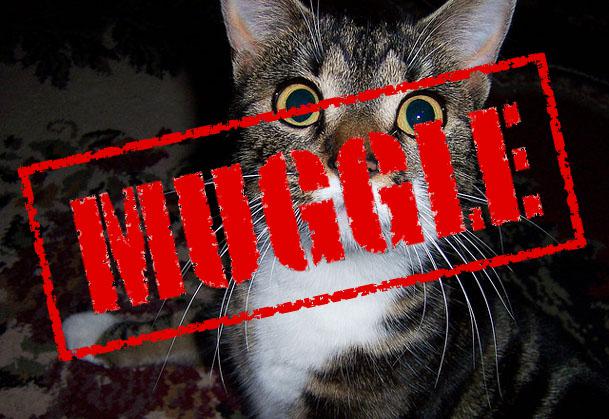
So, if magic is a technology, then looking down your nose at an ignorant muggle may be the equivalent of mocking a poor Somalian for not having an iPhone.
Frater Isla

 The Blog of Baphomet