We are approaching that magical night when the spirit of gift-giving at midwinter visits us. Clothed perhaps in the evengreen of the holly and ivy, or the scarlet and white of the amanita mushroom (or the Coca Cola Corporation) down through the chimney this welcome spirit descends.
Santa, like most mythic figures, is an entity who emerges from a wide variety of cultural streams, proliferating into many guises in different nations and traditions. So is one of these cultural streams that of the shaman? And who or what does that word ‘shaman’ point towards?

Portrait of a Shaman
I had to produce a good answer to this question recently when I decided to share the Yuletide pop choon by Magicfolk Shaman Spirit Reindeer of Siberia with my children. Number Two Son wanted to know ‘what’s a shaman?’ Such a simple question (and the necessity of coming up with a satisfactory reply that would make sense to a person who is 7 years old) is an excellent opportunity to distill complex knowledge into a pithy answer.
Naturally I’m aware of the cultural and linguistic derivation of the word ‘shaman’ (one of my favourite books on the subject is a one of the less well known works by Ronald Hutton ‘Shamans: Siberian Spirituality and the Western Imagination’). Plenty of people (a very few from Siberia, but mostly not) regard the use of the term shaman (by folk outside of Northern Asia) as a form of cultural appropriation. A brief wander round the more excitable areas of the internet can turn up any number of people raving about how person X shouldn’t be using the word ‘shaman’ to describe themselves and/or their practice. Allegations of racism are commonplace, as are suggestions that person X is ‘making up’ their lineage, experience and tradition. (There’s often the suggestion that person X is making bags of cash by exploiting shamanism in toto as well as their clients gullibility. Possibly these points are raised for good reasons and with good intentions. However some of these responses rather remind me of H.G.Wells definition of moral indignation as ‘jealousy with a halo’.)
There are those people who claim the term shaman and are celebrated owners of the word. The biggest hitter is Carlos Castaneda who undoubtedly brought the attention of shamanism to a huge audience at a perfect moment in the cultural revolution of the 1960s. And, for better or worse, plenty of people have trodden the path that Castaneda marked out. Then there is the work of ayahuasca swigging Michael Harner and his later distillation of practices into the less entheogenically influenced Core Shamanism. In these and many other cases the relationship between myth, story-telling, inner world experience and actual ethnographic work is stirred into an evocative blend of narratives. A more recent example is the work of Simon Buxton who, according to his account of bee shamanism, needed to spend a few weeks in a wicker bucket and then consume datura while running about naked on ‘Potato Island’, in order to be granted his shamanic powers.
Now there is certainly merit in exploring the relationship between the fabulous and historical in these accounts (and the just plain bonkers; Simon Buxton for instance claims that bee keepers don’t get cancer because of the special powers of his favourite insects. However a quick glance at the literature of oncology seems to suggest otherwise). Yet the nature of all shamanisms, ancient-tribal and modern-urban, is that they exist in a liminal zone. Depending on the culture into which it emerges this limiality may be between personal spiritual project and a wider social role. It may be the liminality of the wounded healer, or transgendered individual, between drug induced inner world flight and the reality of searching for resources in the physical landscape. Between fact and fiction,’lies’ and ‘truth’.
Mindful of this complex web of claims and counter-claims I had to come up with an answer. Something that would make sense to my young interlocutor and be broadly, defensible. What could I draw from my own experience of the occult? I generally don’t define myself as a shaman however I would describe some of the magical work I’ve done as being in a ‘shamanic’ style. This ranges from the experience of facilitating medicine ceremonies, providing pastoral care and healing for members of my community, undertaking processes of personal dismemberment and reintegration, developing a relationship with spirits and inner-world landscapes, and having been taught esoteric techniques by members of various ‘indigenous’ and ‘tribal’ cultures. Does that make me a shaman? And what about our seasonal red and white clad wise-man, descending through the smoke hole in the roof at midnight, bearing gifts for his community? Travelling across the night sky with his spirit reindeer from the far North. What of him? Is he indeed a shaman?
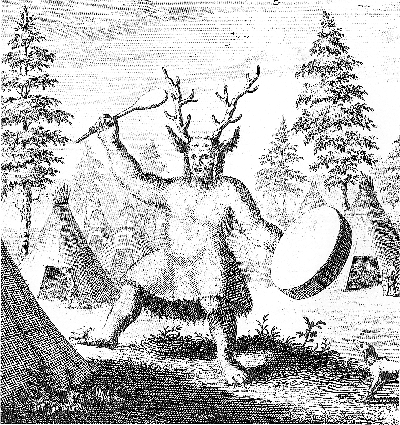
Party animal
So my answer to this simultaneously simple and complex question from my son was this; that a shaman is a magician with a drum.
Where classic magicians typically have wands (either of the hiking Gandalf staff variety, or the Solomonic/Harry Potter pointy style), a shaman combines the stick with the drum. And on reflection maybe this means music is a central feature of shamanism? Music that brings us back to the impossible drumming of the reindeers hooves in the sky, the tinkling of bells and the magical songs sung by many voices, old and new.
All hail the singing Siberian magician, may he bring wonderful gifts to your hearth!
A few shamanic tunes for you to enjoy…HERE, HERE & HERE
JV