
Exploring Thelema and Chaos Magick, with Pete and Sef (Part 4)

Reply to Sef.

Thank you for your exposition of ‘True Will’ Sef. The stoical or detached attitude to duty advocated by the Hindus seems admirable in some ways but it has also propped up the caste system for millennia. If your birth dictates that you will shovel shit for an entire lifetime and so will your children, then just get on with it. If tradition dictates that you must throw yourself on your husband’s funeral pyre then just get on with it, you will reincarnate in a better position as a result.

‘Pure Will’ ‘unassuaged of purpose’ sounds like it can mean anything, everything, or nothing. I consider that people consist of the totality of what they do (which of course includes what they think). The idea of their having some sort of ‘being’ separate from their doing, or for that matter some sort of ‘will’ other than their total doing seems superfluous to me. I can however appreciate the idea that doing some things may tend to give better results than doing others, and to this extent I can understand ‘Do What thou Wilt’ as an exhortation to do the very best of what you can possibly do and love to do, as so many people settle for mediocrity and lousy compromises.

My dear old friend Gerald, the alcoholic Thelemite, really wanted to write and he could write brilliantly at times about things he loved. He wrote a book on boxing described as world class by those who like that sort of thing. I think perhaps that his attachment to Thelemic orthodoxy inhibited him from writing more widely about magic but he did do a rather good little book on the tarot. Tragically he decided that he would try and write trashy thriller novels full of gore and violence and sex. He always admitted the stuff was trash but he said he needed the money. I felt that he developed a rather excessive attachment to the personality cult of Crowley and to that of Hemmingway as well. After a number of years sat at a manual typewriter with a bottle of gin and a carton of senior service to dull the pain of prostituting his art he ended up wrecked (and still more or less penniless). I think he just made some bad career decisions and compounded his mistakes by believing the bad compromises he made served a ‘higher’ purpose.

And now to your question:

‘What misconceptions about Chaos Magick, and yourself perhaps, would you like to set straight once and for all?’

Basically Chaos Magic says that nothing may have absolute truth and that anything may remain possible. Thus by relaxing certain constraints and beliefs and trying others we may achieve surprising results. I have suggested experimenting with such ideas and beliefs as: – arbitrary symbolism to taste, synthetic barbaric languages, relaxing strict material causality, the assumption of indeterminacy, multiple selves, multidimensional time, synthetic servitors, retroactive enchantment, manufactured gods, heretical cosmology, and so on, to see if we can make them give useful results.

Chaos Magic offers toolboxes of ideas and techniques rather than cannons of dogma and occult mysteries.  Some Chaoists do write in an authoritative style when they think they have come up with a more useful idea or technique than has existed before, but usually in the spirit of trying to provoke or challenge the reader, not to solicit blind faith, although it can sometimes sound otherwise.

Some wannabe chaotes seem to think Chaos Magicians worship Chaos. We don’t. We acknowledge and respect its creative and destructive power and we try to use it, and to nudge it, and to make the stochastic best of what it throws up.

Chaos Magic has its own versions of the romance of sorcery, often it presents itself as an esoteric science with a somewhat cavalier and jocular attitude to traditional notions of sanctity, and spirituality and it has an emphasis on results magic. This can lead to accusations of flippancy, materialism, and nihilism or black magic. However I would assert that you can only find or choose your own meaningful path in magic by actually doing it to find it, without reference to other people’s definitions of what they think ‘spiritual’ means.

Some people have mistaken experimental beliefs for truth. For example the idea of reincarnation contradicts the idea that we have no ‘real’ immortal self or soul; however both ideas have their uses if applied separately, as do the wave and particle descriptions of quanta.

Chaos Magic thus thrives on experimenting with misconceptions and alternative conceptions and I wouldn’t try to set any of them straight, don’t believe me, argue with me, find your own chaos magic, I act as agent provocateur, heretic, and devil’s advocate.

As to misconceptions about myself(s), I don’t actually have horns and a forked tail, this sometimes disappoints.

Some left wing people think I have right wing opinions, and vice-versa. I’ve often faced the question ‘how can you sound so conservative about this matter but so liberal about that matter’. (Or vice-versa). Well I have opinions across the whole spectrum about various matters; I don’t feel the need to conform to other people’s expectations of consistency or groupthink mentality.
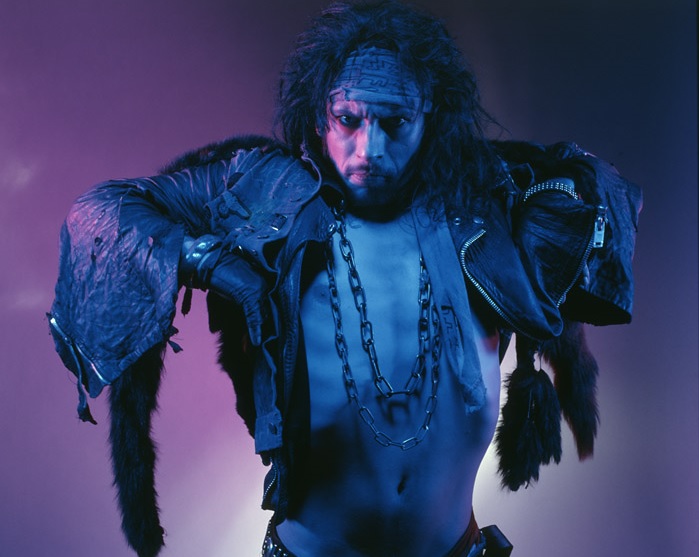
"I got a left wing, I got a right wing. I'm an angel, man." -- Zodiac Mindwarp

“I got a left wing, I got a right wing. I’m an angel, man.” — Zodiac Mindwarp

Plus I relish a certain amount of creative confusion, disinformation, and protective camouflage. No pictures of me appear on my books or the internet; half the people who know me have no idea of my metaphysical interests. My usual appearance of old hippy surfer or biker does not match my daytime profession. I tend to regard suits as formal dress for telling lies in. I tend to catch the bus or walk or cadge lifts because I find it more interesting than using a chauffeured limo, plus it has a smaller carbon footprint.

I would not describe myself as an unqualified libertarian. As Douglas Bader quipped “Rules are for the guidance of wise men and the obedience of fools.” Unfortunately not everyone can handle the freedom to question all the rules and assumptions. I would not advocate Chaos Magic for most of the world’s inhabitants.  Often the introduction of some surprise variables, or randomness, or an antinomian perspective, or some Chaos to a system requires careful planning and premeditation or mere Entropy (destructive chaos) rather than Apophenia and Obdaxazongaga (creative chaos) may result.

So now to my next question to you Sef: The HGA.

I’ve always wondered if seeking The Knowledge and Conversation of the Holy Guardian Angel seems like a good idea. The procedures for discovering it seem functionally indistinguishable from recipes for creating an obsession. It looks like a suspiciously monotheistic belief and thus a self-contradictory and limiting obsession with an ideal that has become effectively unattainable. You said that even with Crowley you follow the message not the man.  Does the OTO acknowledge anyone as having ever attained it?

All the best, Pete.

Exploring Thelema and Chaos Magick, with Pete and Sef (Part 3)

Dear Pete,

Thank you for responding so quickly, and while I have been away myself this last week I hope the delay is tolerable. Firstly, to your previous discourse:

You appear to describe the “true will” as being an exclusive pursuit of a temporal vocation, and I consider this an oft-repeated fallacy which actually has no foundation in Thelema (for “True Will” does not exist in the text, and is misleading I feel). We talk about the “pure will” rather than the “true will”, which is comparable to the saying of Lord Krishna in the Bhagavad Gita, regarding Karma-yoga:

“Therefore, without being attached to the fruits of activities, one should act as a matter of duty, for by working without attachment one attains the Supreme.”

-Bhagavad Gita, Cap 3 Text 19

“For pure will, unassuaged of purpose, delivered from the lust of result, is every way perfect.”

-Liber AL, Cap I v44

While you desired the freedom to play at entrepreneurship, capitalism, familymanship, sculpture, etc, these are not specific “wills” which are mutually exclusive, nor do they need to be in conflict with the pursuit of one’s Will. Should it be your Will to be all of these things at a given time, then they are all in accordance with that Will.

In my pursuit of my Will, as I understand it, I work: in a College to assist with young people gaining skills; on nightclub doors to help ensure people enjoy their night; organising Conferences and events  to assist people to connect with others who practise the same and different esoteric paths and traditions; helping to organise an Oasis of O.T.O. and take part in activities across the country; raising two (that I’m aware of) magical children to be good and decent and, in turn, do their Will. None of these things are in conflict, nor are they any less expressions of my Will for being different facets of my aims here. This is all my karma-yoga, and in working such, allows my Will to express itself.

This leads on naturally to your question:

I had a ferociously committed Thelemic friend once, but he drank himself into a very early grave, all the while proclaiming Do What Thou Wilt.

How do YOU decide whether someone is doing their true will or not?

In my current understanding, someone is most likely doing their Will when they cannot hold themselves from doing otherwise. The Will is that which remains. When everything is lost, if their whole life is disrobed and charred and scattered to the winds, then they are doing their Will because that is the only thing left to do – and on a magical journey, if we do not remove these things consciously then they will be removed for us.

My own view of Thelema ties closely to classical Stoicism. Pop-culture reference: Falling Down is an example of the lesson of the Stoic. On the magical path, we frequently find ourselves in strange if not downright absurd situation, and it is up to us whether we act or react according to our ethics and morals. The film focuses on two leads: Foster (played superbly by Michael Douglas) and Sergeant Prendergast (a likewise brilliant performance by Robert Duvall). They are both on a journey, over the course of one day, and both begin and end right next to each other. While Foster’s story is one of emotional reaction, Prendergast continually manages to act in a Stoic fashion, and thus Prendergast appears to be the “winner” – but they both fulfil their Will.

man

Modern mythology

Foster makes one bad decision after another, beginning with abandoning his car in a traffic jam and walking home across town after being fired – determined to see his daughter and ex-wife, who has a restraining order against him. He declares himself a victim of circumstance, and has a series of bizarre encounters with others who are all also making terrible decisions. He starts with a petty and greedy storekeeper, then goes through some gang thugs, to a white supremacist, and eventually ends up in a position where he is forced to face the fact that he might not be the hero of the story. Each encounter could have a non-violent resolution if he could accept his lot, but instead of making the choice to act rationally and walk away, he responds with unbalanced force and unchecked emotions. The situation quickly escalates, and ultimately he comes face to face with Prendergast as a wanted murderer.

Prendergast meanwhile starts in the same tailback, and his first action is to likewise leave his car – but to support and assist other people. He is on the ill-fated “last day before retirement” which is even called out by the film and yet he is determined to work a full day. In so doing, he makes the connection that Foster is the person making these egregious messes across his city, and pursues Foster despite the obvious danger. He is never rash, he is methodical, and at every encounter he observes and acts accordingly – the exact opposite of Foster, in fact. Even when his colleague is shot and he realises he may die, he resolves to continue, and goes towards whatever fate happily.

As the two finally meet, Prendergast gives one last chance to the wretched Foster rather than shooting him on sight. He asks clearly, “What are you going to do?” and offers the chance to survive. Foster finally understands his actions: “I’m a bad guy? How did that happen? I did everything they told me to.” This crucial line displays his dereliction of personal agency, and in taking the path of least resistance, or the road paved with good intentions, he has completely failed to take control of his own life rather than lashing out at whatever has gotten in the way of his perceived goal – which is forever unattainable.

Foster makes a choice in the end, the only choice he has left: to die. He has absolutely nothing left, even his future rotting in a jail cell cannot hold any hope, all of his potential squandered by carelessly abusing his temporary power. In choosing to die, he fulfils the Will which he so misinterpreted as wanting to see his daughter, and instead looks after her by gifting the insurance payout for his death. Prendergast also is faced with a choice, and shoots Foster to preserve his own life and that of the others to come after him. He makes it to retirement after all – the moksha of escaping the cycle of his working life.

This is a clear triumph of jnana-yoga, as Prendergast has applied Vairagya (dispassion, detachment, indifference to pleasure and pain under all circumstances), or the four Stoic virtues of Wisdom, Courage, Justice, and Temperance, to navigate his path through the movie and fulfil his own Will. There is no victory, just the accomplishment of that which was required by both parties to instruct the viewer.

This is how I decide that someone is doing their Pure Will – that whether they choose to or not, they are acting in harmony with others doing their Will, and doing it sometimes whether they like it or not.

As to your friend, who I am certain is sorely missed by the Thelemic community, the accomplishment of his Will is not tied to the state of his liver, or the continued beating of his heart. Did he act in accordance with his Will? Did he accomplish something to leave behind and be carried on? I think that this is a more valid critique of whether he did indeed do his Will. My only concern is that I hope he has gone on to whatever next phase he Wills:

Unto them from whose eyes the veil of life hath fallen may there be granted the accomplishment of their true Wills; whether they will absorption in the Infinite, or to be united with their chosen and preferred, or to be in contemplation, or to be at peace, or to achieve the labour and heroism of incarnation on this planet or another, or in any Star, or aught else, unto them may there be granted the accomplishment of their wills; yea, the accomplishment of their wills.

-Liber XV: The Gnostic Mass

Mass Revealing

Mass Revealing

An important point to consider is that “Do what thou wilt” is an injunction given to another, and not a personal statement of intent. Was your friend claiming to be doing his own Will when he drank, or was he fighting to ensure you had the liberty to do your own Will?

With that in mind, here is my second question for you:

We have looked at misconceptions on both sides of our mutual fence; in this essay I brought up the difference between the “True Will” fallacy (which implies a possibly unattainable goal, fixed in dogma) and the “Pure Will”, and “Do what thou wilt shall be the whole of the Law” being used as an excuse to do as one pleases rather than the imperative of “Hey, whatever your Will is, that’s what you should be doing, and I’m cool with that.”

What misconceptions about Chaos Magick, and yourself perhaps, would you like to set straight once and for all?

All the very best Pete.

In LVX,

Sef