What We Find Ourselves Doing…

A good friend of my once observed that we should pay more attention to what we find ourselves doing rather than what we think we should be doing. What my friend (who is both a therapist and magician) was pointing towards was that we often cause ourselves suffering through the endless cycle of searching, aspiration and acquisition. “If I just gain mastery of x, acquire this book or undertake this training then I will know who I am and what I’m supposed to be doing here!” Sadly this doesn’t really work does it? We might gain a temporary sugar-high from rebranding ourselves or spending far too much on fine books (or wines), but if your anything like me we end up caught in a solipsistic loop where we end up exhausted (and frankly bored) by our endless self-narrative.

My friend’s theory was that if we pause for a moment and reflect on the things that we actually do and enjoy doing (hence why we keep doing them), then we are probably getting close to understanding something about what we really desire. Desire often gets a bad press, but personally I feel that our problems with distraction and consumerism are often our attempts to flee from the cost that our real heart-longings might ask of us. The quick-fix is really no fix at all and contrasts radically with the type of awakening and attentive self-listening that will allow us to look down to the soil in which are personal roots are really bedded.

Such self-reflection is rarely easy and in making the effort to “tune-in” to these realities, we may have to turn-down or reject the versions of ourselves that others may want us to buy into. This willed antinomianism allows the creation of a space in which we might experience a greater sense of cognitive liberty in experimenting with our dreams. This is the demarcation of the magical circle – a lab in which we create the optimal conditions for self-examination. In waking up to “what we find ourselves doing” I have often opted for a period of elective self-limitation. In a world where endless choice and speed are valued, a period of monastic retreat often allows the cultivation of clarity.

Getting up to stuff in the magic laboratory

Getting up to stuff in the magic laboratory

As we push our hands down into the dark soil of our unconscious, we risk the possibility of contacting some of the core aspects of what drives us and those things that cause us to feel most alive. The discovery of this “dark matter” is rarely linear and the value of art, dreams and synchronicities should not be underestimated. Often the untidy syncretism of our altar spaces, reveal more to us than our ordered book shelves.

One of my personal routes to accessing such gnosis has been through the use of dance and shaking states. In seeking to loosen the tensions and defences that often get located in what Wilhelm Reich described as “body armour”; I often have a sense of a deeper instinctive knowing emerging in and through the body. When I move in response to the music my self-consciousness slowly melts away. This type of “shape –shifting” may well relate to the way in which the body allows us to process aspects of the self that the conscious mind struggles to make sense of. Interesting research is beginning to explore this territory, and it may be the “darker” more instinctive drivers of the early or “reptilian” brain get processed more effectively when we actively engage the body. As I dance I often feel that in my messy embodiment, I am making sense of my early and deepest drives (for more on this see “The Compassionate Mind” by Paul Gilbert and Peter Levine’s work on trauma).

In reconnecting to the “what is” of the moment, rather than becoming stuck we create the possibility of emergence coming from a place of depth. Stirred by the memory of some conversations with a Setian Priest, I keep returning   to the concept of how important “need-fire” is in the pursuit of my own initiatory work. Whether one self-defines as a magician or not, one of the primary indicators of whether a goal will reach fruition relates to the degree to which we are motivated by burning need. To follow a path of the basis of whim or fashion may provide a temporary distraction, but it is unlikely to adequately fuel significant transformation.
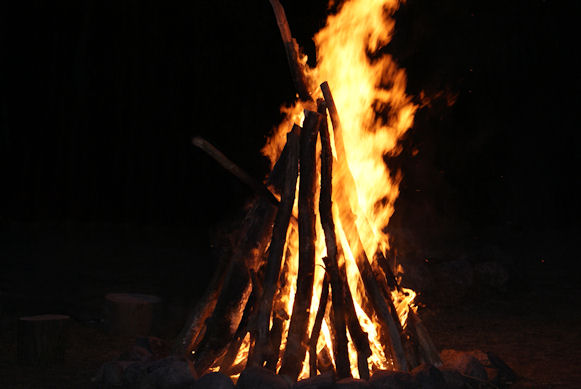
fuelling transformation

fuelling transformation

In many ways these observations connect to the “Chaos Craft” project (and forthcoming book) mentioned on this blog. In contrast to the often hyper-accelerated go-getting that one might associate with Chaos Magic, this project has sought to integrate the inescapability of the moment made manifest in time and the spirit of place. We make no claims to lineage or secrets shared on Grandma’s knee, rather this is a Witchcraft born of a connection to a raw coastline, the beating of drums and a desire to awaken. This is the Witchcraft we found ourselves doing.

To look into the mirror and truly see ourselves requires real bravery. To let go of the script of how it should be and to ask “What is it that I find myself doing…?” is truly revelatory. It may reveal the nature and extent of our current desires and also our need to escape from the current constraints that block our unfolding. There are no simple answers but it is a beginning.

SD

On Having a Girl’s Aura

Sometimes I get mistaken for a female, and for years have explained jokingly that this is because ‘I have a girl’s aura’.

When I was a teenager this happened fairly often. I remember once being at a David Bowie concert in London (part of his Glass Spider tour). With my hair spiked (in a homage to Aladdin Sane) and eye-liner I guess it wasn’t that surprising that the blokes sitting behind myself and my (female) partner remarked; ‘Cor look! lesbians!’ However only a few years later I found myself walking with another girl friend in Cumbria and something similar happened.  Striding up the hillside towards Grisedale Tarn (which I always imagine as the kind of body of water beneath which a Cthuloid God may well lie dreaming) we were met by a gentleman walking the other way. Despite the fact that I had short hair, no make-up, probably stubble, a men’s waxed Barbour jacket, combat trousers and boots (as did my companion) he still greeted us with a hearty ‘Good morning ladies!’

Engendering confusion

Engendering confusion

And it’s not a phenomenon limited to a western English speaking cultural context. Once when passing through airport security in India, having gone through the metal detector, I stood in front of the male security guard and lifted my arms for a pat down search. Despite being taller than the guard (I’m 5 foot 8 inches tall) and us being face-to-face (me wearing jeans, t-shirt and no make-up or other insignia usually thought of as feminine) he directed me elsewhere.  ‘Ladies to go here please!’ he remarked, indicating that I needed to be searched by the female guard (as would be appropriate were I a woman). I’ve also found these misreadings are also not age dependent; there have been numerous occasions in which I’ve overheard a child taking about ‘that lady’, meaning me.

While clearly not a banner-headline masculine type (I’m rather far from the Pipe Bear phenotype) the majority of the time these situations have arisen while I’ve been dressed in ‘traditional’ male clothing and had short hair. It’s interesting to consider these misapprehensions  in the light of the fact that I do identify as a bisexual male, who likes a spot of crossdressing, and the somewhat fay Goth style (in my defense, I did do most of my growing up in Britain during the early 1980s).  It’s also interesting to note that the misinterpreting person often ends up profusely apologising – as though mistaking me for a female is something I’d find offensive – itself a fascinating observation.

Of course there’s much one could explore about these misapprehensions. Firstly are they actually mistakes? Are those folks who ‘misunderstand’ me as a girl actually detecting some of these ‘feminine’ aspects of who I am, even when they are not being overly signaled by context, dress etc? More broadly these ‘mistakes’ make me aware of, and call into question, the relationship between genetic sex, genital identity, cultural norms and so on. The issues that this misinterpretation raises are subtle, fluid and multiple.

I guess for me I take these misinterpretations of my gender as a compliment. Generally I find women more attractive (at least visually) than men and so I’m always a little flattered by these ‘mistakes’. More generally there may well be some kind of cultural feed-back loop from my apparent ‘female side’ or social role (I often get to be ‘honorary girl/woman’ etc at various female-only events, for example Hen Parties).

As a magician I’m interested in these experiences because of the significance of the androgyny in pretty much every esoteric tradition. Whether it’s the dual form of Ardhanarishvarathe appearance of dual-sexed imagery in alchemy, or its modern re-visioning in the chimeric sexuality of Baphomet – the notion of both genders being present in one body is a central motif in many occultures.

Alchemical gender mashup

Alchemical gender mashup

I like to imagine that these misapprehensions of my apparent gender spring from what one might (in a positive sense) describe as my being ‘a bit ergi‘.  This was a term of abuse in Viking age culture and was applied to men who engaged in seiðr; practices of which we know little but many conjecture to have included magics of a dark-feminine, spiritist, sorcerous (perhaps manipulative) sort.  In some respects ergi seems to be much like the complex modern word ‘queer’. Today we might say we’re talking about ‘receptive’ qualities; the ability to listen to others/the unconscious/the spirits, and indeed to take the gods inside ourselves (with the obvious sexual imagery) in trance work and invocation. These seem like essential skills for the well-rounded magician, whatever their gender. (If you want to explore a more nuanced analysis of ergi I recommend reading Nine Worlds of Seid-Magic.)

So perhaps it is indeed my ‘girl’s aura’ that foxes people about the set of chromosomes I carry; maybe they unconsciously register the currents of my magical work (consisting as it does in large part of a chaos-Baphometic-witchcraft which, franky, is pretty ‘queer’), or maybe it’s just that I’m a lot more camp than I generally notice. And then there is the complex issue of whether camp behaviour is in any way intrinsically linked to the behaviour of women, or something else entirely…

JV