Chaos Craft: The Book

Click here for trailer!!!

Click on the image to see our trailer!!!

Blending together the essences of Chaos Magic and modern Paganism, this book records the emergence of the new tradition of Chaos Craft. Many of the essays presented here were first brewed up in theblogofbaphomet.com. New pictures and fresh essays add spice to these existing writings. Some of which, previously unavailable, comprise the secret rituals of this unashamedly syncretic form of occultism.

The potion you may sample inside is infused with the flavours of Gurdjieff, mindfulness meditation, trance-bodywork, entheogenics, Wiccan and Sabbatic Craft. The mixture has been diligently stirred widdershins for two years as the Wheel of the Year cycled through the Colours of Chaos.

The explorations, the questions, the techniques and reflections presented here are part of an ongoing magical work. Like the figure of Baphomet hirself (patron deity of Chaos Craft), the elixir pouring from this cauldron is redolent with the rich alchemical scents of what modern magicians do.

Would you care for a sip?
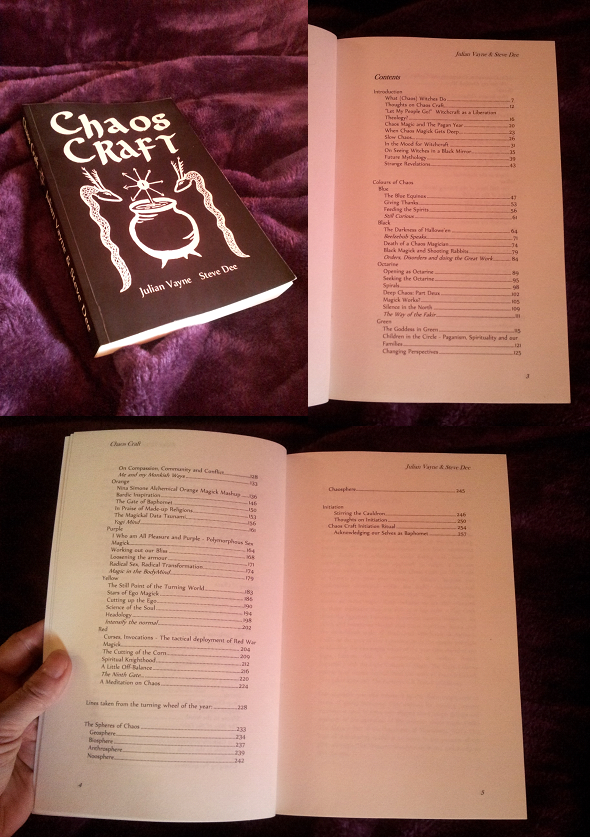
Book and contents picture

Available now, collected together within a physical volume, we present fifty-six posts from The Blog of Baphomet’s two year project Chaos Craft. Combining the chaos magick 8 colour system, with the 8 festivals of the witchcraft wheel of the year, the authors recorded their own musings, the rituals created by their group, and some of the theoretical underpinnings of the group’s workings.

Including previously unpublished material; four new essays, a collection of poetic couplets describing the turning of the year, and with chapters detailing three additional key ritual practices, this volume provides a handy way to browse your favourite writings from those masters of thinking in depth about doing magick, and doing plenty of thoughtful magick, Julian Vayne and Steve Dee.

With a revised text, and many new original pictures, this collection allows the Chaos Craft hybrid to reveal itself as a vibrant, modern path rooted firmly in traditional ground. Written with gentle humour, erudite philosophy, repeated self-reflection and curiosity about what this path may lead to, Chaos Craft is nothing less than a journal of the emergence of a new tradition.
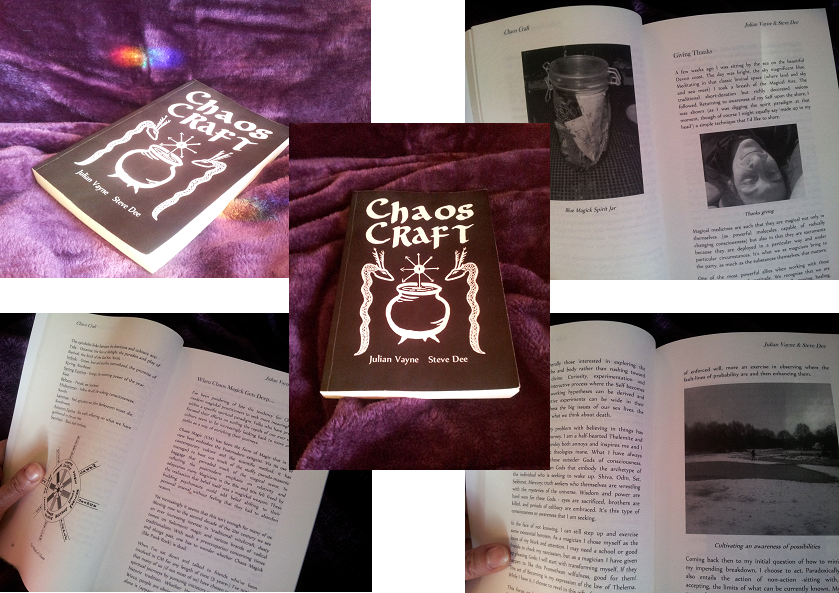
Book outside and inside picture

Comprising 257 pages with 69 b&w pictures, contained in a matt softback, the book provides a pleasurable way to access and browse some of your favourite writings.

Now available from your local Amazon website, for £12. Chaos Craft is also on Kindle, for £4.95.

Chaos Craft. The tradition of tomorrow, today.
Gnostic Musings – Part 3, When Archons become Aeons…

In part 2 of this series I was experiencing serious flashbacks to part of my day job as a family psychotherapist. In seeking to grapple with the dynamics at play within Gnostic cosmology it didn’t feel that dissimilar to the issues that arise in the therapy room. In one corner we have the Pleroma as the somewhat distant father figure, seemingly critical of his wayward son’s attempts in the other corner, to make his way in the multiverse (“Dad you just don’t understand! I just want to create and make stuff happen!”). In the middle of this conflict we have a somewhat care-worn Sophia trying to mediate between these two. It’s not easy being caught in the middle between numinous perfection you respect and a wayward but creative rebel you don’t want to lose.

Is there really only one way to find out…?

Like most families however, drawing in the perspectives of the wider system can bring new and interesting insights that provide balance and richness to stories that can easily get swamped with focusing on difficulty (a “problem saturated narrative”). In the case of Gnostic mythology, I was wondering whether the Aeons and Archons might help.

As intimated at the beginning of this series, Gnostic cosmologies are notoriously complicated and for much of the time it’s hard enough to know what’s going on, let alone what it might signify!  At the risk of over-simplification, Aeons tend to be viewed as extensions or hypostases of the Pleroma (and generally therefore viewed as the good guys) while the Archons are seen as having their origin from the realm of the Demiurge and connected to the “challenges” associated with the material realm. In some Gnostic schemas, those of us awakened to the divine spark within (the “Pneumatic”) must ascend through a number of layers or hierarchies associated with the Archons in order to reunite with the Pleroma. The methods employed on such a journey are manifold – magical passwords may be sought in order to level-up, and groups such as the Sethians seemed to have a complex system of baptisms used for opening up these realms.

For those of us with any connection to the wider Western magical tradition this will hopefully feel like familiar territory. With its heady reliance on Neo-Platonism, the Qabalistic tree of life and various systems of yogic psycho-physiology (Chakras any one?) most “Western” magicians will probably have a fairly ingrained sense that they should be either ascending or descending to something. While the use of such maps may be prone to the danger of getting stuck in taking either them or ourselves too seriously, they can provide helpful tools in seeking to avoid premature maturation.

While we could expend much energy debating whether enlightenment is a gradual or immediate experience of a non-dual nature, I’ll cut to the chase and let you know that it’s probably both 🙂 We may have glimpses of Samadhi or angelic epiphanies, but human nature usually dictates that we want to explore and “unpack” the significance of what such experiences might mean and how we should then live. This idea of a gradual unfolding also permeates psychological models such as Maslow’s “Hierarchy of Needs” and Erik Erikson’s “Stages of Psychosocial Development” as they grapple with the challenges we often need to meet in being alive.  Developmental research such as that done by Paul Gilbert (cf. The Compassionate Mind) also point towards the reality that our need to examine such complexity from a multiplicity of angles, is innately connected to the evolution of the human brain as it has sought to understand and prioritise the competing needs of human existence.

Our engagement with these different stages can take either an adversarial or integrative approach, depending on our chosen worldview. The archonic model can be helpful in that it provides us with a means for understanding the pervasive influence of “the spirits of the age” in perpetuating the dominant discourses of the cultures we are situated within. The Gnostics were often keen to resist these forces in that they were viewed as compounding the Demiurge’s imprisonment of human consciousness. Via the adoption of anarcho-magical strategies (including both asceticism and antinomianism) the Gnostic explorer actively sought to limit the impact of these forces so as to realise their true pneumatic nature.

Rulers can be useful

Rulers can be useful conceptual devices

While such an approach may be understandable from a more dualistic perspective, we may want to question its wisdom in relation to our psychological well-being.  If we view these challenges as being largely archonic and problematic, while a combative approach may provide an initial burst of anger fuelled resistance, we may rightly wonder about the sustainability of engaging in such conflict.

In this series of posts we have already touched on the way in which radical dualism was incorporated as one voice within the Corpus Hermeticum, and for myself  it is within the broader Hermetic and Western alchemical traditions that we find a potent synthesis of the integrative and adversarial positions.  Via the process of seeking to transform lead into gold, the practitioner works with resistance at both a macro and microcosmic level so as to bring change. Magicians are often those who choose to walk the treacherous path of transmuting those substances which others seek to avoid. The initiate’s vows of “Daring, Willing, Knowing and keeping Silent” challenge them to confront those obstacles within themselves formed by either genetic make-up or environmental conditioning. Arguably part of the ‘Great Work’ that we pursue in daring to “immanentize the eschaton” is the transformation of our Archons in order to make them Aeonic opportunities of becoming.

SD