There are certain perennial questions asked by people that are new to magic (and indeed any aspect of human endeavour) which basically boil down to variations of ‘where should I begin?’. This is a perfectly reasonable inquiry. Before plunging into anything new we like to know where we can find support (good books, reliable online sources, helpful organizations and peer networks), and what are the first steps (what practices to do). The issue of support, especially peer support, these days is perhaps easier than it was in ye olden dayz (i.e. before teh internetz). Even though there are undoubtedly a range of opinions (and of course some card-carrying crazy folks) online, the intelligent user (by checking sources and looking at how relationships are between a given person or group and the wider esoteric community) can usually sift the wheat from the chaff. However the problem of ‘where to begin’ is perhaps trickier now than it was in the past simply by dint of the vast range of ideas on offer.
When I started exploring magic there were perhaps hundreds of books available on the subject (back in the late 1970s). These had to be bought (in specialist shops or via mail order catalogues) or obtained through the slow process of inter-library loan. (I remember how excited I was, age 13, having requested The Key of Solomon on receiving the letter informing me that this grimoire was ready me to collect at local library.) While my access to esoteric texts was much easier that it would have been for my ancestors (especially for someone like myself from a working class background living in the provinces), I certainly wasn’t drowning in a sea of data. If I had a book that captured my interest I would read and re-read. If I wanted to try some occult practice it was a case of studying the few texts I had available and picking something from there. As a kid (when frankly I should have been out climbing trees and riding my bike) I worked through tattvic visualizations given in books on the magic of The Hermetic Order of the Golden Dawn. I did yoga by following the instruction of Lyn Marshall and my first try at candle magic was informed by the writing of Michael Howard (Peace Be Upon Him). I used what I had, it wasn’t much but it got me started.
As I reached my teenage years I began to save funds to buy the items of ritual paraphernalia I wanted. This was the early 1980s. I had read about Wiccan ritual and various ceremonial styles (as described by Crowley, and in texts such as The Flying Rolls and Seasonal Occult Rituals by W.B.Gray). This provided me a wishlist of stuff; athame, white handled knife, cords, pentacle, chalice… a whole collection that I imagined would be my essential magical tools. I obtained a ceremonial sword, of the classic Solomonic design, from Lois Bourne (spending a fortuitously uneventful afternoon wandering around the Hertfordshire town in which Lois lived with the weapon until my Dad came and picked me up in his car) along with a lovely heavy copper pentacle inscribed with the traditional Wiccan signs.
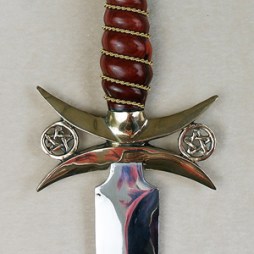
“First the Magic Sword…”
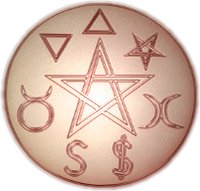
“Fifth the Pentacle…”
I bought my chalice from the fabulous Seldiy Bate and Nigel Bourne at a psychic fayre event. (Surrounded by white light and crystals, we three gathered in a corner full of witchy darkness and pungent resin-on-charcoal style incense.) I filled in more blanks on my occult paraphernalia shopping list; a wand courtesy of Dusty Miller and sundry items from the wonderful Occutique in Northampton. Then I was ready to obtain what I considered to be the most important ritual item (as someone strongly in tune with that Witchcraft style); my athame.
As the witches ‘magical weapon’ I knew that I needed something that was really awesome. Finally, after much searching of cutlers and the few occult shops who sold that sort of stuff, at a psychic festival in London, I came across the marvelous Elizabeth St. George. Elizabeth was a real radical, I guess in some ways a chaos magician before that term had even been coined. I recall visiting her home in London and noticing a bust of E.T. in her temple, ‘a wonderful spirit to work with, ideal for interplanetary magic’ she assured me. It was from Elizabeth that I purchased my athame. A cool looking knife with a dark Toledo steel blade, turned ash wood handle and lunar crescent guard.
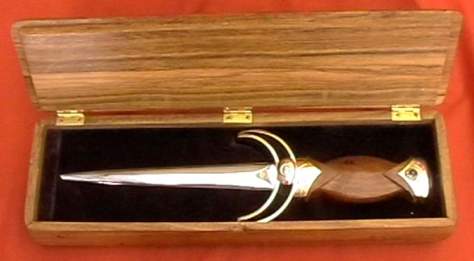
(My athame – a bit like this design only better).
I’d been rather discombobulated by my visit to Elizabeth’s home though. Sure I kinda got the idea of working magic with E.T. but there was more, ‘I don’t really cast a circle’ Elizabeth informed me. ‘I make the whole of this temple protected’. I guess it took me a while to realize that a ‘magic circle’ is an imaginal construct. Unlike if one were to draw a literal circle in a square room, casting a magic circle would not either leave the corners of the room unconsecrated or extend beyond the room to include part of the house next door.
There I was with this totes magic item, my athame, and I knew that before I used it, it would need consecration. I understood consecration to be a process of a) removing any previous vibes from the object so that it was ‘virgin’ and ready to be b) charged with magical power and dedicated to the Great Work. The banishing bit was easy. I recall (following the advice in one of those 1970s occult coffee table books) sticking the blade of the athame in the earth while the sun shone. I guess the sympathetic magic was something along the lines of ‘bright sunshine burns up any lingering ‘shadows’ in the object’. (The UV component of sunlight of course has the literal effect of bleaching and killing bacteria and this cleansing effect was commonly employed by our ancestors long before microscopy). I plunged the blade into a flower bed in the back garden of my family home, the sun beat down. I assumed the process was working.
The next stage was more complex and that’s where I hit a problem. I had various books providing rituals for consecrating objects – from The Key of Solomon through to Mastering Witchcraft. The difficulty was that I felt such an important, indeed central bit of the witches kit, needed a consecration process that was super powerful. The relatively simple rituals given in the books I had simply didn’t seem grand enough. Had I had access to the internet I would have been submerged in even more suggestions on how to accomplish this magical act. I had access to the instructions given in the Book of Shadows that had been published at that time (this was before Janet and Stewart Farrar released The Witches Way), yet nothing seemed quite impressive enough. I imagined a ritual that addressed my own cosmology, maybe including a few of my fave deities such as Thoth and Set, Cernunnos and Hecate and Baphomet. I felt such an important ceremony had to be outstanding and full to the brim with occult symbolism.
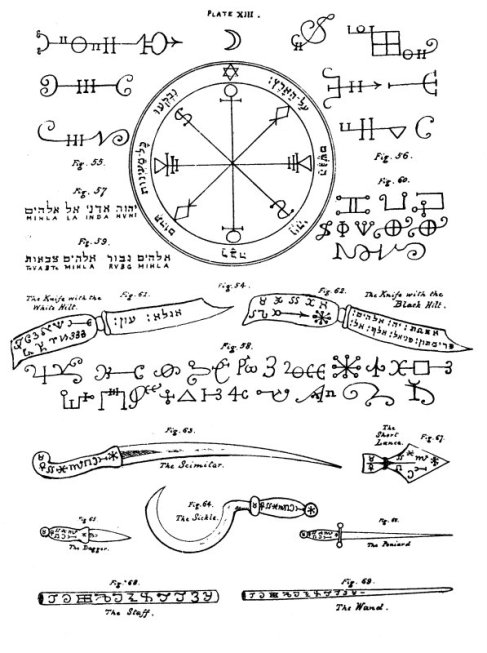
Cutlery lore
Having banished my athame with sunlight I wrapped it in silk (using an old scarf belonging to my Mum, on reflection probably made of nylon) and put it to one side. I carried on doing yoga and meditation and candle magic. I began to make forays into rune signs and sigils, I made myself (rather inexpertly) a robe. But my witches blade lay unused, shrouded in fabric, on my bedroom altar.
By the time I was 16 I was invited to join a coven. A remarkable event that saw the High Priestess of the group thoughtfully speaking with my parents in order to confirm that they knew what I was up to. I remember that first ritual in a large room in a house in north London; it was magical.
I also recall how the High Priestess of the coven asked if I had an athame. ‘Yes’ I replied, ‘though it’s not consecrated yet’. I handed her the knife.
‘Better get it done then!’ She proffered me the pentacle from the altar and placed the athame on it. Muttering some words about power and blessing the High Priestess sprinkled my knife with consecrated salt and water, she wafted incense over it, smoke curled round the pentacle and over the blade. She took an altar candle and waved this over the knife and beneath the pentacle. I could feel the warmth on my hands.
“There it’s done.’ She said, “ready to use!”
Later that evening I had the honour of performing the consecration of the wine with my now fully activated athame. I was told to keep the knife under my pillow for at least a month so it could soak up my vibes and we could bond. I was also told to ‘use it!’
I’d become stuck in that ‘where to begin?’ when it came to what I imagined to be the terribly important business of consecrating my athame. This ‘option anxiety’ led me to procrastinate. I was waiting to do the Work until I found what I thought would be the best (i.e. most super-power-majix – the ideal) way of consecrating this tool. By cutting the Gordian knot of my own confusion the High Priestess had released me from this self-imposed paralysis (and of course this was the powerful magical act I needed!).
Fast-forward thirty three years and I observe similar behaviours among occultists and psychonauts. While it’s sensible to solicit advice, and to consult the terabytes of esoteric data online, there is nothing like cutting through those Gordian knots and getting on with the Great Work – for that is where the magic is; in the act. That’s one of the reasons I rather like the chaos magical approach, where practice wins over theory, and doing is emphasized over being.
We may not have what we think of as the optimum conditions to practice. We may have all kinds of pressures, of time, of not feeling we know enough yet, of waiting until we can find a teacher, whatever. But to do magic we must ‘dare’, and though our first steps may falter we will at least have begun our journey.
As the Goddess Nike might say, ‘just do it!’ Or to quote from one of the idiomatic versions of ‘Nothing is True, Everything is Permitted’ that Nikki Wyrd and I collected for The Book of Baphomet ‘It’s all bullshit, just pick something!’
(As an epilogue to this story, when I consider the magic bling I purchased, I notice that the only thing I still regularly use is my incense burner. A lovely cast iron bowl with a figure of eight serpent coiled beneath it, head rearing up into the perfumed smoke. This item cost me a grand total of £2 from a junk shop in London and ironically has never been formally consecrated.)
JV



 The Blog of Baphomet