Playing with Queer Cut-ups

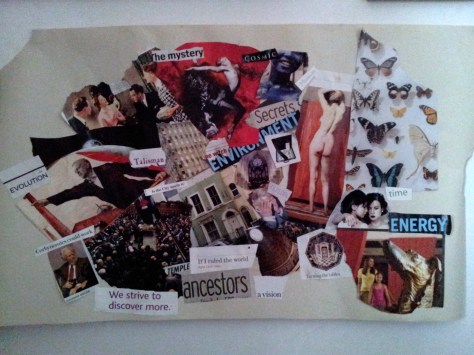
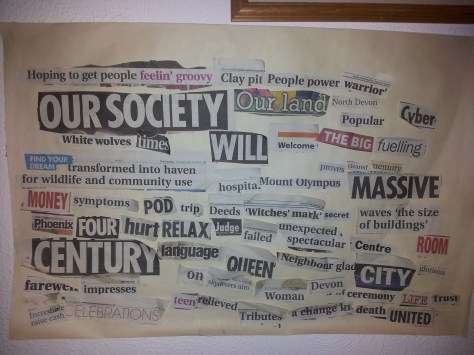
I’m sitting in Julian’s front room and I’m surrounded by a multitude of artefacts from past rituals and hours spent in meditation. While the wood burner and main altar space provide a natural centre piece, today my eyes are drawn to the array of cut-up collages that deck one of the walls. These are not elaborate or overly wrought attempts at occult art; rather they represent raw, psychic high-dives in order to explore fragments of self and the processes that unfold as we try to explore darker, stranger terrain.
2016-08-18 09.13.37.jpg

Cut-up

Having recently read and enjoyed Queer by Meg-John Barker and Julia Scheele, I started reflecting on the possible connections between how cut-ups and Queer dynamics might interact in our process of exploring Self. I have already written a post reflecting on how cut-ups might interact with aspects of ego psychology, but their book got me to wondering further about how cut-ups might represent a highly queered and magical form of expression. As I observed back then:

“Like collage, cut-ups seek to use existing material in new ways that often involve the combining and juxtaposition of words and images so as to create new insight and meaning.

In tracking the lineage of cut-ups as an approach, from the surrealism of the Dadaists, Brion Gysin, Burroughs and Genesis P-Orridge, we can begin to see the depth of magical thinking embedded in this technique. As we seek to engage with and manipulate reality, the cut-up not only embodies the desired efficacy of our sorcery, but also the fluid shape-shifters that our arte forces us, the magician, to become. If our magic has any real depth, then our ego must undergo a similar process of reassembly.”

Cut-ups for me are a potent means of challenging our attempts at fixed certainty and polarity. Ideas and images that we previously kept apart are cast together in potentially abrupt disruption. These cut-ups don’t allow for tidy answers or for a buttoned-up, linear sense of self, rather they represent a bubbling up from the unconscious that may reveal as much about the dynamic tensions at work as they do potential answers. Apparently unconnected images are juxtaposed with stark headline text and so new meanings and connections are made. To me this dynamic process feels potentially unsettling and hugely creative and thus quite Queer:

“Queer is by definition whatever is at odds with the normal, the legitimate, the dominant. There is nothing in particular to which it necessarily refers. It is an identity without an essence. ‘Queer’ then, demarcates not a positivity but a positionality vis-à-vis the normative.” David Halperin  Saint Foucault: Towards a Gay Hagiography

The Queer self is one that has a profound connection to the constructed and performed. As an outsider position it has had to survive by being magpie-like in pulling together those jewels and glimmering half-truths that help make sense of what it means to live with a greater sense of magic and power. Others may dismiss its rag-tag approach for its lack of coherence, but like the trickster or the holy fool it holds up a mirror to those parts of culture whose attempts at control appear all too reliant on dusty outdated certainties.

For me the playful complexity of Queer identity is one that disrupts my attempts at locating my sense of self in fixed descriptors and concrete identities. Any attempt to side-step curiosity and open-handed questioning is unlikely to withstand Queer’s rainbow-laser side-eye. This type of awareness asks that we acquire and develop skills that allow us to more effectively tolerate process, journey and uncertainty.
2016-08-07-00-30-32

Wild words

Similarly the process of the cut-up requires vulnerability as we step-back, allowing patterns and (potential) meanings to emerge. Techniques such as cut-ups and automatic writing/drawing are certainly more towards the artistic end of the “Art and Science” dialectic, but such creativity shouldn’t be mistaken for laxity. Ironically it often seems that as we seek to make use of approaches that are less linear and apparently chaotic, that we have to exercise a more focused sense of awareness in gaining benefit from them. It may be that those people who are drawn to more scripted workings do so because it provides them with a greater sense of security and control.

One of the primary reasons that I was drawn to the magical path was its sense of collaboration and play. World views and metaphysics that declared absolute certainty were no longer viable but I was still hungry to explore the mystery of consciousness and the glimpses of awakening that were coming in and out of view. Techniques like cut-ups and collage can provide us with potent and creative means for accessing new insights regarding the paths we are seeking to walk. They are rarely complete answers, more often they are snapshots of a work in progress that we may need to slow down and wait for, rather than rushing to a sensible, adult conclusion.

SD

Chaos Craft Reviewed

Reviewed by Charles Barrie

Before reading Chaos Craft, my general perception of contemporary Chaos Magic was as a highly creative and practical, often amusing, yet more or less shallow philosophy; largely lacking a living relationship with the evolving world, biological and spiritual.

Chaos Craft, however, through a collection of essays on life, spiritual practice and ritual craft, conveys a far different sense of the chaos approach to magic. The perspective offered – which is presented as a journey around the wheel of seasons and colours of magic (after Peter Carroll) – is rooted in traditional magic, practice and craft; and is both politically and ecologically aware.

image004

Wheel of Chaos

Key to the inclusiveness of this perspective is the eclectic magical and philosophical pedigree of its two authors, Julian Vayne and Steve Dee. Both are active practitioners and researchers, and have many years of experience in a number of initiatory traditions, including AMOOKOS, the IOT and Wicca. Together with Nikki Wyrd, the pair also run the excellent Blog of Baphomet. Furthermore, Dee, for whom Chaos Craft is his first book, brings the unique approach of being both a working psychotherapist and a former Anglican priest in training.

From this position of research, initiated practice, and hard won experience, Vayne and Dee discuss a wide range of vital magical topics through a broad range of disciplines: witchcraft, Lovecraft’s mythos, shamanism, Buddhist praxis, western mysticism, alchemy, tantra, Gnosticism, pop-magic (love the Nina Simone working), ecstatic practice and psychotherapy (Israel Regardie would be pleased). The content explores, among other things: meditation and mindfulness, cognitive liberty, initiation, ritual practice, group work, applied animism, sexuality, and the family life of a magician.

The essays draw from Blog of Baphomet highlights, with new pieces and contributions from the work of Vayne and Dee’s magical group ‘The Western Watchtower’. They are presented as a revolution around the axis of the neo-pagan Sabbat festivals, each interval of the year viewed through the lens of one of Peter Carroll’s eight colours of magic. I found this musing on how the quality of magic changes as the earth turns the book’s greatest gift, as it encouraged me to find my own magical calendar, lift my head from books and pay attention to the outside world again.

Rather than a listing of techniques and ‘how to’s’ (though it is certainly full of interesting tips), Chaos Craft instead elucidates a living magical worldview; traditional yet totally dynamic, reflective and on the edge of one’s own experience. Through the approach of this ‘mongrel’ (their term) Book of Shadows, the need to integrate one’s spiritual path into daily life is made clear, and the discussion on ‘Slow Chaos’ encourages us to relax into the spheres of the seasons and days and experience life more deeply.

Chaos Craft, through its presentation of the group work of The Western Watchtower and their egalitarian, anarchistic approach to leadership, also reinforces the importance of sangha, community and sharing on the magical path, even as an otherwise lone practitioner. Living a magical life in the modern world involves knowing how to follow your own directive, whilst also being able to interact, navigate, and collaborate with those around you. Further to this, in presenting the magic of Chaos Craft, the Authors feel no need to attack muggles, or overly focus on the distinction between their approach and that of any other, allowing the content a wide relevance.

The responsiveness and creativity of the Chaos Craft perspective on magic gave me a timely prompt to take the next step in my own practice, and begin to freely design rituals that worked for me within the context of the landscape and seasons, and my reactions to them. I view the book as a muse rather than a manual and it strengthened my confidence in the fact that I had the capacity to generate my own ritual, and draw from my experiences a personal symbolic reference palette, a language that I know the spirits hear and understand, due to the deep feeling that it just makes sense.

Crafty chaos star

Crafty chaos star

Chaos craft is a context, a worldview which allows us to be fully present to the world around us, gaze us into the future to manifest our chosen reality, while having the full force of our collective ancestry and the powers of all spheres of existence as our allies. It speaks of the rebirth of a natural magical culture.

Through taking a very personal approach, Vayne and Dee create an intimacy that seems a more apt vehicle for conveying magical knowledge than a dry tome full of tables and charts. Personal secrets are perhaps more valuable, more useful than increasingly abstracted secrets held in tradition.

In contrast to politics and posturing, Chaos Craft brings a sense of service back to magic, which is a key aspect of what inspired me to the path in the first place; service to the unfolding, living, deep Earth.

Demonstrating the living vibrant nature of chaos magic, witchcraft and tantra, the book rests in balance between a traditionalist approach, an honoring of initiation and empowerment and the postmodern chaos understanding of magical technology and the power of paradigms. Bringing a chaos approach to traditional crafts supports an understanding of their underlying tech, allowing for colloquialisms; individual and shared dialects of practice stemming from timeless roots.

The book invites us to create our own magical form, one that is contingent with our traditions (of which it is but the latest iteration), and with the living magical landscape. A form that is thus able to draw power from the deep evolutionary process that has brought it into being. Such living traditions are able to evolve with time, connecting past and future; distinct and independent, yet forming a continuity with the living powers from which they spring.

I would recommend this book to anyone who is looking to find a more natural approach to magic, and those who are wishing to deepen their understanding of the connection between their practice and the greater cosmos of which they are a vital part.

Chaos Craft is now available on Amazon as well as direct from us.

Charles Barrie has explored his own magical context through a number of Western magic, masonic and yogic traditions. He currently works in conservation, community development and environmental education, and tries to live his magic in daily life through an active relationship with the Pandaemonic All and service to both earth and community. He also plays bass guitar for New Zealand band Bella Cajon, who can be found at www.bellacajon.com

Golden magick

Chaos gold

(Meanwhile more shameless self promotion proudly presents…)

Nikki Wyrd will be leading a workshop entitled Baphomet 101 at The Ecology, Cosmos and Consciousness Salon‘s event Neuro-Magica: Weaving Ecology, Cosmos & Consciousness: A three-day retreat exploring the liminal space bridging science and magic, from Thursday (evening) 8th – Sunday (evening) 11th September. This retreat has sold out! Keep an eye open for future exciting events on the ECC facebook page HERE.

On the 5th of November Julian Vayne will be leading a workshop at Treadwells, London on Altered States of Magic, details HERE and then a few days later on November 8th will be addressing the University of Kent Psychedelic Society on Psychedelics and Magic see Facebook and HERE.