Adventures in Zen Odinism…

I don’t know about you but I own far too much occult tat – “magical bling” a working partner calls it (and he’s as guilty as I am) – too many misspent years working within the Thelemic/Chaos paradigms- “so many gods, too little time!” Frankly sometimes it’s good to strip it right down to basics and ask what all this effort and attention is really for. We need the Magic of the Void.

I’ve recently been re-reading the excellent Apophis by Michael Kelly. In Apophis, Kelly maps out a magical working that is both stark and striking. Built upon his work and past leadership of the Temple of Set’s Order of Leviathan he challenges us to question how we will really work when faced with the yawning potentiality of primal chaos (Apep). When the eye of the dragon is staring you down, is your pseudo-masonic choreography going to meet the mark? Via the working of the Void I think that Michael is highlighting something of critical importance both in terms of the true nature of magic, and how we as practitioners withstand its rigors. The contemporary occult scene seems rather strong on its espoused aim of “To Dare and To Will”, but is arguably rather weak in the “To Know and to keep Silent” department.

This working and the minimalist aesthetic that it embodies resonated deeply with my own struggle to stay on the path. In my 15 year journey as a magical practitioner I have sought to maintain a silent mindfulness-based practice at the heart my endeavours as a means of both keeping balance and seeking gnosis of a deeper nature. What follows are some reflections on an example of how such technologies can be utilized in seeking the Great Work.

Working in a Zen Hearth

One of the ways I have sought to bring together my own desire for both a profound stillness and the transformative path of magic has been via my involvement in the hearth of Odin the Wanderer.

The small number of us who meet to celebrate the turning of the year are moved at a profound level by the weightiness of the Northern aesthetic – its emphasis on honour, its sparseness and sense of stoicism – the Gods, Goddesses and Wights that we honour and follow are clearly within the Northern Mythos since as we meet on the land this makes sense at a primal level. Now this is all sounding fairly normal for anyone who has been to a blot or a hearth before, but what one might be struck by is that we don’t say a lot! We spend most of our time sitting down and we also (gasp) spend some of our time laughing.

Zen lolcat demonstrates the Art of Sitting

Zen lolcat demonstrates the Art of Sitting

As to the ‘how’, we deem what we are doing as being Zen related. Zen is the Japanese translation of Chan which in turn is the Chinese translation of the Sanskrit Dhyana i.e. meditation. Meditation can mean many things but I think the ideas of mindfulness, awareness, wakefulness and quiet receptivity are at the heart of the experience I am pointing to. In practice this means that after acknowledging the elements and directions and welcoming the Gods, Goddesses and Wights, we spend most of our time listening both to the inner stirrings of ourselves and to the spirit of place. For us this echoes the ancient practice of “uta seti” or sitting out when the wisdom of the ancestors and spirits of place were sought. As the practitioner seeks to rest their attention with the physical sensation of the breath, a spaciousness of consciousness is possible – a personal ginungagap where the stirrings of new realities can be sensed.

In Havamal 138 Odin speaks of “giving Self to Self” during his seeking of Runa on the World Tree. Similarly for the Northern mystic seeking to utilize mindfulness techniques there can be the creation of a space where outdated “certainties” can be shed so that remanifestation can occur. For those seeking the hero’s path this does not mean the abandonment of Self, rather it opens up new vistas of potential becoming.

I know that I hung on a windy tree
nine long nights,
wounded with a spear,
dedicated to Odin,
myself to myself,
on that tree of which no man knows
from where its roots run.
No bread did they give me nor drink from a horn,
Downwards I peered;
I took up the runes, screaming I took them,
Then I fell back from there.

SD
Out Demons! Out!

I was reading the excellent blog by Taylor Ellwood which carries a great article ‘Why I’m out of the Broom Closet. Like Taylor I’m someone who is fairly ‘out’ (at least in terms of my involvement in occultism 🙂 ) to both family, friends and work colleagues and I’m really pleased I’m able to do this. There have been slightly nerve wracking moments in my past, such as when the boss says ‘I put your name into Google…’ but luckily I’ve never been subject to any direct prejudice for being a Pagan, dabbling with the dark forces, or even my views on the use of drugs. Obviously others are not so lucky. People can and do lose their jobs over being occultists, though it’s now many years since the famed Gerald Suster vs The News of The World case. In Britain our employment and other laws should, in theory, preclude prejudice in the workplace but for those of us who choose to stick our necks out there’s always some risk. Sure we can talk about ‘keeping silence’ as being one of the powers of the magician but I reckon that this injunction is probably more about the importance of not-acting and mindfulness in ones practice than it is about not letting on about your spiritual path.

There are obvious dangers to going public, but I feel that it’s important for those who are able to, to take these risks. Changes in legislation concerning male homosexuality, for instance, would never have come about were it not for those brave souls who admitted to ‘the love that dare not speak its name’. So even in situations where dominant culture and the law says one thing (eg ‘drugs are bad’ or ‘women cannot vote’) it’s important to stand-up and be counted, to put other opinions forward and make our demands. Part of the Great Work of magick is the transformation of the universe around us. This can be imagined in lots of different ways; the re-enchantment of the world, conjuring for the sustainable integration of technology and biology, the immanentization of the eschaton or whatever. But for a social species like us humans it must also mean the transformation of public opinion. Coming out is one tactic in this social transformation and I salute those people who are ready, able and willing to embrace that process.

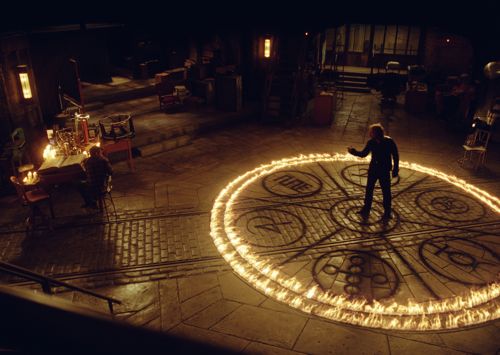
I sometimes think that for occultists our obsession with secrecy (hey it’s ‘the occult’ after all) does us a disservice. Making us feel weirder than we actually are. As an example many years ago I approached the priest of the local Unitarian Church in Brighton where I was living at the time, to see if it would be possible to use their space for our chaos magick group to meet. I explained to the priest that we were ‘an ecumenical group of friends exploring spirituality together’ which I figured would make sense to her, and was of course, quite true. However even allowing for the liberal stance of the Unitarians in that most liberal of British cities I was taken aback later in our discussion. Showing me the room that she proposed we hire she enquired, ‘will you be drawing and circles or sigils on the floor?’ I made some non-committal noises but she rapidly followed it up by saying ‘…it’s just that there is a mop, bucket and broom in the cupboard in case you need to clean up afterwards’. The fact that we were chaos magicians was, at least for this priest, no big deal. And
for me the fact that the priest was a woman was something I hardly noticed as unusual (except as a Wiccan I think priestess sounds better). That incident was almost 20 years ago and increasingly I’ve seen chaos magick, shamanic and other groups being able to be much more open about who they are when booking venues. And of course the Pagan community as a whole has made great strides in terms of social recognition and integration.

sigils on the floor

sigils on the floor

How else do we change public opinion? Well in the words of Bill & Ted we can ‘be excellent to each other’. Each time we used the Unitarian building we’d make sure we left the room not only tidier than when we found it but we’d usually leave the flowers from our altar too. I like to imagine the conversation the next day; “those black magicians are sweet really.  Everything is spotless after they’ve used the room, and look at these lovely roses they’ve left us!’ Creating allies, as every
shaman knows, is a powerful magick.

On the downside of being open – becoming a scapegoat, especially in times of social stress, is a real possibility. And it’s fair to say that members of minority religions and folk with left-field beliefs are frequently the targets of the proverbial angry mob. It’s also true that in these days of Google and Facebook Timeline discovering who thinks what, and where they live, is dead easy. Stirring up serious trouble may be only a few mouse clicks away. But standing up for ourselves is important not just in terms of our own project, but because it gives us insight into the position of others who are scapegoated. Perhaps if we admit our own beliefs and acknowledge our inherent vulnerability, we’re also more likely to oppose the scapegoating of others.  I’m reminded of an interview I heard recently with activist Peter Tatchell in which he said that lesbian and gay liberation was about more than just equal rights for homosexuals. It was about working to create a tolerant, open and free culture in which a range of sexualities and identities could flourish. Like Buddha says, liberation isn’t really liberation unless it’s liberation for all. And that’s the world that I’m enchanting for too.

JV