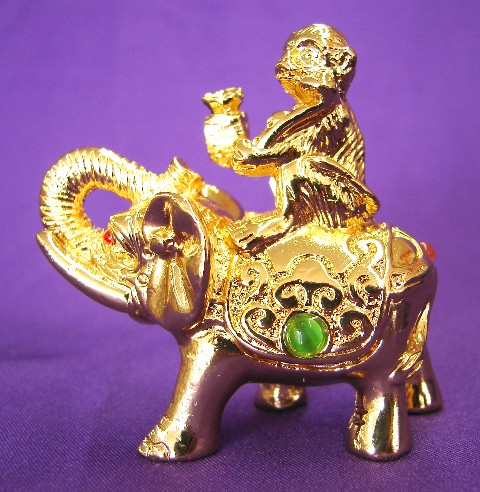
For a few years now, some people I know have been using the model of the chattering monkey mind riding on the momentous elephant body as our metaphor of Self. Together, they stand for aspects of the human entity, as described by us with our categories of meaning.
Language provides the handles we use to manipulate the world around us within our brains. In order to do this, it copies the physical world; all One, yet we act as if the parts have separate forms, rather than temporary waves on a sea of informational quantum foam. Words take our place & time referenced views of what we call events and objects, and put handles upon these ‘things’ so we have a practical system of restricted focus.
Huxley’s image of the senses as doors of perception, filtering and focussing an otherwise overwhelming tirade of mostly irrelevant impression, rings true to me. Words then, as many present day linguists like Steven Pinker would hold, follow from the physicality of our sensory perceptual apparatus and describe the world in a similarly filtered way.
Descartes, as he lay dreaming of numbers in his sickbed every morning, had to have Thought to fall back on to justify his existence. He faced a physical life of weakness and pain, yet he knew he thought like a genius; for him, body and mind followed Cartesian co-ordinates and had positive & negative values.
Freud, examining some very disturbed people (including many deeply deranged by syphilis), found unintegrated psyches full of unshared communications, repressed desires, and likewise used the dualistic model of the Ancients to split our ‘mind’ in half.
Jane Austen called her novel Sense and Sensibility, to reflect the intellectual and emotional takes on life of her two heroines, who by the end of the book have understood the value of learning from the other’s counsel.
Today we read about our left and right hemispheres, or the higher and lower centres of the brain.
As bilaterally symmetrical lifeforms, this seems a reasonable approach to take. My personal division rests on verbal and non-verbal types of awareness and thinking.
Monkeys make a lot of noise. In stories and myths, they have curiosity almost as ‘satiable as the elephant’s child, and the attention span of a flea. Monkey see, monkey do. Monkeys learn fast, move with incredible agility and graceful strength, and make travelling through the trees look effortless. Renowned all over the planet for their intelligence, they often play the role of Trickster, with the usual happy accidents that result from this character’s challenging attitude. Monkeys look like us, but with less internalised processing. According to the historical models, that is. Current research seems to indicate that in fact they have far greater preplanning and abstract manipulation powers than we gave them credit for.
We can leave reality aside for now however, here we are dealing in mythological animal figures.
Monkeys, then, mischievous, vocal, clever, supply a convenient shorthand figure for our internal narrative process.
Like people through the millennia I choose to use an alive creature as my metaphor label, because as a human animal I have a vast part of my brain wired up to understand social interactions between individuals in a group. My ancestors all know exactly how to divide a piece of food to share between six people, of various ages/sizes/deserving qualities etc. That kind of mathematics has great importance, more so than giving the answer of 1/6 each.
Elephants in stories have enormous weight to their presence. Their physical size makes them wonderful emblems for the perspective of me seeing myself as a physical object in spacetime. Elephants move slowly, remember embodied knowledge for their entire lives, move purposefully, communicate without making sounds (although again inconveniently for our little tale here, current research has revealed their low tones which rumble through the ground for miles). Elephants manipulate peanuts and tree trunks with ease, dexterous and muscular, just like our own species. Kind to their young and their extended family, playful or wrathful at times, they possess a centeredness we often strive to emulate.
So the old myth of mind & body, maps fairly neatly onto monkey and elephant. This metaphor gives the original objective words some characters, and now we can start to work and play with this illusion of a divided self, to see if some form of healing resolution might exist.
Monkey mind states of consciousness have suited society’s needs in the place & time I have lived through. Quick learning of ideations play increasingly important roles in determining who we describe ourselves as, our niche in the noosphere (realm of thought). Monkey mind has a massively inflated sense of importance, a big ego. We ‘are’ our stories, our internal narrative content. To live without a memory of the past or an imagined future, these ways of living look like a type of death to our eyes. I think, therefore I am.
Elephant body knows different. That automatic pilot we set in motion when we start from our homes to visit the shops, that’s elephant. Walking, swimming, standing. Not knowing where our keys are yet going straight to their location and picking them up, is elephant. Finding ourselves moving towards the phone then remembering we need to speak to someone, elephant. Writing, shifting furniture, cooking; once learned, elephant does these actions while monkey supplies a helpful commentary…
Wait though; these ways of experiencing the world don’t fit neatly into isolated boxes. Monkey and elephant move together, think together, informing each other constantly about their versions of reality. Monkey, sitting up on elephant’s back, likes to pretend to have control. Often we justify an act subsequent to carrying it out, and our narrative (some call it consciousness) explains how it meant for our body to do that, even when it clearly had no knowledge beforehand.
I’ve been helping the elephant part of me find its voice, and simultaneously letting the monkey rest, put down its burden of fallacious control. Partly this has emerged from a long period of imperfect physical functionality ( a damaged inner ear/vestibular system), when for some weeks it was all I could do to recall the day of the week, and standing up without swaying simply couldn’t happen. Enforced spiritual retreat, in the comfort of my own home. I didn’t enjoy it. Being In the Moment has appeal until you have no way out for several weeks at a time.
I learnt from this time though. I inhabited my body with great care and attention to detail. Elephant needed to tell monkey how to steer it again, they had to relearn the whole process of co-ordinating the arms legs head body machine they comprised between them.
Elephant spoke of the urges she had to enjoy existence once more; sights of nature, comfortable fluffy clothes, beautiful scents, full relaxation in a safe place. Monkey listened, and in a flash knew what to point elephant’s feet and hands towards. Together we started along a road to recovery, of a new way of inhabiting the shared skin which seems to define the boundary of this organism of I.
Prior to this, I had spent years practising the technique I now realise is called mindfulness. I had used the basic asana, pranayama, and no-thought exercises of Liber MMM for twenty years, and out of this the mindfulness organically arose long before anyone told me that particular name. Without this practice I feel sure the sudden switch of attention to the pure physical moment for prolonged periods would have proved a harrowing lesson.
This quietening of the monkey chatter forms a basic component of many meditation practices. Various techniques supply the result of allowing an observer perspective on the seemingly constant state of story we tell ourselves. Me as monkey knew how to stop. Listening to elephant took something else though; NLP exercises, some of which derive from esoteric practices, especially the way Ramsey Dukes explained to us at a talk once, where you practice listening to your body and the sensations of kinaesthetic awareness it communicates in. Hello legs, how are you today? You feel heavy, oh, if I shift the body weight like this do you feel happier? Ok. Back, do you have any message? You want the shoulders to stop tensing up, and the core abdomen muscles to help support the torso? Ok, message passed on. Etc.
You know that sense you get when leaving the house, that urge to return, which later resolves itself into Oh no I have forgotten my… [insert vital object]. Or the restless sensation one sometimes has when a task needs doing. Those come from elephant.
Monkey listens to these, hears them for a moment; the trick happens when it listens and reflects, evaluates the complete path of the physical urge. Preventing elephant from merely indulging every momentary whim, monkey guides the vessel in ways that make sense to the narrative, in keeping with the character of the person they comprise, and hopefully conducive to the continued presence of that person in the universe!
Integrating the two approaches to the environment, one rational & linear, the other instinctive and interwoven across spacetime, provides a holistic persona, much as the Scythians were renown for appearing to exist as man/horse combinations (in myth, centaurs) they acted so intimately together. In other places and times it might prove necessary to excite the monkey narrative faculty, however for those of us brought up in a predominantly linguistic intellectual setting, the opposite approach has much to recommend.
Shutting up now…
NW