After a recent Litha celebration in a roundhouse in the woods, drawn away from the post-ritual socialising, I found myself once more scrabbling up a muddy hillside in rain-soaked twilight in search of fairies.
Fairies. Me. Indeed.
A magicurious friend of mine has some difficulty coping with my earnest references to fairies. After all, am I not (for want of an adequate description) a chaos magician, incredulous of creeds, piratical of paradigms and sceptical of systems occult and otherwise? When this friend asked me to explain about the fairies thing, I told her something like “In certain circumstances (like scrabbling up a muddy hillside in rain-soaked twilight) I have certain experiences for which my culture has no ready words. Checking around, I’ve found that people like pagans and magicians have words that most closely correspond to my experiences. I translate the experiences into such words and the these people seem to understand, judging from their responses, which sometimes include remarks not prompted by me but which I recognise as a similar sort of experience to what I was describing. So I’m stuck with talking in terms of fairies.”
You feel sorry for my friend, yeah?
Now where was I? Oh yes, chasing fairies up a muddy hillside. The rain is pattering gently on the leaves of the old trees around me, the tea lights and bonfire of the roundhouse are glimmering in the dusk at a surprising distance, and I’m getting a light dressing of mud. Above me there’s a ridge beyond which I seem to sense the fairies sniggering at me. We’ve played this game before. They don’t seem satisfied until I’ve fallen on my arse in the mud or slipped off a stepping stone and stuck a foot in the stream. In the middle of the woods, in the middle of the night, I feel drawn away from whatever else is going on and I absolutely must wander off, sometimes getting lost among the trees with my feeble torchlight revealing no more than an undistinguished mass of greenery in any direction.
What the hell am I doing here? This is the question that drew me into and out of religion, through philosophy and into magic. The whole quest of the Kite has been some variation on “What is really going on here and how do I know?” Now often, when people ask ‘how do you know what you know?’ they seem to be looking for certainty, but I learned long ago that certainty is an invented criterion that we don’t really need in order to function well. I need no certainty about the nature of fairies to have this experience of getting muddy, sweaty and lost in the woods. And freed from the ‘certainty’ dogma, I can get on with knowing what’s going on and relaxing about what I don’t know. Which is most things, actually. So it’s just as well that I can be relaxed about not knowing them.
I don’t know how to get back off this hillside. I imagine the fairies rolling around, holding their sides laughing. They’ve done it to me again. What to do? What I did in the first place, when I felt drawn out of the roundhouse and away from my lovely pagan friends. I looked around and saw the trees and … the spaces between the trees.
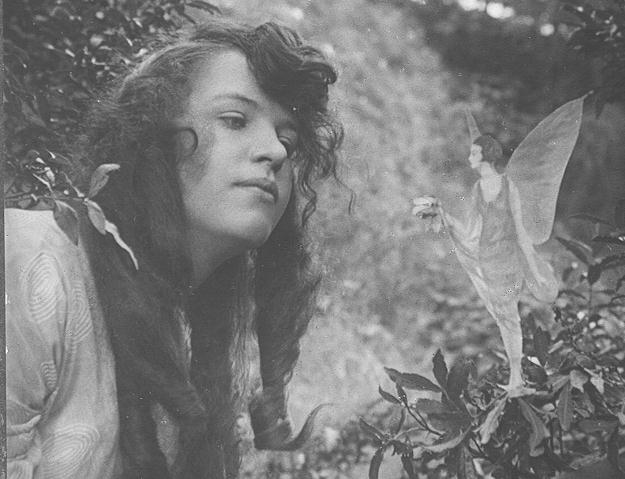
Fairies! Wow!
It’s the spaces between. Near the roundhouse there’s a little grove, a stand of comparative saplings, and to me it’s a power spot. I stand with the trees and the world goes still, as though it’s just gone “TA-DAA!” and spread its wooded arms wide to reveal to me the miracle. The grove waits expectantly for me to see and go “Wow!” And of course I do. And the grove still waits, silent, expectant, as though I’ve only begun to see what it’s revealing to me. So I stand very still so as not to distract myself, and I simply pay attention to what is really going on. The rain patters, the dusk deepens, an occasional bit of birdsong, chatter from the roundhouse, and as my vision goes to peripheral, the feeling of the spaces between. I’d like to say that total silence descends, but this is me, right? Talking. But even the interior monologue becomes unimportant as the grove’s Great Presence permeates my awareness.
As my awareness grows wider, I begin to feel other Great Presence, glimpsed up the hillside. More trees and spaces between, and I feel my attention drawn in a particular direction, as though I’m being invited. So of course I make my way up the hill, crossing little rivulets, taking fences, struggling up the slope to space after space, stopping frequently and Paying Attention. No more than that; paying attention. When the monologue recovers, I move on. As usual, I feel eyes on me from atop the ridge.
Again, the story of my life. Moving from one great place to another, seeking and finding fresh insight each time, but drawn onward by some sort of vaguely intuited invitation which I call Fuck Knows What, numerologically rendered into my magical name as ‘625.’ So Fuck Knows What is going on here, and Fuck Knows What is inviting me to Stop & Pay Attention. So you see, I know what the fairies are. Fuck Knows What the fairies are.
At last, I’m on the ridge. And wouldn’t you know it: it’s a footpath with a view to both sides of the ridge. I Stop & Pay Attention. I can’t readily describe what my attention consists of at this point: you’ll have to do this yourself. But it’s something around a sense of belonging there. We are not put onto this earth, we’re grown from it like apples from an apple tree, and right now in the dark and the rain and the wooded ridge and the little groves and glades I am no visitor but relaxing into my natural place. Fuck Knows What is happening and I’m doing it right here, right now.
After a while I feel that the fairies have taught me all they’re going to tonight. I spot the warm lights of the roundhouse down among the trees and head back down. It turns out that the fairies have one more lesson for me: wear non-slip boots next time. Bastards. Still, the entertainment I apparently afford them is small price to pay for what I’ve received this Midsummer Night.
Kaitŵm.625 – The Kite