Strange Revelations

I was recently sitting around a table drinking tea with some fellow magicians (a favourite pastime of mine!) discussing those films and works of fiction that have wriggled their way into our personal magical systems. I guess Chaos magicians are renowned for this sort of approach-taking inspiration from contemporary cultural references and valuing them as valid channels for pursuing personal and collective gnosis. In a fantastic version of geek cage fighting we traded off verbatim quotations from David Lynch’s Dune script and wondered how we could use sleeping bags to act as the giant sand worms of Arakis.

Recent mention has been made at this blog about folks working with the Cthulhu mythos and the way in which Lovercraft’s imagery allows a vivid exploration of the existential angst and alienation that many of us experience. Having done a bit of work with “the Mythos” I must confess that it’s really not my thing. As much as I like HPL’s writing and the bizarre cosmology he envisaged, I don’t find myself rushing to spend time hanging out in his universe. Perhaps because I spend most of my working life wrestling with psychic pain and descents into “madness” I prefer to spend my leisure time avoiding cosmic terror! It may just be that my middle-class aesthetics lean more to facing the universe on a Zen cushion rather than having my soul sucked out by the tentacled one.

This idea that our spirituality is innately shaped by contemporary cultural references is hardly surprising. When I think about my own timeline, it’s hard to get past the tsunami sized impact of both punk rock and Star Wars. 1977 you rock! Joseph Campbell via George Lucas has allowed the hero’s journey to become one of the primary metaphors for 21st century psychological development. The battling dualism of the Force seems to make more sense of our attempts at psychological integration than idealised monotheisms. Some of us may harbour more Sith-like passions than the straight-laced Jedi (bunch of goody-goodies!), but most of us are still seeking to bring balance to the Force.
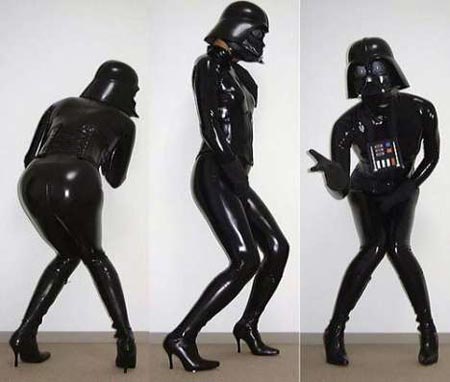
Sith like passions

Some Sith-like passions

Revelation rarely sits still. I’ve recently been having a fairly thorough pummelling via the work of Octavia Butler. For those not in the know, Butler was an awesome sci-fi writer who as a Black Woman brought a vital voice to the genre. Through her work sought to address themes around race, gender and community. Whether via polyamorous alien/human interbreeding (Lilith’s Brood) or a necessary shot in the arm for the Vampire novel (the Fledgling) she brought new perspectives and raised crucial questions in the minds of her readers.  The series that’s currently blowing me away is the “EarthSeed” duology . In these books Octavia depicts a young woman’s battle to find meaning in a dystopian landscape in which the outdated faith of her parents has ceased to make sense. “The Parable of the Sower” and “The Parable of the Talents” describe her experience of receiving the revelation of “EarthSeed”, a new theology that sees God as a chaotic process of change that the awakened can shape via their intent. Each chapter of the books begin with quotations from “Earth Seed” and what follows are a couple of quotations to give you a flavour:

Consider: Whether you’re a human being, an insect, a microbe, or a stone, this verse is true.

All that you touch
You Change.

All that you Change
Changes you.

The only lasting truth
Is Change.

God
Is Change.

Parable of the Sower, Octavia E. Butler)

God is Power-

Infinite,

Irresistible,

Inexorable,

Indifferent.

And yet, God is pliable-

Trickster/

Teacher,

Chaos,

Clay,

God exists to be shaped.

God is Change.

(Parable of the Sower, Octavia E. Butler)

The divine word or Logos need not be limited to ”sacred” texts-whether they be the Bhagavad Gita, Liber AL or Principia Discordia. We will probably all have books, music, films and people within which we find a rich source of inspiration, but the Mystery may even burst through during the X-Factor or a Murdoch tabloid. Nothing is inerrant and Everything is useable!

The incoming of gnosis can come in many forms-whether via conscious spiritual endeavour or the over-heard snatches of a stranger’s conversation, when the lights come on and revelation ignites in our skulls we find ourselves back at that crossroads of the present moment. For that conversation with our muse to flow we need to find a way forward. We don’t always get it right, but the internal pull of Will drags us onwards. May we all be brave enough to keep listening.

I must not fear. Fear is the mind-killer. Fear is the little-death that brings total obliteration. I will face my fear. I will permit it to pass over me and through me. And when it has gone past I will turn the inner eye to see its path. Where the fear has gone there will be nothing. Only I will remain.

Bene Gesserit Litany Against Fear.

SD

The Chapel of the Ancient Dead

Autumn Equinox, 2006.  A local Druid decides to energise greater awareness of ancient burial sites and the rights of those interred, with a vigil at Paviland Cave, site of the earliest known deliberate human burial in Britain, conveniently a few miles down the road.  A group of us volunteer to establish a base camp nearby while the Druid keeps vigil in the cliffside cave, which is accessible by land for two hours only, twice a day.

Paviland from outside

Paviland from outside

About this poem.  It is a straight factual account.  The one anachronism, the proto-Indo-European expression Wekwom teksos widtorm spel, is a well-attested bardic formula meaning ‘the maker of words tells the story,’ and I use it only to give a flavour of solidarity with that millennia-old oral tradition.  Every year at this time I revisit this poem, and I hope you get as much from it as I have over the years.

So, join us at a campsite on a wet September evening.  A small tent with four magicians sat inside, gathered around a little altar on which stands, among other things, a replica of the Venus of Willendorf.  Frankincense spices the atmosphere, previous rites have put the magicians into a magical state, and the Kite drums softly and begins to chant the poem, leading the others…

Here we gather, in the gloom, our little space like to the cave
wherein the Druid fasts and prays, Paviland, the Goat’s Hole cave
wherein the Druid fasts and prays for restoration, seeking balance. 

As we approach the Equinox, the seasons give a quarter turn,
the nights are getting longer now, the Indian summer turning cool
but in the cave so cold and dark, still the Druid keeps his watch.

Wekwom teksos widtorm spel.  I, the weaver of the words,
tell the ancient history.  I, the bard, recount the story
of the land and of its people, of the cave, the sacred site.

Five hundred million years ago the land around was undersea,
an ocean bed that teemed with life which had not ventured yet on land.
For millions and yet millions more the land around was undersea.

The ocean bed that teemed with life also took into itself
the dead who swam the ancient sea, who in time could swim no more
and their remains became the rock that lay beneath the ancient sea.

Once again and once again the oceans closed around the land
as the land submerged itself and washed itself in ancient seas
taking to itself the dead, who in time could swim no more.

 Every time it sank below, so again it rose above,
giving up its ancient dead, who at last became the land
the land which then became a home to their descendants in their turn.

And so in time a cave was formed, a fold within the ocean bed,
lifted up to face the sky, sculpted by the wind and rain,
sanctuary from the cold, a chapel of the ancient dead.

Wekwom teksos widtorm spel.  I, the weaver of the words,
tell the ancient history.  I, the bard, recount the story
of the land and of its people, of the cave, the sacred site
wherein the Druid keeps his watch.  There the Druid keeps his watch. 

Thirty thousand years ago, in spells between the Ice Age cold,
humans sheltered in the cave, sanctuary from the cold,
chapel of the ancient dead, descendants in their turn.

They hunted mammoth and the deer right across the ancient plain
fought it out with bear and rhino, fished for salmon in the river,
in the distant river Severn, right across the ancient plain.

To the cave they brought their winnings, worked the skins with tools of stone,
sinew, needles made of bone. They ate the flesh and left the rest,
bones which joined their forbears in the chapel of the ancient dead.

To the limestone cave they brought the stones that they themselves preferred,
in time they laid inside the cave thousands upon thousands more,
laid them in the hall of stone, the chapel of the ancient dead.

Six and twenty thousand years ago, between the Ice Age cold,
humans sheltered in the cave, one of them alive no more,
brought inside by those who cared, as they consigned him to the earth.

He was young, his early twenties, European, tall and thin,
eaten salmon from the river, hunted mammoth and the deer
right across this ancient plain, ate their flesh and wore their skins.

They dug his grave and laid him out, laid two stones at head and feet,
on his chest a set of bracelets, at his side a bag of shells,
and so he took into himself remains of those who lived no more.

They anointed him with ochre, haematite, the earth’s blood stone,
as they did with figurines of Woman buried in the earth,
from east to west of Europe six and twenty thousand years ago.

Finally they laid upon him precious bone and ivory,
said farewell and filled the grave, placed nearby a mammoth skull,
left him in the hall of stone, the chapel of the ancient dead.

Wekwom teksos widtorm spel.  I, the weaver of the words,
tell the ancient history.  I, the bard, recount the story
of the land and of its people, of the cave, the sacred site
wherein the Druid keeps his watch.  There the Druid keeps his watch. 

For several thousand years again, people visited the cave,
left behind their artefacts, works of art in ivory
and bone, which joined their forbears in the chapel of the ancient dead.

Twenty thousand years ago the Ice returned and froze the land.
No more mammoth, no more deer, no more salmon in the river,
Humans followed where they led, sanctuary from the cold.

As the Ice at length departed so the sea rose up instead,
sculpting rock, shifting stones, digging up the ancient dead.
The cave became a home to their descendants in their turn.

Nigh on two hundred years ago, humans visited the cave,
found the bones, found the horns, found the body’s open grave
and in the name of higher learning took what they could find of it.

They were not like ones who cared, coming to the hall of stone.
Without a thought they took the man, laid among the ancient dead,
took him as their property, dealt with him as they saw fit.

What they took they kept but some, threw away the ancient dead,
stole away the mammoth skull, robbed the sanctuary
of the chapel of the ancient dead. 

Wekwom teksos widtorm spel.  I, the weaver of the words,
tell the ancient history.  I, the bard, recount the story
of the land and of its people, of the cave, the sacred site.

Here we gather, in the gloom, our little space like to the cave
wherein the Druid fasts and prays for restoration, seeking balance,
where the Druid keeps his watch.  There the Druid keeps his watch. 

 entrance from inside

entrance from inside

The Kite