
I have a confession to make. I own an electric toothbrush…
[Actually, that is not in itself the substance of my confession, although in my youth I would have considered an electric toothbrush to be a ponceypiece of nonsense. But about 10 years ago a dentist persuaded me to get one, and it has reduced my dentist bills significantly, despite the processes of ageing.]
…My electric toothbrush is a sophisticated model that encourages you to brush for two whole boring minutes, and it does so by making a little hiccup signal every 30 seconds to remind you to move to the next dental arena. The thing is this: I like to make sure that, when that signal happens, I am not at that moment standing on one of the lines between our bathroom tiles.
That’s the confession.

The magickal use of the electric toothbrush
I can just picture the global psychic meltdown that might occur if ever it gets out that Ramsey Dukes, Grand Master of Occult Philosophy, has fallen to such depths of mindless superstition that he has to avoid stepping on the lines between tiles when he brushes his teeth (I write this on the concluding day of the Mayan Calendar).
Well, yes, it does have something to do with childhood memories of being read stories about Christopher Robin, who could not step on the lines between paving stones for fear of being eaten by bears… But there is more to it than that. Honestly.
For a start, let me widen the frame of reference with a further, similar confession. Living in wicked South Africa, we have a burglar alarm system in our house that requires me to turn it off when I go down to my office outside the main building. The confession is this: I am more comfortable turning the system off from within the house than I am simply entering the office and then turning it off – even though the former procedure means two further button presses and a couple of metres extra walk.
Where does the feeling of comfort come from? Here is one source: with Sun in Aries my inner soldier can be quite obedient when given a clear chain of command, but it gets very rebellious when ordered around by lesser beings. If I enter my office with the alarm on, it starts whistling and gives me just 30 seconds to put down the things I’m carrying and switch off the alarm. GROWL! But if I switch off the alarm on my way down, it is I giving the orders, I am in control, and that is worth the little extra effort. It feels more comfortable.
And that casts a little more light on my toothbrush superstition. You see, even if I try counting thirty seconds, I never quite judge the exact moment that the little hiccup signal will happen. It can take me by surprise. As a command, it does not have the force of the 30 second warning from an alarm system, but it still disturbs me to have a surprise sprung on me like that.
This is a growing problem in our increasingly digital world. Analogue systems don’t generally spring surprises. You can watch the minute hand of an analogue clock creeping inexorably towards the hour and, even if it is a striking clock, there is that little mechanical clunk and whirring noise that prepares you for the hour being struck. But look at a digital clock reading 11:59 and nothing happens. You say to yourself: “I’ve got my eye on you, you bastard” and try to outstare it; during the slowest minute ever, something distracts your gaze for an instant and suddenly you see it is reading 12:00. GROWL!
That is one of the penalties we suffer as digital citizens, we are increasingly at the mercy of unexpected events: mobile phones going off, iPhone announcements of an arriving SMS, missed call or iCal event reminders, the car chiming because I have not yet attached the seatbelt – sudden sounds of signals without any warning. Even the old POTS phone service used to give a polite little ping before the full ringing tone began.
So, with this revelation, should we start a movement to roll back the tide of progress and put a stop to all this technology?
Not at all. This is exactly the sort of pressure that humanity evolved to live and cope with. I now live in South Africa, the cradle of humankind where homo sapiens is currently believed to have evolved. Having lived and walked for a while with bushmen unprotected in the wild, I have some small experience of the state of constant awareness required when every step might disturb a scorpion or enrage a puff adder; when any slight tingle on the skin could herald a tick or mosquito – let alone the potential threat from lions and bigger game. Our forbears lived like that for many times the span of human civilization and they not only coped,but thrived on it and took over the world.
How did they manage? To judge by my experience of the bushmen, they used a combination of mental alertness, protective amulets and rituals.
In that context, my little bathroom ritual could be seen as a natural human coping mechanism, developed over millions of years, to keep the unexpected in its place – rather than becoming overwhelmed by it.
Now for the million dollar question: is my bathroom ritual a superstition? If not, what is it?
My answer is that it is not superstition, but magic.So,what is the distinction here?
It is not superstition because I do not have to do it – I quite often forget or don’t bother, and then I do stand on a crack between tiles – and the reason I don’t have to is because I know I can always do it if I want to. It’s the same with the alarm system ritual. The knowledge that I have found a coping mechanism gives me power in itself, and I have the power to use it or not as I please. That is magic – a conscious, willed activity.
Superstition is a little different. It arises when one moves from a faith-based culture like religion or science into a magical culture. A faith-based culture believes in absolute truths and so, for example, if something is found to work then it adds to a weight of evidence that it must therefore be true. I know my dental and alarm system rituals work, but have no illusions that they encapsulate an absolute truth that makes them compulsory or even necessary. I would not tell children that they must never step on the cracks between tiles when using an electric toothbrush.
There is an innate problem here, for “the digital revolution” is indeed taking us from a faith based scientific culture into something closer to the magical world of the bushman. Unlike the transparency of a mechanical, or even electrical world of Victorian times or the early twentieth century, digital technology takes us back to a world of hidden mysteries. Given a complex mechanism like a clock, and enough time, an intelligent mind could study it and eventually find out how it works, but given a microchip, and even an electron microscope to probe its depths, it remains a mystery unless we have some meta theory or “myth” to explain it.
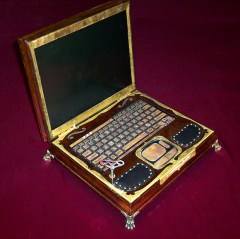
So how exactly does your laptop work?
No, me neither…
Whereas my father’s generation always had to know “how things worked” – even when studying paranormal subjects like telepathy – today’s citizens are increasingly happy to accept that things “just happen”, even magical things. Witness the public reaction to street magic performers like Dynamo and Blaine: people shout “Oh my God! He walked through a wall!” rather than “it looked just like he walked through that wall” – which is how people of my generation would be more likely to react.
So the scene is ripe for superstition. And that is one reason why I consider an understanding of magic to be so important.
I remember being very moved years ago by a newspaper report of an elderly couple that had just been mugged in Tonbridge Wells. The old man was devastated, saying that he had been a marine in the Korean War and had the training that meant he could, even in old age, have easily overpowered those attackers. But what had happened was that he just froze in surprise “things like this just don’t happen in Tonbridge Wells” – and, to his shame, the muggers had got away with his wife’s handbag.
I also remember a Tai Chi lesson where we were shown how to stand in a state of Tai Chi balanced alertness in the likelihood of an attack – the position itself was not a defence, but it reflected a mental alertness and equilibrium from which “centred” state one could react quickly and effectively to any surprise. When I consciously stand so as not to have my feet touching a crack between tiles, I approach a similar state of alertness. It is a remnant of that even more intense state of awarenessthat our forebears needed when walking in the savannah.
Whole spiritual systems, from Buddhist non-attachment through Gurdjieff to The Power of Now, are built around thisconcept of becoming more conscious, of not drifting through life in an abstract dream. As a country boy I learned to cross my left foot if I saw a single magpie – a small physical action that brought my attention to the here and now.As an adult I make a choice each morning about how I will stand as I brush my teeth. It is like an ongoing meditation, a heightening of awareness.
Little rituals can help us to feel comfortable in a world full of surprises. Not because we do them, but because we can do them.
Ramsey Dukes


 The Blog of Baphomet