In the first three parts of these musings, I have tried to honestly engage with some of the core beliefs of those groups of people that we currently categorise as “Gnostics”. As we have emphasised, the view that our world was the product of an imperfect craftsman often led to the belief that the realm of matter, the body and the earth needed to be escaped from.
In wrestling with my own discomfort with this perspective, I began considering hermeticism as a potentially more subtle interface between a shamanic/earth focused path and the transcendentalist impulse. Many of the complex cosmologies within the wider Hermetic tradition contain ladders of ascent (and descent) that seek to acknowledge that the divine may manifest in differing ways during different aeons. Given the apparent linearity of such maps, it could be easy to type-cast earlier stages as somehow “primitive” and thereby missing the subtlety of the mythic terrain that they are trying to describe. The gods of shamanism should not be type-cast as simplistic faces of animism; although their focus is inevitably more on the concerns of pre-industrial cycles, the intricacy of their stories reflect a complex of ideas that remain key to our embodied humanity. In contrast to the cosmic escape-plan envisaged by many dualistic Gnostics, the Hermetic perspective seeks a more integrated holism that endeavours to hold together the apparent disparity of above and below so as to synthesise a new position.
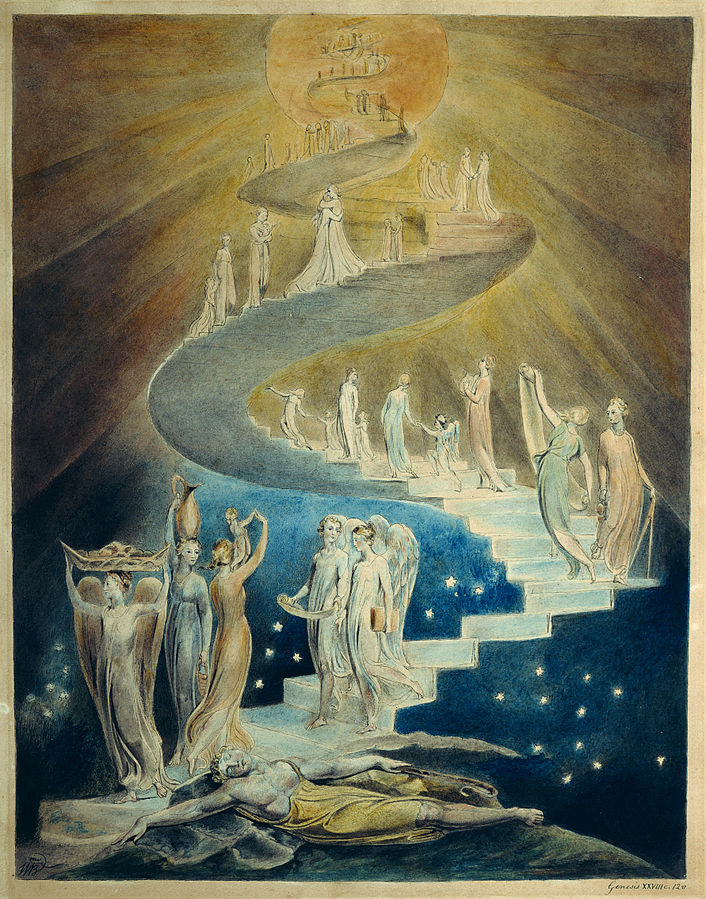
And when they were only halfway up…
Some contemporary practitioners seek to describe such a path as being that of non-dual gnosis, but for it to retain any connection with historic Gnostic traditions, it may be more accurate to describe it as ‘less-dual’ or a form of soft-dualism. While many view the concept of dualism as innately negative in nature, I would argue that it can still contain valuable insights if applied thoughtfully. As with many spatial religious metaphors, the sense of otherness and distance that they are seeking to evoke often relates to spiritual aspiration and longing. It’s interesting to consider how many magical traditions would be able to maintain a viable metaphysic without at least some sense of movement from our current state to a desired destination.
In seeking to actively engage with the dualism present in the primary texts of the Gnostics it would be easy to problematize the tensions that exist in the dynamics between the Pleroma, Sophia and the Demiurge. In contrast to this perspective, I find myself being curious about the manner in which they may be viewed as encapsulating the core process of how we as humans wrestle with dilemmas, of both our humanity and creativity. The threefold schema of hylic, psychic and pneumatic (approximately body, soul and spirit) reflects the dynamic tension that many of us experience in our lives. Those of us drawn to engaging with the Gnostic material are usually well aware of these dilemmas, and are rarely placated by either simple answers or promises of peace:
Jesus said, “Those who seek should not stop seeking until they find. When they find, they will be disturbed. When they are disturbed, they will marvel, and will rule over all.” Gospel of Thomas v.2
To walk the path of the Magician often involves the conscious induction of those states of mind and body that will precipitate change. In contrast to my own more orthodox Nicene beginnings in which the Logos (word of God) was an external focus of belief, the path of the Gnostic explorer is one in which we seek both the joy and terror of the word entering our own flesh. The disquiet that we may experience leads to an awareness of our longing; a longing that only the stillness of the Pleroma and wisdom of Sophia will resolve.
In contrast to more catholic or sacramental forms of contemporary Gnostic practice, my own approach to accessing gnosis has been to utilise a form of “deep listening” practice that has many parallels with Buddhist inspired mindfulness practices and centering prayer.
It seems a somewhat obvious thing to say, but many of us live our lives very quickly, bombarded by information, struggling to get our bearings in a world that seems to be ever changing. If nothing else these stillness based approaches give us a chance to slow down. With more mental space at our disposal our ability to truly listen and therefore to learn takes on a radically different quality.Access to these states is rarely permanent, as the complex beauty of our own incarnation oscillates as part of Nature’s dance around us.
The warnings that magic is a dangerous path are in many ways accurate, but so potentially is the psychic death of not responding to the “still, small voice” of what we might become. In cultivating practices that seek to pull in the aeonic words of the logos, so we pursue the fabulously messy work of integration:
“Enlighten your mind…Light the lamp within you. Knock on yourself as upon a door upon yourself as on a straight road. For if you walk on the road, it is impossible for you to go astray…Open the door for you so that you may know what it is.” The Teaching of Silvanus, The Nag Hammadi Library
SD

 The Blog of Baphomet