In a recent interview that I did about Chaos Magic and Gnosticism, the interviewer was keen to understand more about the process of ritual creativity that Chaos magicians often engage in. For me personally I am engaged in an on-going journey of exploration, research and poetic inspiration as I seek to make deeper sense of the material that I’m digging into.
Anyhow, I thought I’d provide a recent example of such ritual practice that probably gives you a feel for how we go about such work. Such ritual outlines are not meant to be prescriptive; rather they are serving suggestions to inspire your own innovation and creativity.
The purpose of this ritual was to creative a ritual environment in which the concept of divine wisdom could be explored via the Gnostic figure of Sophia. Via the use of both poetry and meditative technologies, we were seeking new insight regarding holy wisdom and a sense of deep listening as to how future work should proceed.
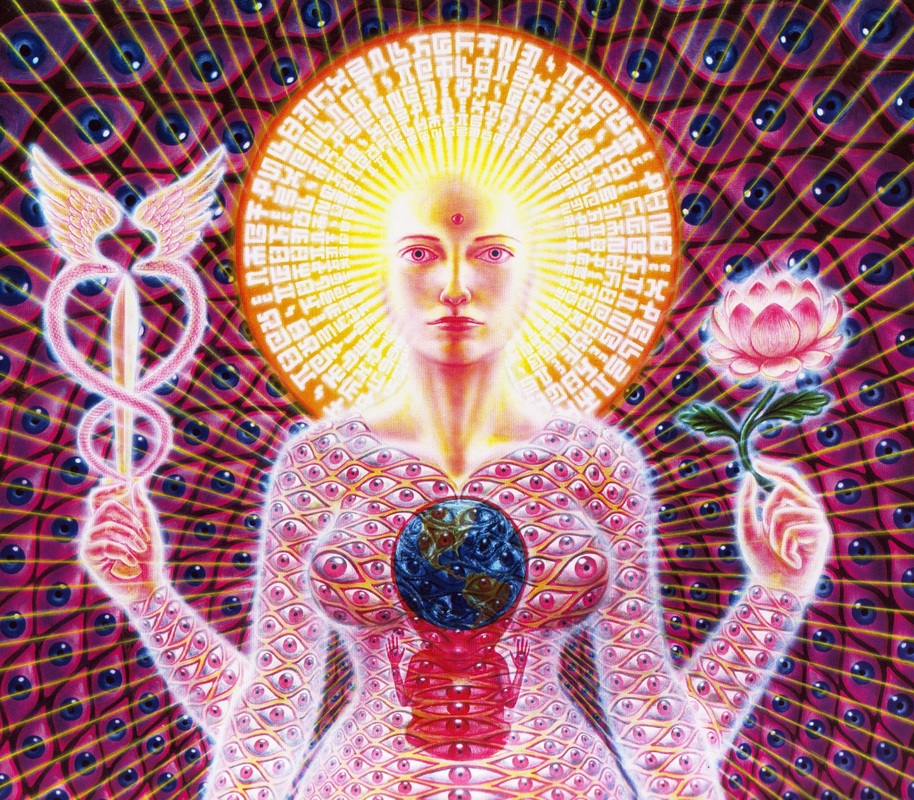
Wisdom hath builded her house, she hath hewn out her seven pillars
Opening with singing bowl rung in the 8 directions.
“We begin in Silence and Space
The realm of the Pleroma
The marriage of Darkness and Light.”
8 Breaths taken together.
“In the pregnant space of reflection
Wisdom is born
Glowing deep blue against the blackness
Silver Star points glow
As the holy Aeon descends
And gives birth to life.
Selah
20 minutes Mindfulness practice – using awareness of the breath as an anchor for awareness and gently surrendering thoughts, feelings and bodily sensations as they arise.
“Wisdom makes manifest
An outflowing of the multiple and the complex
The Craftsman makes the World
Soul glows and breaths:
“I was sent forth from the power,
and I have come to those who reflect upon me,
and I have been found among those who seek after me.
Look upon me, you who reflect upon me,
and you hearers, hear me.
You who are waiting for me, take me to yourselves.
And do not banish me from your sight.
And do not make your voice hate me, nor your hearing.
Do not be ignorant of me anywhere or any time. Be on your guard!
Do not be ignorant of me.
For I am the first and the last.
I am the honored one and the scorned one.
I am the whore and the holy one.
I am the wife and the virgin.
I am the mother and the daughter.
I am the members of my mother.
I am the barren one
and many are her sons.
I am she whose wedding is great,
and I have not taken a husband.
I am the midwife and she who does not bear.
I am the solace of my labour pains.
I am the bride and the bridegroom,
and it is my husband who begot me.
I am the mother of my father
and the sister of my husband
and he is my offspring…..
I am the silence that is incomprehensible
and the idea whose remembrance is frequent.
I am the voice whose sound is manifold
and the word whose appearance is multiple.
I am the utterance of my name.”
(Excerpt from Thunder Perfect Mind.)
Trance drumming.
During this ritual we had three drummers all using the technique outlined by Michael Harner, where trance is induced through the use of a consistent drum beat of around 200 beats per minute.
After the trance period and drumming ceases the following words are spoken:
“The many forms beget Joy
But also the forgetting of our original face,
We give thanks for these moments of stillness and remembering!
Wisdom calls:
“Does not wisdom call out?
Does not understanding raise her voice?
2 At the highest point along the way,
where the paths meet, she takes her stand;
3 beside the gate leading into the city,
at the entrance, she cries aloud:
4 “To you, O people, I call out;
I raise my voice to all humanity.
5 You who are simple, gain prudence;
you who are foolish, set your hearts on it.
6 Listen, for I have trustworthy things to say;
I open my lips to speak what is right.
7 My mouth speaks what is true,
for my lips detest wickedness.
8 All the words of my mouth are just;
none of them is crooked or perverse.
9 To the discerning all of them are right;
they are upright to those who have found knowledge.
10 Choose my instruction instead of silver,
knowledge rather than choice gold,”
(Proverbs 8 1-10.)
Close with three bells.
SD
In my recent post I mentioned the concept of ‘soul making’. This notion appears in a number of contexts. One of the earliest is in the Ireanean theodicy inspired by the work of Saint Irenaeus, the second-century philosopher and theologian. The Ireanean view is that creation happens in two stages. This process requires the existence of suffering and evil, making the world something akin to schoolroom for the soul. The creation of a soul is the work of humans, their aspiration being to become perfect and like God.

Soul Brother
This ritual grows out of a desire to explore these ideas, concepts related to the tension between the (theoretical Platonic) perfect creation and the (apparently) flawed world of the Demiurge. Through this meditation, this trance and these words we have a space to encounter imperfection, suffering, pleasure and those other abstractions that so fascinated the ancient Gnostics.
Soul making also appears as an important concept in the work of psychologist and Jungian analyst James Hillman. The Wikipedia entry for Hillman nicely summarises this:
The poetic basis of mind places psychological activities in the realm of images. It seeks to explore images rather than explain them. Within this is the idea that by re-working images, that is giving them attention and shaping and forming them until they are clear as possible then a therapeutic process which Hillman calls “soul making” takes place. Hillman equates the psyche with the soul and seeks to set out a psychology based without shame in art and culture. The goal is draw soul into the world via the creative acts of the individual, not excluded [from] it in the name of social order. The potential for soul making is revealed by psychic images to which a person is drawn and apprehends in a meaningful way. Indeed the act of being drawn to and looking deeper at the images presented creates meaning – that is, soul.
Thus this ceremony is an encounter with this Gnostic ‘realm of images’ and, critically through drumming, emphasising the encounter as a somatic as well as intellectual event. This is Gnosticism but one that includes, rather than rejects, the world of the flesh. Fathoming suffering and the vicissitudes of life not as the result of a Fall from grace but perhaps as a necessary proving ground for the unfolding of a divine Self.
JV

 The Blog of Baphomet