
Review: Acts of Magical Resistance by Phil Hine

While the beginnings of many religious traditions are decidedly focused on the salvation, liberation or empowerment of the individual, they rarely remain as such. Given time to evolve and gaze outwards, many religious traditions develop a greater sense of collective responsibility, where the impact of any apparent awakening demands a response to the “other” and the world around them.

In considering such development, contemporary Paganism is no different and this concise work by Phil Hine provides us with a pacey and inspiring overview of the evolution of the political dimensions of Paganism within the UK scene.


Phil begins by mapping some of the origins of political conservatism within occult and esoteric circles, with writers such as Dion Fortune casting doubts over the spiritual pedigree of those who involve themselves with worldly politics. Such messages helped shape the reluctance within the magical and Pagan circles well into the 1970’s and early 80’s often leading to an absence of challenge to the mainstream positions in a way that translated into activism. For Hine this shifted radically during the ‘Satanic Panic’ that hit the UK in the late 80’s and early 90’s, which seemed to catalyse parts of the Pagan and magical communities into adopting a new radical openness in seeking to challenge the lazy stereotyping and misinformation so widespread in the media.

This work features some inspiring flyers and snippets from ‘zines from this time period that help capture the dynamism and punk rock energy that inspired many Pagans to greater acts of openness and heroism. Phil helpfully tracks a timeline of magical resistance before the late 1980’s as it manifested in Pagan contributions to the Greenham Common anti-nuclear protests, PAN: Pagans Against Nukes, Stop the City and the contribution of the PaganLink Network. These movements alongside seminal works such as Starhawk’s Dreaming the Dark (1982) helped ferment a new questioning as to whether “we are content to be spare bedroom Witches” with a limited vision of what our Paganism has to offer the world.

Moving into the 1990’s Phil paints a vivid picture of the collective ritual workings of the Dragon Environmental Network, Thee Temple ov Psychick Youth and Queer Pagan Camp as they sought to bring people together to challenge both ecological threat and attempts to limit sexual liberty.  These collective actions fostered community and helped create a sense that change was possible. The book provides us with insights into large group rituals such as the ‘Heal the Earth’ working (summer solstice 1987) and smaller sorcerous rites born from his time in the Leeds squat movement where the “magic of need” brought together activists seeking change in their immediate communities. These aren’t simply feel-good pathworkings in the hope of societal change, with rituals such as ‘Unleash the Furies’ illustrating how occult technologies such as Goetic working can be used to name, contain and then redirect contemporary demons such as patriarchal abuse or homophobic violence.

While this work is inescapably a challenge for us to move our magical practice and perspectives out of our spooky-club ghettos, it also manages to avoid the grimness that can feel present in our often near-exhausted activism. What I really enjoy about Phil’s writing is his ability to remain playful and humorous even as he is trying to describe the realities of trying to bring about political change. In a similar way to his ‘Liber Nice’ in his seminal Prime Chaos, he frames many group rituals as having a Discordian and almost Dadaist potential in being able to disrupt and undermine the bloated misuses of power that so often lay at the heart of oppression. When we are able to ‘play’ via our protests, so we model and embody a freedom that can even act as an invitation to those who we are protesting against.

The book concludes with a rich and diverse section on influences and resources to inspire. Phil reminds us of our heroic forebears such as Annie Besant, Florence Farr and those Kali worshippers who invoked her potency in order to challenge British colonialism. These spiritual allies and suggestions all aid what Phil calls “A Space for Wonder”, that can help us when our activism and protest might threaten burn-out or compassion fatigue. How can our Paganisms and practices reawaken creativity, openness and a connection with others? This is surely one of the primary goals of our magic and as such Hine urges us to embrace Wonder’s “alienating presentness”:

“Wonder propels us toward the unfamiliar, to seek new relations, to revel in dizzying complexity and richness. Wonder pulls us into the world beyond a limited horizon, beyond the certain, the familiar, the possible.”

In our current times, Phil’s book is a real grimoire for a magical engagement with our lives, our struggles and our joys. Highly recommended.

Steve Dee

Buy Act of Magical Resistance by Phil Hine


Coming up next…

Baphomet Magic – March 13th and 20th, 7-9pm UK time live and recorded.

Ghost in the Machine – March 25th, 7-8:30pm UK time live and recorded.
Psychotropics & Western Magic – April 3rd, 7-8:30pm UK time live and recorded.

Aleister Crowley & Liber AL – April 8th, 7-8:30pm UK time live and recorded.

Breaking Convention, Europe’s largest and most diverse conference on psychedelic consciousness. 17th-19th April at The University of Exeter.

The History & Practice of Scrying – May 15th, 7-8:30pm UK time live and recorded.

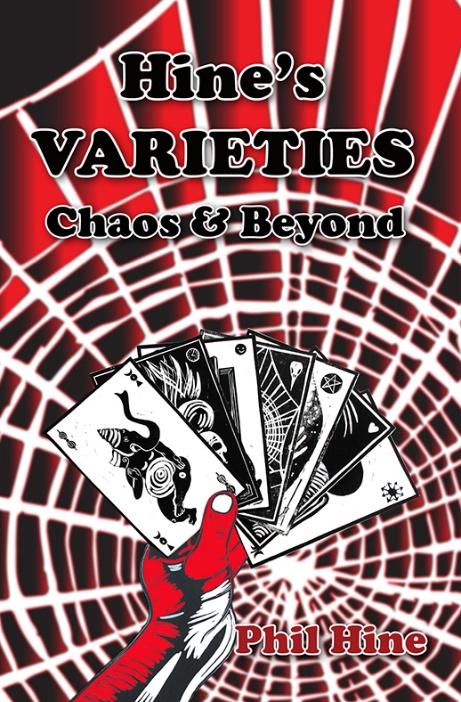
Review: Hine’s Varieties Chaos and Beyond by Phil Hine

C:\Users\DaviesSte\AppData\Local\Microsoft\Windows\INetCache\IE\BL9634F0\Hine's-Varieties-front-cover-w-bleed.jpg
Cover by Strutz & Hine

As a latecomer to Chaos Magic in the mid-1990’s, Phil Hine’s Condensed Chaos provided an excellent guide to the Neophyte Steve Dee. Having been spiritually burnt out by my previous struggles with belief and attempts at religious faith, the iconoclastic approach of Chaos Magic articulated in that work felt like an invigorating breath of fresh air.

In this latest collection spanning over 40 years of magical practice and reflection, Phil has brought together not only a rich smorgasbord of his writing that has previously been featured in Zines, collections and his on-line presence, he also intersperses these pieces with illuminating snapshots of magical autobiography and reflections on his inspirations at the time they were written. In addition to Phil’s written work, the book also features evocative linocuts by Maria Strutz at the beginning of each of its major subsections.

He provides us with a vivid recollection of his own beginnings in Magic that reference the impact of Austin Osman Spare, Theosophy and some bold experimentation with the pantheon of HP Lovecraft. Early occult group work came in the form of a rather bumpy experience with a Wiccan Coven, and we also see him giving his playful and non-conformist streak expression via more experimental work with the Discordian Goddess Eris. Things clearly lit-up during his involvement in the vibrant Pagan/magical scene in the North of England during the 1980’s and his involvement with the enigmatic Lincoln Order of Neuromancers provides a Segway into the books first major section containing writing on Chaos Magic.

Even with the passing of time, Phil’s writing from this period still contains both a vibrancy and a relevance. Pieces such as the channelled Erisian Stupid Book and the brutally honest Fracture Lines provide clear insight into the magician both at work and struggling with the emotional realities of being a human being. In Cthulhu Madness he challenges the sanitised safety of our overly psychologised magic and our attempts at control. “Real Magic is Wild” insists Hine and yet he also asks us to use on whole of our beings in balancing magic and mysticism, work and play: 

“Chaos Magic is a process of mutation…the deconstruction of Identity from the beleaguered Ego into the legion of Selves requiring only self-love”

In his section on Paganisms, we find Phil in full activist mode using both his writing and group ritual to challenge the hysteria of alleged satanic child abuse and the ecological threat posed by industrialisation. This a Paganism unbolted from the politeness of social conservatism and in his writing for Pagan News we see a clear embodiment of the magician-shaman as social disruptor. In his Must we Love the Golden Bough? I sensed the beginnings of Phil’s role as erudite historian of religion and critic of Western Occultisms lazy reliance on the Universalistic assumptions that reflect an insensitivity to cultural context.

Phil’s section on Practice provides some rich anecdotes and some very down-to-earth principles for magical practice. He provides valuable thoughts regarding the power dynamics present within the student-teacher relationship and how the paradigm of mentorship might provide a less lopsided model. I was especially struck by his piece on Leaving Magical Groups and was aware of the parallels in my own experience of how such departures can have long lasting impacts on friendships, personal psychology and the shape of on-going spiritual work.

Image result for phil hine
Phil throwing down some organic Tantra   Portrait by Asa Medhurst

Somewhat organically Hine takes us with him on a voyage into his exploration of Tantra. We are treated to tales of his meeting his Guru, involvement with the AMOOKOS tradition and a description of a deeply personal embodied Kundalini experience. Phil openly wrestles with what it might mean to let the complex traditions of South Asia speak for themselves and inform his efforts to create a “hybridised Tantra”. Through a number of nuanced pieces of writing he invites us to become detectives with him in trying to experience the complex layers of meaning of Tantra’s twilight language rather than coarsely pillaging concepts around rebellion, antinomianism and sacred sexuality. However these concepts are present, they need to be able to speak on their own terms.

His sub-section on Sexualities was a personal favourite of mine, as Phil provides a robust challenge to much of the heteronormativity and phallo-centrism that is still present within certain quarters of western occultism. In exploring the fluid and evolving concept of Queer Paganism we encounter Baphomet as an “unfinished” deity who contains “a multiplicity of shifting planes and horizons”. These aren’t merely theoretical constructs but rather profound explorations of when the personal is the political and pieces such Sodomy and Spiritual Fulfilment and Biography of a Kiss provide us with some truly tender insights on how we unfold in becoming more human.

The final two sections of the book are given over to Histories and Fiction and in this juxtaposition we see Hine in both his most incisive and playful modes.  In his analysis of the work of Lobsang Rampa and Elizabeth Sharpe’s writing on The Secrets of the Kaula Circle we have Phil in full religious historian mode challenging us to stay sensitive to context and to appreciate the complexity of contributions within the timeline. In Fiction (probably the section that appealed to me least), we see the blurring of the lines between story and history and the weird tales described could quite feasibly be chapters from his own biography.

In his writing on Masters, Mentors, Teachers and Gurus Hine advises us to let go of our fixation in seeking parental authority figures and to “seek friendship instead”. Finding such magical mentors can take time but I feel that Phil has provided us with a warm and authentic version of this albeit in print. This collection provides us with a rare, raw and at times hilarious insight regarding what it might mean to be a magician in the 21st century. While playful and irreverent it also contains a moving story of the search for meaning, the fluid nature of identity and also a desire to find the Goddess in all their multiplicity of forms.

Highly Recommended!

Steve Dee

Book Launch of Hine’s Varieties

At Treadwell’s Books, London on 13th February.

Details HERE


Deep Magic Spring Retreat

Cultivating Connection

Last few days to secure your place at the early-bird price. Details HERE