Shaking up your Magick

I’ve been exploring shaking recently. The kind of trance state that often goes by names such as the Seiðr (seething*) or simply as ‘shaking’ within the Christian tradition (hence The Quakers et al). There are a couple of good books on the market which explore this approach, Jan Fries Seidways  and Shaking Medicine by Bradford Keeney (which comes with a nice CD of sounds to shake to).

[*Ed’s note: I have been asked to point out that despite  recent use by some individuals equating the similar sounding words ‘seiðr’ and ‘seeth’, they are in fact from very different etymological origins, and historically unrelated. Further information about more plausible etymologies of this word can be found at http://en.wikipedia.org/wiki/Seiðr. Seiðr covers a wide range of complex magickal techniques, and should not be taken as equivalent to the technique of entering trance by shaking. We apologise for any confusion! NW]

As I’ve already mentioned shaking trance turns up in many spiritual traditions, and there are many techniques you can use to get into that state. But as with most things in magick (especially in the DIY-punk-inspired style of chaos magick) no guidebook is as good as your own experience. Playing with this state I’ve discovered that, unsurprisingly, if I spend some time stretching (using yoga, tai-chi and other non-stylised movement) getting into the shaking trance is easier than if I plunge straight in. Sometimes a rattle helps, so there is a neat ouroborous feedback loop feedback from one’s own movements through sound and vibration (even if you’re shaking to pre-recorded sound) and back into movement.

Different shakes can arise. Sometimes they start at the periphery of the body, but for me the deepest and most powerful ones start at the root – the dan tien, the muscles of the core. As with much martial arts practice the idea of allowing movement to arise from the belly, the spot we quite literally grow from (attached to our mothers via the umbilical cord) makes movement of the arms and legs deeper and stronger than if the limbs are used in isolation.
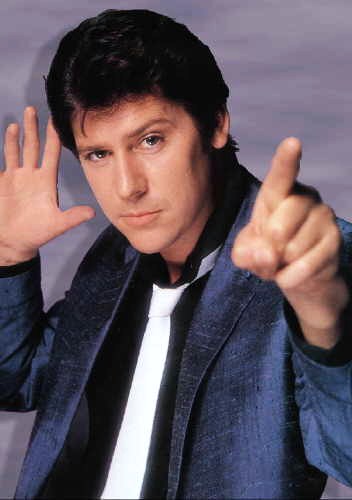
shaking can open up many spiritual powers

Shaking can open up many mysterious spiritual powers

The shake can go through phases. Faster or slower, moving the body around in the space or keeping it fairly static and merely vibrating; shivering on the spot. The rule is, feel into it and go with it.

So what’s the point? There are many different uses of shaking trance. There are the physical and psychological healing benefits. By shaking ourselves we unblock channels of lymph, energy, blood and mentation. We stir the blood and stimulate the organism with global sensation. Vibrations pass though the organs as well as along the arms and legs. We feel good.

Then there are the more clearly esoteric uses. Shaking trance can be used as a state to build energy or gnosis for acts of results magick, casting sigils and all that. But for my money one of the most interesting features of it is the oracular or inspirational use of shaking.

Like some aspects of Seiðr there is a sense in which this trance can be regarded as passive. The practitioner is carried away by the vibrations of the bodymind; spontaneous glossolalia, song and even prophecy may arise. They may be a sense of the body changing into other animal or mythic forms, emotions well up, dislodged from the depth of the mind, floating up to awareness. So although the technique is one we deliberately employ there is very much a sense that the practice unfolds through the practitioner rather than originates from him or her. We create the conditions for kundalini to strike up the sushumna; light the touch paper and our occult organism does the rest. We shake out obsolete patterns and dance into the Mystery.

Try it for yourself!

JV
The Art of Magick

Many years ago a friend (a Cambridge graduate and journalist) opined that modern Paganism really hadn’t created any great art. This made me rather cross. Aside from the not insignificant issues of ‘what is art’?, and ‘great by whose definition?’ I claim that there is a vast array of excellent Pagan art, across every artform, in the contemporary world. Indeed if we allow the term Pagan to include, or be extended to, esoteric art, then it’s rather hard to find any art these days that isn’t influenced by, or springs directly from, a magickal sensibility.

The field of music is particularly rich. Whether we are dealing with the directly esoteric work of bands such as Current 93 (frontman Dave Tibet also happens to be a noted scholar of Coptic & Gnostic writings) or the hugely popular Qabalistically influenced work of Madonna. If we want a high-brow composer perhaps Philip Glass who describes himself as a ‘Jewish-Taoist-Hindu-Toltec-Buddhist’  is a possible candidate and certainly for folk music the Eisteddfod winning Damh the Bard is certainly ‘one of us’.

In the field of architecture one might suggest the Damanhur community who secretly created a vast system of corridors and amazing vaulted chamber temples inside an Italian mountain. As an example of what is clearly esoteric art this shines, quite literally, as a beacon of architectural brilliance. Then there are those artists who are less well known but are deeply embedded in their own practice and craft, creating objects which sing with beautfy, attention and a deeply Pagan sensibility. One of my favourites in this field at the moment is Phil Cowley Jones. Phil creates or rather ‘births’ the most exquisitly crafted, explicityly shamanic, tools at a level of skill that should see them exhibited in gallery spaces as well as being played by practitioners.

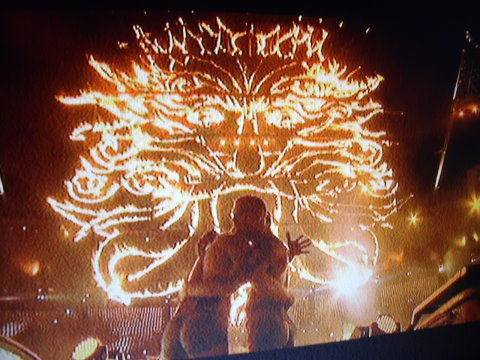
Pagan iconography at the London 2012 Paraolympics closing ceremony

Pagan iconography at the London 2012 Paralympics closing ceremony

For poetry I recommend the work of Peter Redgrove. As well as co-authoring the first major work on menstrual mysteries (The Wise Wound – Menstruation & Everywoman with Penelope Shuttle) and an excellent work on the subtle anatomy and sensory systems of our species (The Black Goddess and the Sixth Sense), he also produced numerous volumes of poetry and almost a dozen novels. Redgrove both writes about magick and was indeed a practitioner himself, both through his own practice and by using his writing as a vehicle for his Pagan sensibility.

For prose that often shades off into poetry, one should pause briefly to mention the work of Alan Moore (Peace Be Upon Him). Moore is, as he will tell anyone who cares to listen, a practising magician. His numerous writings include the graphic novel series Promethea which, for my money, is the most engaging text on the subject since Dion Fortune’s The Mystical Qabalah as well as being a ripping good yarn. His poetic vision Snakes & Ladders is, as they say in America, awesome.

For visual art, and perhaps also installation, we might mention the work of Alex Grey. Creating artworks which lay bare the psychedelic experience in paint isn’t an easy thing to do but Grey admirably pulls this off time and again. He’s also taken his painting to the next level by creating a total environment within which the work may be encountered in his Chapel of Sacred Mirrors in New York. Then there are the technically brilliant and deeply magical works produced by Una Woodruff. Not only is Woodruff a very successful artist in financial terms but her work expresses her own unique form of witchcraft, with each canvas being in itself a powerful spell.

Then there are all those artists who may not be banner-headline athame-waving occultists but certainly create work which is deeply indebted to the magickal revival. For instance earlier this year I got the opportunity to work with Jeremy Millar. Millar produces all kinds of art that is shown in galleries around the world. While we worked together on a project in North Devon we spoke about Voudou, possession and trance states and I shared with him my involvement with occultism. Part of the reason for the discussion was that his work had appeared in The Dark Monarch  a major show at Tate St.Ives in 2010. The theme of the show was esoteric art and alongside Millar’s work was that of Derek Jarman (ritual film-maker and collaborator with occultist Genesis P.Orridge), Ithell Colquhoun’s  surrealist work and the collages of tantric adept Penny Slinger to name but a few. In his work Millar had reproduced a text by artist Sol Lewitt but had altered it so that the word ‘artist’ was replaced by ‘magician’ and ‘art’ by ‘magic’.

Many expressions of modern spirituality (from Philip Glass’s ‘Jewish-Taoist-Hindu-Toltec-Buddhism’ to contemporary neo-paganism) emerge from processes which are at once intensely personal and widely syncretic. We learn from what’s around us and in doing so weave our own ongoing interpretation of the perennial wisdom. This process, of being inspired by the environment and finding a unique way to express that inspiration is, in my opinion, an important aspect of what it means to be an artist. It is for this reason that so much magickal art exists because there is a direct parallel between the artistic process and the autonomous development of one’s own spiritual path. Both are creative acts, both rely on a culture of freedom (the absence of draconian censorship in the case of art, or witch-hunting in the case of alternative spiritualities), both empower the individual to explore and continuously create their oeuvre (as an artist) or The Great Work (as an esotericist ). Both rely on a blend of persistent practice and playful inspiration.

To be charitable I could say that my former chum simply couldn’t see the wildwood for the trees. His post-modern ennui had perhaps dulled his appreciation of those glorious artistic creations emerging from, and influenced by, Pagan culture. Creations which were in fact around him all the time. But then beauty, like art itself, is mainly in the eye of the beholder. And if our eyes are closed then any beauty that is present will certainly elude us.

JV