
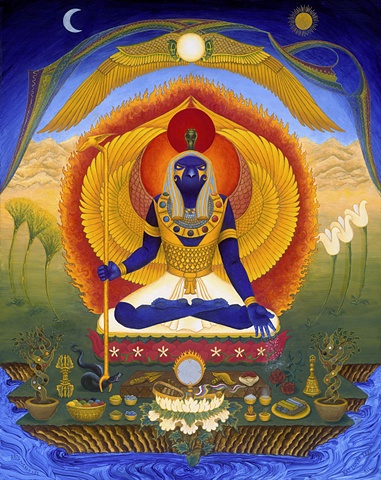
Written as a proper tantra (addressing his beloved the author speaks…) this book continues the excellent fusion of the western occult tradition (particularly as it manifests through the work of Crowley) and Oriental occultism. Tantric Thelema occupies the same cross-cultural zone as Crowley’s Book 4 (on meditation) and the style of groups such as The Arcane and Magickal Order Of the Knights of Shamballah (AMOOKOS, who bring together Hindu Tantrism and Thelema). The author certainly comes across as someone who really knows his magick in both theory and practise. Using the Vajrayana style of Buddhism Sam Webster provides an interpretation of Thelema and The Book of the Law that makes total sense, and is much grander and deeper than those rather superficial quasi-Nietzschean, apocalyptic readings. In this work the hawk-headed Lord of the Aeon is presented not as an angry child but rather as a wrathful Buddha, who, through ‘skillful means’ swiftly liberates all sentient beings.
There are plenty of rituals in the book, and programs of practice. These (as with most tantras) are nice as serving suggestions but are not obligatory in terms of making use of the ideas in this book. I’ve certainly been able to adapt some of the techniques in the book to my own Work very easily.
The core of this tantra is distilled into some brilliant passages in Chapter 2 ‘Taking Refuge, Dedicating Merit’. In this section Sam Webster like Joscelyn Godwin (author of Theosophical Enlightenment), ‘…wonders what it would have been like if Bennett and Crowley had discovered Tantric Buddhism, the Vajrayana or Tibetan Buddhism.’ Webster goes on to show explore how the bigger picture of the Vahrayana approach helps grow our magick rather than diminish it, enriching the neo-Pagan movement (including Thelema) just as it did to Bon in Tibet and other esoteric practices in the East.
Webster writes; “…the Pagan tradition is floundering and needs a deeper, richer, tap root by which to develop itself beyond mere spellcraft and seasonal celebrations…When Buddhism escaped the hands of the monastics and attained to the greater view of the Mahayana it began to spread outside the Buddhist philosophical colleges to the villages and craftsfolk. There, among the native magick-using folk of India who were honouring the seasons and their many deities, some heard the call of the greater view. They embraced the understanding of the void nature of the ground of all things (Shunyara) and saw that compassion (Bodhicitta) was the necessary corollary and result. Rather than give up the magick and methods of worship they had known for countless generations they brought them to bear on the task of attaining to the complete realization of this View. Thus was born Tantric, Vajrayana Buddhism.”
Crowley engaged with Buddhism but, given his experience of it in its more transcendental and monkish styles, couldn’t quite square that philosophy with the assertion that ‘Existence is pure joy..’ in Liber Al (or indeed his penchant for getting mashed). So in answer to the question, what would have happened if Crowley had met the Vajrayana school I suspect the answer would look very much like Tantric Thelema.
Webster’s work helps propel the iconography of Thelema, and more broadly Western Ceremonial Magick, into a new orbit. So if you fancy taking refuge in the Hawk-headed Lord of Double-Justice this is certainly the book for you. Ha!

 The Blog of Baphomet