On Seeing Witches in a Black Mirror…

I recently bought a black mirror from the extraordinary witch, writer and academic Levannah Morgan. Levannah, as visitors to many Pagan events in Britain will know, is also the creator of a wonderful array of home-made, beautifully crafted objects. These range from what are clearly ritual tools (like my mirror), through to charms, knitted hats and socks which, though ostensibly simple knitwear, are undoubtedly magickal objects in their own right. In this sense Levannah straddles the worlds of the Wicca (she’s a High Priestess of many years standing) and what some call ‘Traditional Witchcraft’ (which we might briefly define as being the use of folk magic).
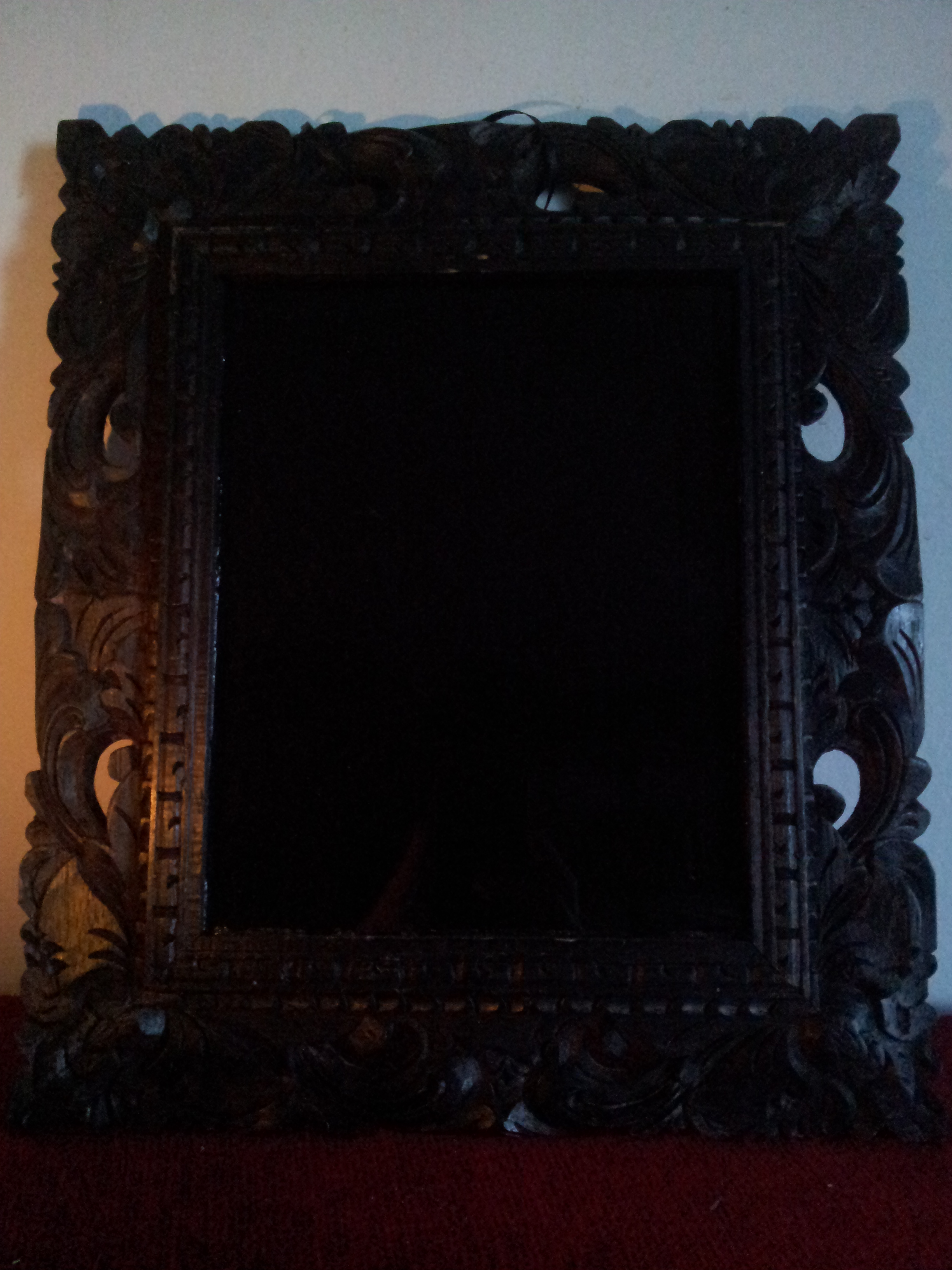
the witches mirror

the witches mirror

The relationship between ‘The Craft’ (ie Wicca) and ‘The Craft’ (ie Traditional Witchcraft). Is one where I’ve observed a fair amount of contention. For instance one of the Traditional Witchcraft facebook groups I belong to (arguably the most venerable group in that social media forum) sets out its stall by stating (in one of those pinned post thingies) that it is emphatically not a group for people interested in Wicca. The whole vibe of Trad. Craft (aside of discussions about which is the most ancient of its facebook manifestations) is one of toads, skulls, horned spirits, circumambulations, spelling coven ‘cuveen’ etc etc. Now I’m down with all that; I love a bit of folksy style magick the same as the next wizard who happens to live in an 18th century west country cottage. However when I actually look at this style in relation to the work of the Wiccans I know (of which Levannah is one) I find it hard to see more than the narcissism of minor differences  between the assumed distinctions of Trad. Craft versus Wicca. Read, for instance the engaging book Traditional Witchcraft by Gemma Gary. A likeable vision of the Craft which feels like a more folksy (and of course west country orientated) version of the classic Mastering Witchcraft by Paul Huson  However if one were to compare say, Eight Sabbats for Witches by Janet and Stewart Farrar with Traditional Witchcraft certainly there are differences, but these are greatly outweighed by the similarities.

Now one of the criticisms of Wicca by Trad. Craft people is that Wicca can be ‘fluffy’, of course by that they mean that it can emerge as a ‘love and light’ focused gentle spiritual tradition which doesn’t have the earthy scent that Trad.Crafters imagine suffuses their preferred style. Various allegations are made against this ‘fluffy craft’; that it’s not much more than a superficial, product orientated life-style choice. You can get your Wicca off the shelf, mediated through the work of writers such as Silver Ravenwolf  et al. Thing is that for every example of vapid consumerism by ‘Wiccans’ I can find just as many examples of similar behaviour within Trad.Craft culture (a recent high point of this for me was this ‘stang’  formerly owned by Cultus Sabbati guru and asthma victim Andrew Chumberly, being offered for sale, admittedly along with a ‘talismanic’ edition of the Azoetia and a letter or two, for £3000). Incidentally the text of this uber spooky volume may be found HERE.  (There are certainly some enjoyably evocative bits of material in Cultus Sabbati literature, and it’s also true to say that sometimes the Emperor is completely skyclad…)
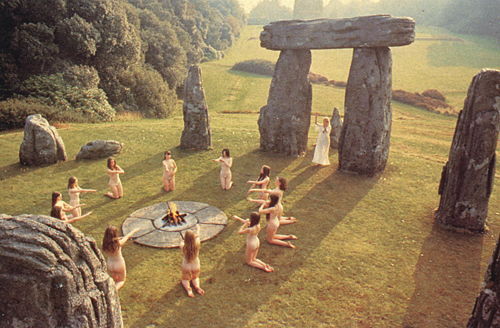
"I trust the sight of the young people refreshes you?"

“I trust the sight of the young people refreshes you?”

So it seems obvious to me that a superficial engagement with any spiritual tradition says more about the person doing the engaging, and not necessarily much about the tradition in itself.

Another aspect of the Wicca/Trad.Craft dichotomy arises from that fascinating word ‘religion’. Wicca is, in some sense, a religion (though my preferred understanding would characterise it as a ‘mystery religion’, closer to the classical sense of ‘mystery’ described recently by Ronald Hutton in a lecture at the Pagan Federation Devon and Cornwall conference). Trad. Crafters, while generally being of an animist bent are, it seems, typically more concerned with operative magick (often of the type described by chaos magicians as ‘sorcery’). They frequently acknowledge (unless they have some really out-there fantasies about secret Sabbats being celebrated on hilltops in the middle ages) that the operative witchcraft of the past (or folk magic, to use what I feel is a more accurate term) was done by people who would probably have identified themselves as Christians.

Meanwhile Wicca, particularly in parts of the United States, has made the fully-fledged transition into a church or denomination of Paganism. This is perhaps (and I’d love to hear the thoughts of North American witches about this) because religion plays a different role in American society than it does in British culture. The question ‘which church do you go to?’ is an important component in getting to know someone in the USA, whereas in Britain it’s unlikely to be an item for discussion at all. American religion plays an critical role in social identity and so the creation of a neo-Pagan Wiccan ‘church’ (with all that means) makes total sense. However to the British Trad.Crafter this all looks very suspicious and a long way away from solitary rituals involving rhyming charms and black cat bones.

But in the reflection of the black mirror such divisions begin to blur. Here I am, an initiated Gardnarian/Alexandrian Wiccan and chaos magician making use of a tool fashioned by the skilled hand of my Sister. Is this Traditional Craft, Chaos Magick or Wicca in action – could it perhaps be all three?

JV
The Trial of the Witches

I was taking to my friend Paolo recently (who I’m looking forward to seeing at the forthcoming Occult Conference in Glastonbury) and was reminded of a lecture I attended some years ago given by the brilliant Ronald Hutton in aid of the Friends of the Boscastle Museum of Witchcraft. Ronald’s talk discussed the different ways in which witch trials played out in different regions of Europe during the early modern period. My discussions with Paolo reminded me of the wonderful work, at that time, of the Spanish Inquisition – yes, you read that right, and no I’m not being ironic!

As with most witch trials, the events of 1609 at Logroño, near Navarre, in northern Spain, happened from the grass roots up and not, as is often imagined, as the result of the evil machinations of the Church and State. Although typically referred to as ‘hysteria’ (these days we might use the term ‘moral panic’ from the work of Stanley Cohen) many trials developed from the claims of just one individual. These days we’d probably say these denunciations came from people suffering from ‘personality disorder’ (this means they can appear relatively lucid but, often as a result of arrested development following childhood trauma, develop a narcissistic need to create situations in which they are socially important, often as victim). While it’s a tricky business psychologically diagnosing people in the past what we do know if that the allegations of witchcraft was always a powerful one (comparable these days with claims of ‘ritual abuse’ and ‘terrorism’). Once such a claim was made the machinery of the State swings into motion, and this is where the Spanish Inquisition comes in.

Moral panics, the stock-in-trade of the media

Moral panics, the stock-in-trade of the media

The Council of the Inquisition has always taken a fairly sceptical position in terms of claims about witchcraft. In the early 1500’s they warned against an uncritical acceptance of the classic witch hunters manual Malleus Maleficarum. So by the time the Basque witch hunt had racked up an impressive 7,000 allegations the Inquisition dispatched Alonso Salazar Frias, then junior inquisitor and hot-shot lawyer, to find out what was really going on.

Salazar found himself entering a highly charged situation of claim and counter-claim  Priests were suspected of using (illegal) talismanic magic, almost 2000 people had confessed to their crimes (1,384 of whom were children between the ages of seven and fourteen). Over 5000 people stood accused of visiting the witches Sabbat and all the usual satanic orgy stuff. Salazar wasn’t convinced. Neither was his boss the Inquisitor General who had only permitted the first executions in this case because he felt it might help calm the general hysteria of the populus. Of course in the face of the moral panic Salazar himself was suspected of being in league with the Devil but, brilliantly, our young Inquisitor decided to do something really simple – he looked for evidence.

Since a large number of people had confessed to carousing with Satan Salazar and his team employed the tactic of asking them where they sat at the Devils’ table in relation to other accused persons. Even though the general motifs of the story (viz killing babies, kissing Satans’ bottom etc. etc.) were more or less the same, the lack of consistent evidence allowed our young Inquisitor to throw out the whole case. This event prompted changes in the rules of evidence and effectively stopped any further witch trials in the Catholic controlled regions of Spain.

Meanwhile in parts of Europe where the agents of justice were more closely located in the immediate community it turns out (according to Ronald Hutton), that the story of the witch trials generally plays out very differently. Without having people from outside the situation coming in to unpick the scapegoat ‘madness’ of the mob it was much more likely that large numbers of the accused would end up executed.

So what can we learn from the tale of the Basque witches?  Firstly that sometimes having an external intervention by the State, especially when it’s using rational rules of evidence, can be a jolly good thing. Having people who clearly have no axe to grind sorting fact from fantasy is very much what is needed, especially in such emotionally charged situations. Secondly that although many people think that local=good there are times when dealing with problems within a community is more likely to lead to scape-goating (which is a normal but of course problematic social process). Thirdly, that the Christian Church was not always the agent of violence against supposed witches and in fact the annals of the witch craze have plenty of examples where Catholics and others actively stepped in to prevent executions. In addition we should be mindful that in England one of the bloodiest periods for witch killing was during the English Civil War at the instigation of Matthew Hopkins, a time when the machinery of the State (such as the Magistrates circuits) was disrupted.

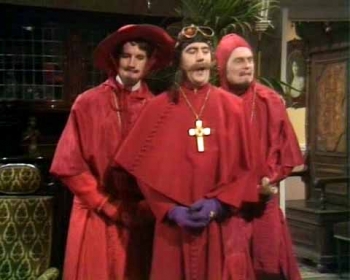
Amongst our weaponry are such diverse elements as: fear, surprise, ruthless efficiency, an almost fanatical devotion to the Pope, and nice red uniforms

Amongst our weaponry are such diverse elements as: fear, surprise, ruthless efficiency, an almost fanatical devotion to the Pope, and nice red uniforms

So while there may be many things which are rotten about the Catholic Church and the institutions of our States there are also many things which are humane, wise and beneficial. This also makes it all the more important to support the anti-defamation work of various Pagan groups, interfaith work and that we support social diversity in cultural and legal terms. We are social creatures and creating and supporting mechanisms to ensure that moral panic and social unrest don’t get turned into excuses for lynch mobs is a good thing. And allies in this work can come from surprising sources; as they say, nobody expects the Spanish Inquisition…

JV