
Stars of Ego Magick

The Ego (as Rob Dickins  pointed out in his brilliant presentation at Breaking Convention) often gets to be the villain of the piece. It’s something to be smashed, to be transcended – it’s a psychic structure that gets us caught up in petty social processes and leaves us grasping at attachments.

Yellow/Gold magick – the bright light of Midsummer time, encourages us to engage with this aspect of ourselves. What does it mean to be who we are? For this season, rather than trying to go beyond the self, let’s have a respectful look at what it means to be us – right here, right now.
Golden magick

Golden magick

Eight people were present at our meeting, including a new participant who had predominately worked within the Ordo Templi Orientis. His presence mirrored delightfully the nature of the Work during this meeting. The Illuminates of Thanateros  and OTO are quite different beasts in structural terms, but they are both, to use a rather lovely analogy, ‘Organs in the body of God’. There are things the OTO structure (let alone anything to do with magic itself) allows it to do (hold public liability insurance for example) which, in certain settings can be really helpful. Meanwhile the IOT approach means that some things are trickier for that group whereas other processes (eg not requiring any payment of membership fees and therefore being accessible to people irrespective of their financial situation) may have benefits in other respects. So these two Orders (as structures), unsurprisingly, just like individual people, have things they are well suited to, and things they find more challenging. The same is true of us as people, we’re social beings and therefore while we might want a broad base of education and experience, we don’t all need to be or do the same thing. And, assuming our social relations with many others suggest that we’re successfully part of society as a whole – there are undoubtedly things that, as individuals, we should be proud of. (We’re also really lucky with our group in that not only do we have contributors from the IOT and OTO but also folk who are not part of those structures but come from Wiccan, Zen and other backgrounds.)

Celebrating our individuality, our uniqueness, is what our Midsummer meeting was all about. This was done using a variety of techniques such as this; the ‘Yellow Magick Chaos Craft Ritual by me, Nikki‘.

Sitting in a circle Nikki laid a packet of cigarette rolling papers and a gold pen neatly in front of her. The purpose of the ritual, she explained, was to explore our own magical names. Each person took a paper and wrote their name in gold on it. Licking the gummed edge of the paper it was then stuck on the forehead, so that each person could see each others name.

Participants were then given the opportunity to speak to another person about the meaning of their chosen name. Each person also had a chance to listen (to a different person than the one they explained their name to).

Following this process of explaining the naming of ourselves, and listening to the story behind the name of another, it was time to seek out a new insight from our name. To achieve this we simply take the rolling paper and crumple it up, swallowing it with a few mouthfuls of the lemon barley water from the ceremonial chalice (the sacrament used in our earlier round of introductions at the start of the meeting).

In doing this, in the style of ancient Egyptian magic, we are absorbing our name and asking for a new insight into its meaning. We sit together each person silently repeating their own name until trance and then insight happen, guided gently by a few words from Nikki.

A simple practice like this, framed perhaps with a banishing practice and maybe a formal Statement of Intent, is sometimes all you need. The magic is in the attention the participants bring to the practice (our group members are all experienced magicians) and the skill of the ritual leader (which in the case of Ms Wyrd, having done ritual magick for quarter of a century, is considerable).

But some rituals are more about ‘bells and smells’, and require other paraphernalia. Other items used during this meeting included a vacuum cleaner (an underused ritual tool in my opinion, after all what do you actually use to banish stuff you don’t want hanging around?), a Yellow Troll Zen teacher and internet connection to the teachers’ wisdom HERE, a composite ‘exquisite corpse’ creation made from three of our ‘subpersonalities’ (or other egos), a smoke machine, lasers, strobe lighting and the brilliant ritual music used by The Temple of Set HERE.

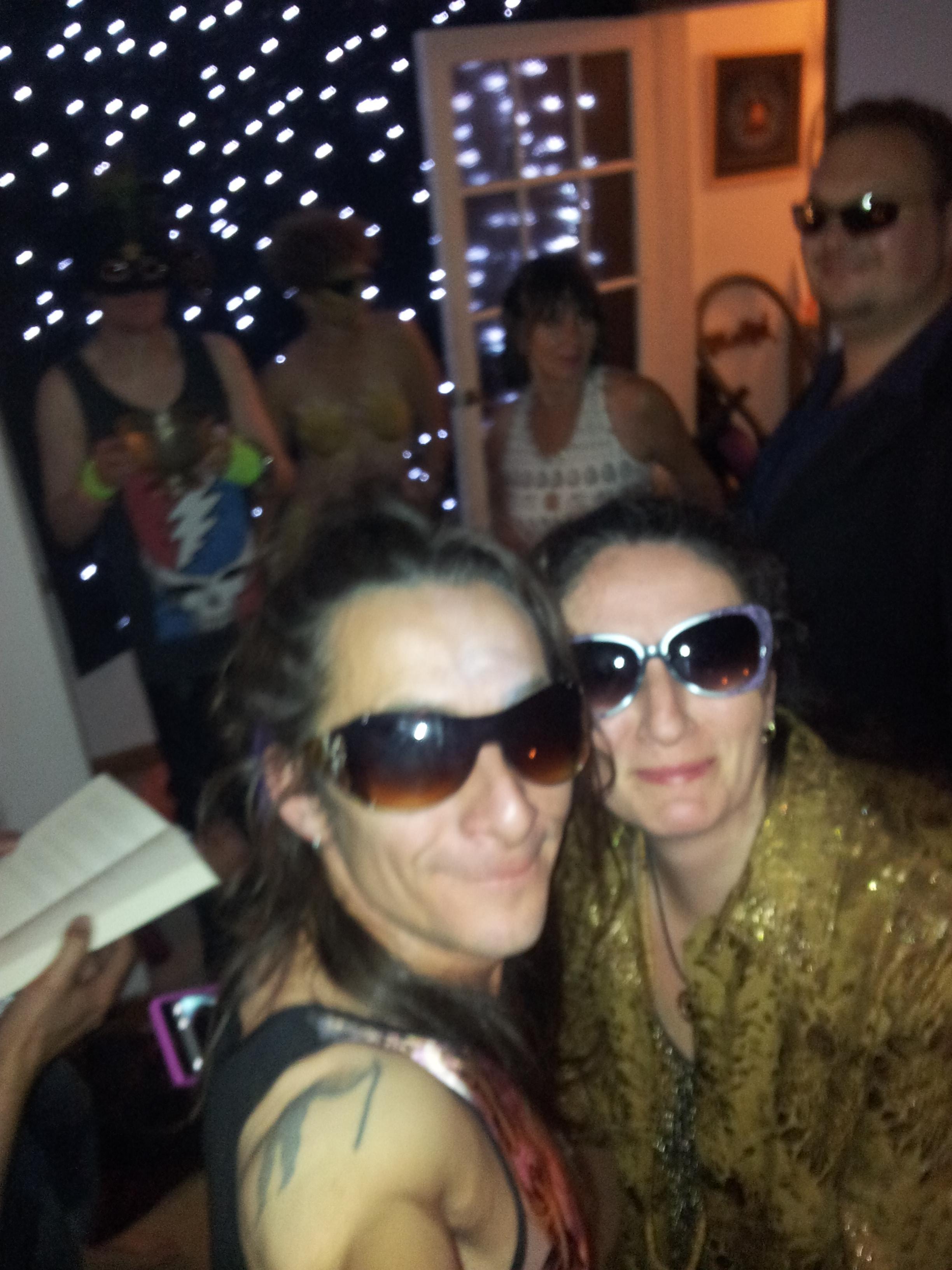
For the final rite we invoked Set, the principle of the isolate intelligence, the separate sense of self and of being-in-the-world (see p133 HERE). Then, emerging from the darkness into the light of the sun god Ra, we each put on an outfit we’d brought especially for the purpose. There were sharp suits, feathered masks, leopard print high heels, gold body paint and much more besides! There was dancing, mutual admiration and a photoshoot!
Stars in their eyes

Stars in their eyes

Celebrating our unique individuality and ourselves is something that, particularly perhaps in Britain, people get uneasy about. We don’t want to seem big headed which is fair enough. However we need to recognise that it’s okay to celebrate in this way, and that to big ourselves up doesn’t mean we have to put someone else down. Quite the reverse – in fact, for as my OTO Brother might remark; ‘Every man and every woman is a star’.

Some sounds for Yellow Gold magic HERE, HERE and HERE – enjoy!

JV

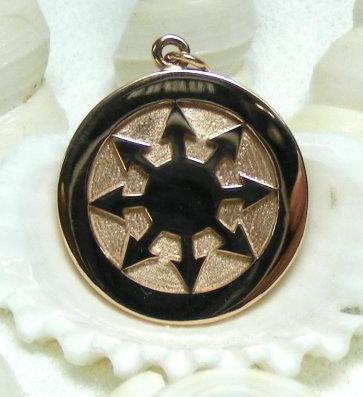
Picture of the gold chaosphere pendant owned by Nikki Wyrd courtesy of the artist Russell Lownsbrough @ http://www.whaleandsmith.co.uk/
The Magical Technology of Fotamecus

Fotamecus is a spirit that I’ve worked with for several years, an entity with the power to assist us in expanding or contracting our subjective perception of time. I say ‘subjective’ advisedly – while we live in a world of atomic clocks and the connected pulse of internet timekeeping – as Dr Who observes, “People assume that time is a strict progression of cause to effect, but *actually* from a non-linear, non-subjective viewpoint – it’s more like a big ball of wibbly wobbly… timey wimey… stuff.”

Clocking the nature of time

Clocking the nature of time

I’ll give you a recent example. I needed to catch a train and had set out from home just a little too late. The inveitable morning traffic jam meant that I arrived into town only 7 minutes before the train was due to leave. While waiting at a roundabout on the road, watching the digital clock in my vehicle tick inexorably away, I chanted the name Fotamecus and deployed the Slow Time mudra. This is one of three mudras that were developed during the rituals which attended the filming of Chronomancy (I’ll explain the tech. in a moment).

Arriving at the railway carpark I had moments to spare. I grabbed my belongings and rushed into the station. In front of me a man was buying a complex ticket but even so I was still able to pay for mine and successfully board the train. Once sat down I used the Reset Time mudra to put time back into its normal course, and mentally thanked the Fotamecus spirit for its assistance.

Now of course as a chaos magician there are numerous ways in which I can look at the sequence of events above. I could say that psychologically the effect of placing my trust in an (apparently) external entity (ie Fotamecus) allowed me to relax and not to get flustered (and end up wasting time by doing stuff like dropping my keys, fiddling for change in my wallet, forgetting that I has already got the number on my phone needed to pay for my parking and so didn’t need to use the machine in the car park but could pay for the service once onboard the train).

Then there is the inner scientist which says ‘well hey, what about all those times where you used Fotamecus and it didn’t work?’ However the answer to that is ‘there aren’t any’. Now this doesn’t mean I, Fotamecus or whoever has absolute control over time. Had I left my house even later, or the traffic had been even more heavy, I probably wouldn’t have bothered with any magical shenanigans, but would have simply accepted the fact that I’d have to drive to my destination rather than take the train. This is part of the trick of magic. That the magician seeks to bend reality, to warp the possible futures of experience. There is little or no point in casting spells to achieve highly improbably outcomes. The skill of applied magic is finding where some wriggle room in a system exists and placing pressure skilfully there. (The story of the Taoist Butcher explains this beautifully.)

Then there is the animist or spiritist view of Fotamecus. That this is an entity which exists in something like another dimension (usually called the astral plane or whatever). This could means that the manifestation of this entity is a warping of the 4th dimension (duration) which has effects in the first to the third dimensions (the world of apparent objects). The spirit doesn’t exist only in a separtate reality but has some form of agency because of its emergence in dimensions beyond the 4th (check out this nice video, previously posted by Sef to this blog, to wrap your brain round multi-dimensional reality HERE). This means that what the spirit can do in our apparent reality can look miraculous. The emergent properties of the spirits’ character, and its abilities, may well be rooted in the 3D world (they exist as names, gestures, films, images etc) and are really no more tricky to explain than the fact that a cascade of chemical interactions emerges to form your mind reading this text.

So let’s get down to some magic-tech…

Developing a relationship with the spirit

It’s polite to develop a relationship with anythng your going to work with – people, entities, entheogens, tools. In the case of the spirits there are various models of how to do this. Perhaps one of the most obvious is the notion of feeding the spirit. In the case of Fotamecus I recommend the following:

Spend some time getting to know the spirit. Read its back story (some of which is HERE). Maybe create your own sigil, or use one of the ones that have already been connected to this entity, and place this on your altar or perhaps beside a clock in your home.

Have a party for Fotamecus. In Britain I do this when our clocks change; forward an hour in the spring and back an hour in autumn. Decorate the sigil or other represetentation of Fotamecus with suitable offerings (clock parts and dandelions for example). Watch films that you think Fotamecus would ‘like’ (aside of Chronomancy movies like MomentoRitual in Transfigured Time or Back to the Future  and lots of others, would work). Chant the name Fotamecus as an offering of practice – experiment with doing this slowly, faster etc.

Devotional Fotamecus wallpaper

Devotional Fotamecus wallpaper

Using the Fotamecus Mudras

These are three mudras designed for empty handed magic. They are based on one of the forms of sign language. They are best deployed after chanting the name of Fotamecus (at whatever speed or volume) to get into a light trance state and of course having first made your own connection to the spirit.

To slow time down: Extend your left arm, palm down, and slowly move the palm of your right hand up the left arm, stroking it from fingers to upper arm. This is a slow movement.

To speed time up: Hold your thumb, index and middle fingers out beside your right ear. Now quickly move your hand forward so the arm is outstreched, with the fingers closing as the arm reaches full extension (rather as though catching an insect).

To re-set time: Place the palms of both hands over the forehead, thumbs extended. Now pull the hands apart so that the hands end up roughly over the shoulders. As you do this the thumbs and fingers fold in (imagine you are strectching out an invisible blob of  ‘timey wimey’ something between them). As you make this mudra close your eyes for a moment.

Experiment with these techniques for yourself (and, of course, create your own) and you too can discover how time is on your side 🙂

Enjoy!

JV