Recently I had the opportunity to be involved in an ‘Alice in Wonderland‘ working – a type of psychogeographical ceremony that saw participants moving around a series of ritual spaces in which they would encounter The Cheshire Cat, The Caterpillar, Tweedledum and Tweedledee and other denizens of Lewis Carroll’s fabulous tale. I’d worked with the Wonderland current previously and always found it really engaging. Alice’s Adventures in Wonderland reminds me of Crowley’s dramatic, if less entertaining, Book of the Law in that it is a text with many layers of meaning. On one level this is a charming children’s story, on another it points to the surreal and disorientating experience of trying to make sense of the world (which can be tricky at the best of times, whether we are younger or older people). Alice is full of parody and play – from the personal (The Mock Turtle could well be artist and critic John Ruskin) to the universal (as a mathematician Lewis Carroll makes plenty of references to numbers and logic).
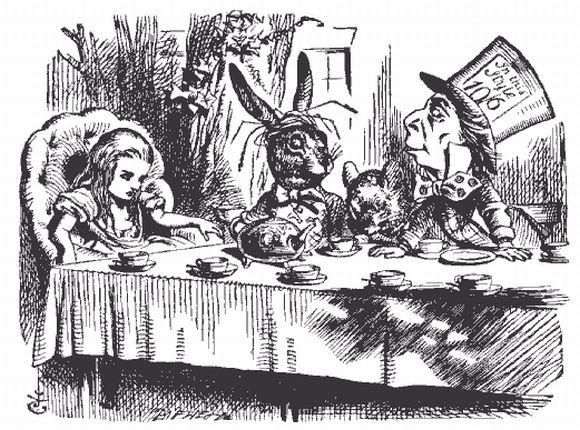
“We’re all mad here…”
One of the important elements of the Alice mythology is that of confusion. All those things that Alice thinks she knows, from popular poetical verse through to the shape of her body, are no longer to be relied upon. Given the uncertainty and disorientation of the text itself it’s hardly surprising that the character of the author, real name Charles Lutwidge Dodgson, is also called into question. There is (perhaps) a sexual element in the Alice narrative; certainly a dream-like and maybe a drug-induced reading of the tale. Jenny Woolf, author of The Mystery of Lewis Carroll, writes:
“…Dodgson’s image currently stands — in contention — among scholars if not yet in popular culture. His image as a man of suspect sexuality “says more about our society and its hang-ups than it does about Dodgson himself,” Will Brooker says. We see him through the prism of contemporary culture—one that sexualizes youth, especially female youth, even as it is repulsed by pedophilia. The nature of his relationships with Alice, with other girls and with women may never be established with certainty. But then, uncertainty is a consistent theme in the Alice books.”
Aside of the controversy surrounding Dodgson himself and the obsessions of contemporary society (which in popular cultural settings, rather than legal ones, are often about vilification and scapegoating behaviour and rarely about supporting victims of abuse or challenging actual coercive processes), Alice points to something very important. In Victorian times as today many voices within civilisation seek to create simplistic polarisations of people, objects and behaviours. There are the Good Guys and the Bad, the Unknowns and the Celebrities, the Heroes and the Victims. These categories, and the narratives we expect to be associated with them, must be easily explained & digested before the end of the Youtube clip or the start of the advert break. Yet as Carroll points out in his work (I mean Lewis, though the same may be said for Peter J.Carroll) the world is complex, sometimes disorientating and at times can appear quite mad. So rather than take refuge in simplistic assertions and slogans of ‘us versus them’, a wise course of action (which Alice demonstrates in the novels) is to act in the moment, to keep your wits about you, to be prepared to sit with uncertainty and to consider a range of possible readings of what the world presents to us (especially if it does so by claiming to be ‘The Truth’).
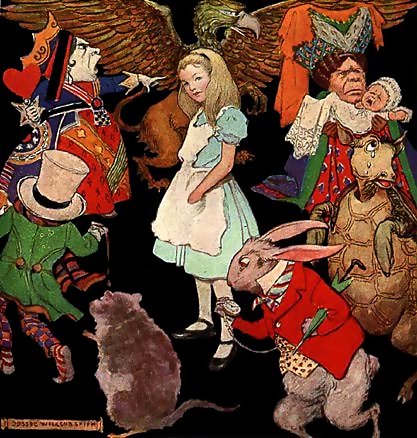
“Will you, won’t you, will you, won’t you, won’t you join the dance?”
The child-like quality of Alice, in a more playful way than the ravings of Crowley’s Hawk-Headed kid out of Liber AL, points to the existential situation in which thoughtful people find themselves today. We’re thrown upon the stage of life and, while the absence of clear rules can be a source of conflict and confusion, it also represents the opportunity for us to radically remake things both personally and collectively. Could this be what magicians, with our project of autopoiesis, are all about? Perhaps part of our social role is to help others embrace just such an open-ended, curious and mutually respectful engagement with world? A world where, as in Wonderland, things are not fixed but ebb, flow and change. As someone who works in a variety of educational situations my own experience certainly bears this out. What matters more than either facts or opinions is the ability to be curious,, to meet new ideas in a playful spirit of ‘what if?’ Sure information, evidence and real data do matter (as well as discerning the origins and agenda implicit in all information) but without a questioning frame of mind, information can get overlooked and supposed ‘facts’ may be absorbed without discrimination or discussion. This makes for more, rather than less, ignorance. Being open-minded and good critical thinking actually go together, whereas ranting certainty usually betokens a blinkered and often oppressive attitude to our being-in-the-world.
And as magicians who, to use a modern Wonderland derived metaphor, have eaten the ‘Red Pill’, we know that the world is a strange and marvellous place. A place where it’s good to remember and indeed celebrate our uncertainty. As Pete Carroll puts it, ‘Nothing may be absolutely true, anything may prove possible’ or to quote Alice herself “Who in the world am I? Ah, THAT’S the great puzzle.”
 The Blog of Baphomet