Enchant Long…

The maxim to ‘enchant long and divine short’ is one of the many bits of wisdom from the work of Pete Carroll. The suggestion is simply that if we want to create magical effects we’re generally better off casting our desires into the reasonably distant future, into situations where there are lots of variables that might be tweaked by our spells. Meanwhile divination is best done ‘short’. As with predicting the weather it can prove reasonably successful a few days ahead for a given region, but long range forecasts (especially over larger areas) are no more accurate than simple guesses. While flashes of insight can and do occur for the skilled diviner, divination tends to be primarily about allowing the querent to reflect on their own situation at the moment of the reading, and to empower them to understand their possible options in a given situation.
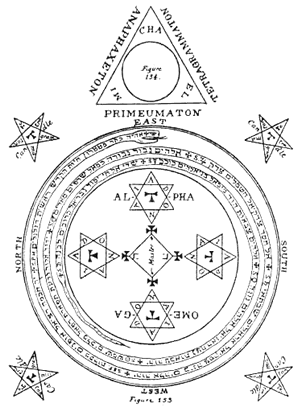
from a book of long enchantments

from a book of long enchantments

If we consider a Left-Hand Path style of magic the injunction to ‘enchant long and divine short’ can result in some interesting ethical effects. Let’s take the example of long-term enchantment. We know that our self changes and, whilst it’s true there is a ‘narrative centre of gravity’ (to use a term borrowed from phenomenology and hermeneutics) our needs, desires and our identities can and do change. With this in mind a long-term enchantment requires the magician to see the problem (their desire) not in terms of the (immediate) self but as part of a much bigger picture. This transforms what can initially arise as a grasping, outcomes-driven personal need, into something greater and more inclusive.

As an example; a couple of magician friends of mine, some years ago, were diagnosed with viral hepatitis. This is a blood borne infection for which, at the time they contracted the virus, there was no known cure. Obviously as magicians we wanted to address this problem; and while sometimes ‘miraculous’ healing does take place (in my experience this typically manifests itself as the patient discovering that they have been ‘misdiagnosed’ and that the illness that threatened has literally vanished), it’s best to take advice from Mr Carroll and learn to play the long game.

In this instance the work that we pursued was not limited to healing our friends but instead focused on finding a cure for hepatitis. As anti-viral technology developed it also became necessary to work on affecting the cultural and financial side of the pharmacological industry (there was, for example, one period when two firms were peddling rival drugs that actually worked best when taken in combination). The long-term result of this work is that both my friends are now thankfully clear of the hepatitis virus and all the health problems associated with that infection.

While it’s impossible to be certain that our muttering of spells, invocation of spirits or deployment of magical Clingfilm (really) helped these scientific developments (we can’t of course re-run the control experiment of this bit of medical history where we don’t do the magical work) the bottom line is my friends are now healthy and well. The bigger benefit is that tens of thousands of other people on the planet are well too, and it’s this process that lifts the ‘narrow’ desire-oriented LHP style magick into something that looks much closer to a Vajrayana path; we use our own personal desires (for specific outcomes or for illumination/enlightenment) and skilfully deploy these in order to achieve an outcome where all beings become liberated.

When you’re doing ‘results magic’ for yourself why not consider how to play the long game and if there is a way of getting not only what you want but helping many others into the bargain? The example above involving healing magic is ideal; rather than working simply for your own (or your clients) health, consider all those others who share the same problem. Conversely when doing divination, rather than trying to scry the actions of complex networks, focus your questions on what you (or the querent) can do in a given situation. Considered through the lens of a LHP  approach any divination will emphasise personal responsibility, empowerment and agency.

Perhaps this allows us to expand Pete’s dictum to: ‘Enchant long and global, divine short and personal’. In works of enchantment let go the individual desiring self, consider the bigger context of your magick and, by skilful means, get much more bang for your esoteric buck. In works of divination give up the illusion that you are without agency and discover the most empowering way to adapt to the situation in which you find yourself.

JV

Season of the Spiders

Autumn comes to the valley in which I live. The warm sunshine is still (Sunna be praised!) with us, but the pivot point of the September equinox has passed. Mist shrouds the trees in the morning  the leaves of the willows fill up with yellow and fall down upon the moist green earth.

This is the season of the spiders, when these miraculous beasts spin their webs between the fast dying stems of grasses. In common with many humans I deeply admire the tenacity and technical skill of spiders. I watched one recently in a still-scented honeysuckle bush, dealing with a yellowed leaf that had become entangled in its web. She (I usually think of spiders as ‘she’, because reasons) carefully made fast some gossamer lines. She ran new strands from her spinnerets and carefully cut other silks. The leaf went swinging out from the face of the web, dangling, quite literally, from a thread. Then she sat for a while, me watching intently to see if she would slice the final connection. She didn’t, and looking down, I could imagine why she had stopped. The leaf hung now away from the prime killing zone of her trap, it was no longer an impediment to her. Had she cut the final strand there was a distinct possibility that the leaf would have become caught on one of the lower main strands supporting her web. If the leaf landed in this position it would have been very hard to remove, and she could have risked the structural integrity of the whole network. Instead she chose to let this now minor irritation stay, to make the calculation between risk and benefit and decide she had done enough.

Araneus diadematus hangin' out

Araneus diadematus hangin’ out

As in the fabled story of Robert the Bruce the spider is an instructor. In the context of the spider I observerd, she teaches an approach to the things in your life that are irritations, things that get in your way. These things may be social issues (your tiresome ex-partner is still obsessively bad-mouthing you), physical difficulties (you notice that your back problems are getting worse, inevitable as you age) or more esoteric problems. The lesson of the spider (in the honeysuckle) is that you really don’t always need to finish the job. Sometimes good enough is simply good enough. If you’ve already done all that’s needed to get your irksome ex out of your circle of friends, if you’re doing exercises aimed at strengthening your poorly spine and so on, then that may be sufficient. Save your energy for what matters (in her case sucking the life blood from flies) and strengthen your core. Don’t waste attention on that which is good enough, especially if, by trying to completely resolve the problem, you risk ending up with diminishing returns or even upsetting what you have already achieved.

Meanwhile inside my house another lesson from the spiders. A voluptuous garden spider had spun her web right across my kitchen window while I was away at a conference in Cambridge. Upon my return I noticed her handiwork, a lovely circular web of almost Platonic perfection. While I do groove on that Goth style I was minded to remove her until I considered the implications of doing so. On my windowsill (which is pretty deep, it being an 18th century building) sit a number of pot plants. These include aloe vera (essential medicine for minor burns), various exotic cacti and more delicate plants. One in particular is very susceptible to insect attack (this beautiful herb reproduces by getting humans to make cuttings of it, and rarely flowers or sets seed). So why move my arachnid guest, especially when she is protecting my indoor garden?

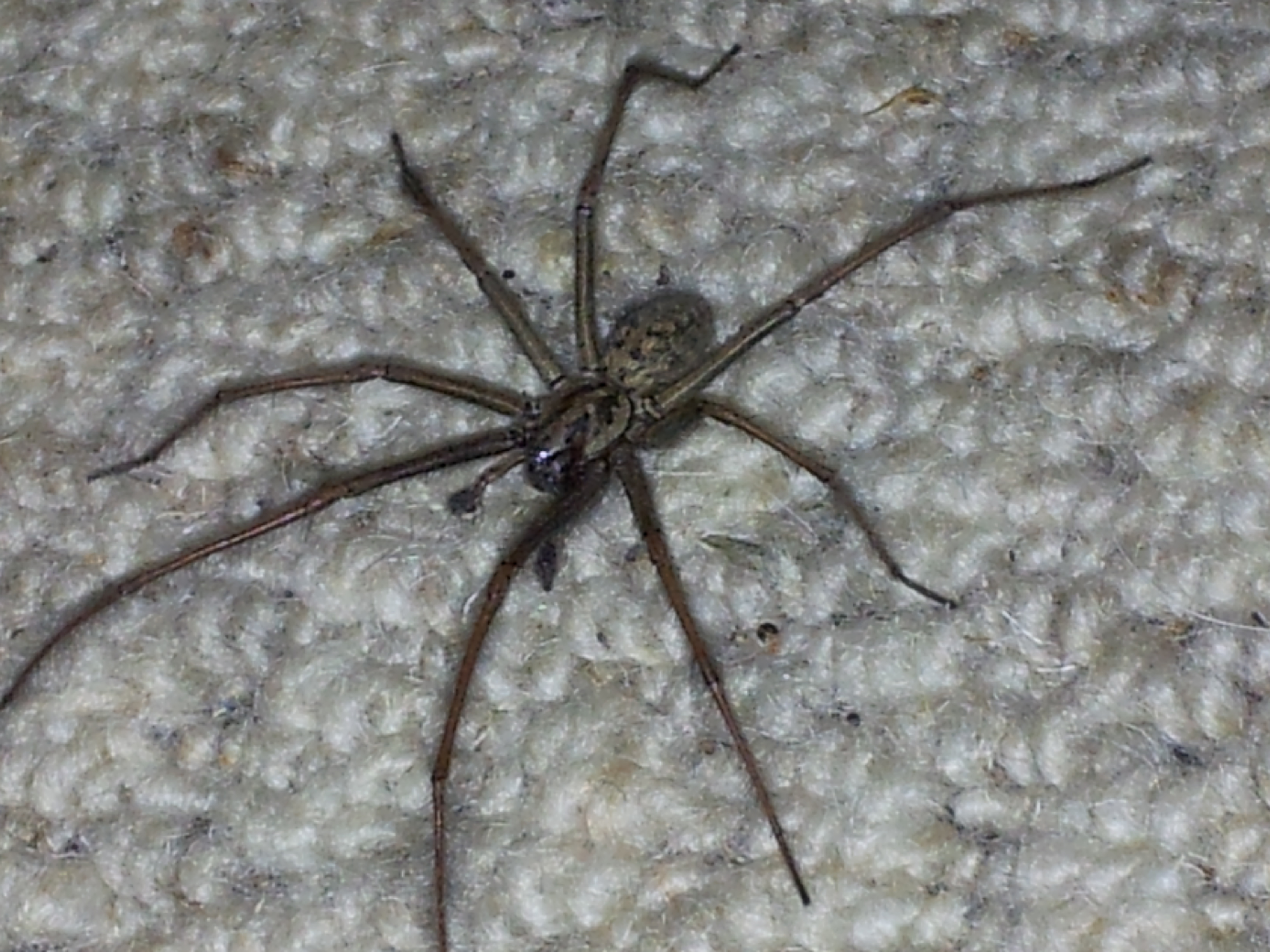
Another spider who made an appearance in my living room last night was a giant house spider. As autumn arrives so the males of this species leave dark and unmolested webs in the corners of buildings. They race across the prairie of the carpet in the hope of finding a mate. Typically we encounter these chaps when they get stuck in the bath. Whether spotted in the tub or on the prowl along the floor there is a tendency for folk to capture them and ‘set them free’ in the garden.  This reaction is understandable. We think of our homes as ours, they are the modernised caves in which we dwell. We’ve bought and paid for them and any other living things inside (pets, plants, children etc) are there because we’ve put them there. Spiders are also, for possibly evolutionary reasons, creatures than many of us are nervous of. Best get their weird eight-legged forms out of our house.

However again the spider has a teaching, and that is that all our spaces are in fact shared. Whether we’re talking about the immense amount of microbial life that swarms inside and upon our bodies, the dust mite denizens of our beds, or our much bigger (and therefore more obvious) eight-legged housemates. We are actually surrounded by other lifeforms all the time.  There are very few environments in which humans find themselves where other lifeforms don’t exist (there are perhaps even bacteria on the outside of the international space station as well as those in the guts of the crew). Typically you’re never more than a couple of meters away from an insect and of course the very air we breathe is seething with bacterial beings. Speaking of spiders, several species are specifically linked to human dwellings. We are part of nature, we make and shape habitats, and in any given environmental niche lifeforms will find a foothold; fleas, silverfish, rats, pigeons, foxes, hawks, mice….the list goes on…

Eratigena atrica on the prowl

Eratigena atrica on the prowl in my front room…

While some of us might imagine that we have few dealings with other creatures in our day-to-day lives actually, if we stop and look, other non-human persons are all around us. These facts are one of the considerations that makes that old chestnut, that modern pagans are necessarily cut-off from nature, untenable. We can learn from the attercop racing across the kitchen floor, that this is his territory too. Paying attention to our needs, as I did with the arthropod who now protects my house plants, we can often enter simple, mutually beneficial relationships. And as we observe and interact with these beings, these spirits, we can learn from their wisdom.

JV