A Mindful Mass to Sophia

In a recent interview that I did about Chaos Magic and Gnosticism, the interviewer was keen to understand more about the process of ritual creativity that Chaos magicians often engage in. For me personally I am engaged in an on-going journey of exploration, research and poetic inspiration as I seek to make deeper sense of the material that I’m digging into.

Anyhow, I thought I’d provide a recent example of such ritual practice that probably gives you a feel for how we go about such work. Such ritual outlines are not meant to be prescriptive; rather they are serving suggestions to inspire your own innovation and creativity.

The purpose of this ritual was to creative a ritual environment in which the concept of divine wisdom could be explored via the Gnostic figure of Sophia. Via the use of both poetry and meditative technologies, we were seeking new insight regarding holy wisdom and a sense of deep listening as to how future work should proceed.
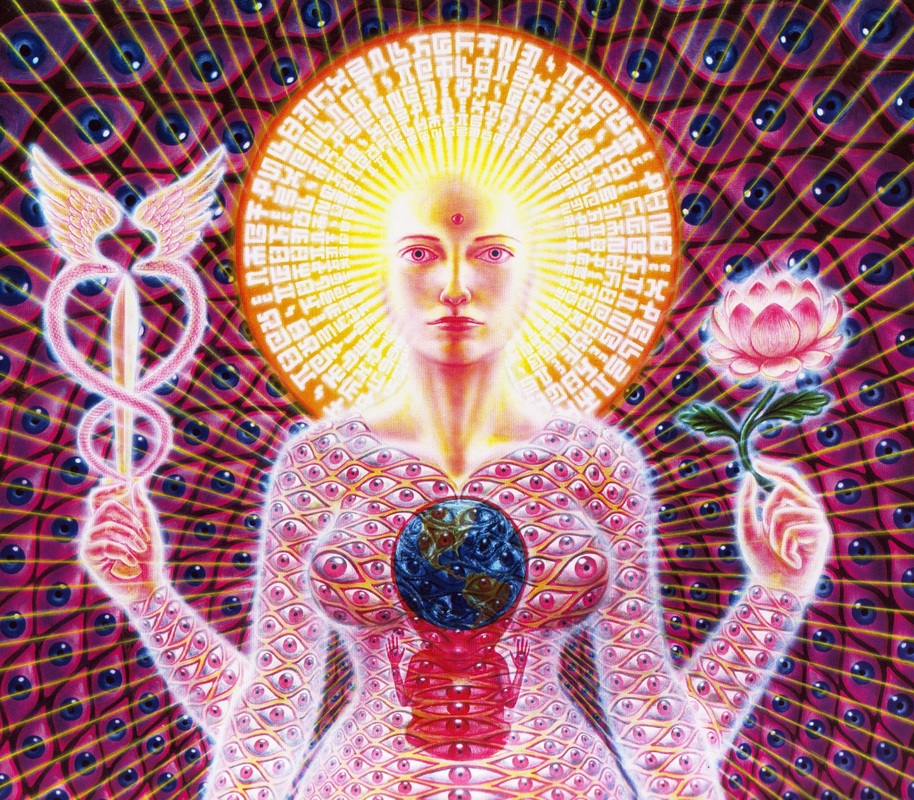
Wisdom hath builded her house, she hath hewn out her seven pillars

Wisdom hath builded her house, she hath hewn out her seven pillars

Opening with singing bowl rung in the 8 directions.  

“We begin in Silence and Space

The realm of the Pleroma

The marriage of Darkness and Light.”

8 Breaths taken together.

“In the pregnant space of reflection

Wisdom is born

Glowing deep blue against the blackness

Silver Star points glow

As the holy Aeon descends

And gives birth to life.

Selah

20 minutes Mindfulness practice – using awareness of the breath as an anchor for awareness and gently surrendering thoughts, feelings and bodily sensations as they arise. 

“Wisdom makes manifest

An outflowing of the multiple and the complex

The Craftsman makes the World

Soul glows and breaths:

“I was sent forth from the power,

and I have come to those who reflect upon me,

and I have been found among those who seek after me.

Look upon me, you who reflect upon me,

and you hearers, hear me.

You who are waiting for me, take me to yourselves.

And do not banish me from your sight.

And do not make your voice hate me, nor your hearing.

Do not be ignorant of me anywhere or any time. Be on your guard!

Do not be ignorant of me.

For I am the first and the last.

I am the honored one and the scorned one.

I am the whore and the holy one.

I am the wife and the virgin.

I am the mother and the daughter.

I am the members of my mother.

I am the barren one

and many are her sons.

I am she whose wedding is great,

and I have not taken a husband.

I am the midwife and she who does not bear.

I am the solace of my labour pains.

I am the bride and the bridegroom,

and it is my husband who begot me.

I am the mother of my father

and the sister of my husband

and he is my offspring…..

I am the silence that is incomprehensible

and the idea whose remembrance is frequent.

I am the voice whose sound is manifold

and the word whose appearance is multiple.

I am the utterance of my name.”

(Excerpt from Thunder Perfect Mind.)

Trance drumming.

During this ritual we had three drummers all using the technique outlined by Michael Harner, where trance is induced through the use of a consistent drum beat of around 200 beats per minute.

After the trance period and drumming ceases the following words are spoken:

“The many forms beget Joy

But also the forgetting of our original face,

We give thanks for these moments of stillness and remembering!

Wisdom calls:

“Does not wisdom call out?
Does not understanding raise her voice?
At the highest point along the way,
where the paths meet, she takes her stand;
beside the gate leading into the city,
at the entrance, she cries aloud:
“To you, O people, I call out;
I raise my voice to all humanity.
You who are simple, gain prudence;
you who are foolish, set your hearts on it.
Listen, for I have trustworthy things to say;
I open my lips to speak what is right.
My mouth speaks what is true,
for my lips detest wickedness.
All the words of my mouth are just;
none of them is crooked or perverse.
To the discerning all of them are right;
they are upright to those who have found knowledge.
10 Choose my instruction instead of silver,
knowledge rather than choice gold,”

(Proverbs 8 1-10.)

Close with three bells.

SD


In my recent post I mentioned the concept of ‘soul making’. This notion appears in a number of contexts. One of the earliest is in the Ireanean theodicy inspired by the work of Saint Irenaeus, the second-century philosopher and theologian. The Ireanean view is that creation happens in two stages. This process requires the existence of suffering and evil, making the world something akin to schoolroom for the soul. The creation of a soul is the work of humans, their aspiration being to become perfect and like God.

Soul Brother

Soul Brother

This ritual grows out of a desire to explore these ideas, concepts related to the tension between the (theoretical Platonic) perfect creation and the (apparently) flawed world of the Demiurge. Through this meditation, this trance and these words we have a space to encounter imperfection, suffering, pleasure and those other abstractions that so fascinated the ancient Gnostics.

Soul making also appears as an important concept in the work of psychologist and Jungian analyst James Hillman. The Wikipedia entry for Hillman nicely summarises this:

The poetic basis of mind places psychological activities in the realm of images. It seeks to explore images rather than explain them. Within this is the idea that by re-working images, that is giving them attention and shaping and forming them until they are clear as possible then a therapeutic process which Hillman calls “soul making” takes place. Hillman equates the psyche with the soul and seeks to set out a psychology based without shame in art and culture. The goal is draw soul into the world via the creative acts of the individual, not excluded [from] it in the name of social order. The potential for soul making is revealed by psychic images to which a person is drawn and apprehends in a meaningful way. Indeed the act of being drawn to and looking deeper at the images presented creates meaning – that is, soul.

Thus this ceremony is an encounter with this Gnostic ‘realm of images’ and, critically through drumming, emphasising the encounter as a somatic as well as intellectual event. This is Gnosticism but one that includes, rather than rejects, the world of the flesh. Fathoming suffering and the vicissitudes of life not as the result of a Fall from grace but perhaps as a necessary proving ground for the unfolding of a divine Self.

JV

Adapting our Religions and our Pacts

I was told an amusing and instructive story recently by my Brother. He was relating an experience of a Mexican shaman we know who had been leading a ceremony in Miami. In the style of ceremony being performed it is conventional, after a person has finished speaking, to say ‘Aho‘. This is a contraction of the Lakota phrase ‘Aho Mitakuye Oyasin‘ which translates approximately as ‘I understand this [the prayer/offering/song etc] is for all my relations [ie all the beings of the universe], so be it! These ceremonies are typically very heart-felt, devotional and thanks-giving styled affairs, and so the presiding shaman felt he needed to find out what was going on with the Japanese guy in the circle. You see every time someone said ‘aho’, even if this was at the end of a powerful and emotional prayer, the Japanese man would giggle uncontrollably. The reason my shaman chum discovered was a simple trick of language. ‘Aho’ in Japanese means ‘stupid’ and that was the joke. Every time someone said something poignant or passionate they would finish by saying ‘stupid’! (And be echoed by all the rest of the circle.) Moreover when I checked this out the Japanese ‘aho’ (あほ), actually one of several possible ways of saying ‘stupid’; means something (as I understand it) less like ‘silly’ and more like ‘retard’!

This is just one of many examples we can find where particular religious customs don’t travel very well in our global culture. Another might be the fact that in British cities with high levels of immigration from the Middle East and North Africa traditional religious dress may be responsible for health problems. Long sleeves, robes and even veils mean that people (presumably especially women) don’t get sufficient exposure to the sun, and this means a lack of vitamin D. Various regional authorities have issued health guidance and, where necessary, vitamin supplements to address this problem.

alchemical sun-substance

alchemical sun-substance

Texts from religions which had their genesis in the arid regions of the world are of course full of prohibitions and practices which worked perfectly well there (and then) but make no sense, or are even actively dangerous, in other latitudes (and times). Not eating pork, keeping milk and meat separated when preparing food – these and other traditions made sense thousands of years ago, in the days before refrigeration, canning and many other inventions. But not when these behaviours are transplanted to places where rain and mould are more in evidence than blazing sun.

When we speak of tradition we’re always talking about something that imagines it’s conservative but, when considered over time and geography, is actually something highly diverse and adaptable. No matter how much literalist fanatics (and fantasists – since, as I said ‘traditional’ change is inevitable) claim that one must stick to some imagined letter of the law (be that law of Moses, Muhammad or even perhaps the Master Therion), praxis will and must adapt (or die).

Maybe the only issue (of the fitness of the belief ‘meme’) is whether that religious impulse – whatever inspired it and holds it as valuable in the mind of believers today – has the skills to adapt. The same may be said for beliefs such as Wicca or chaos magic. These traditions (which inevitably claim to be distinct and special – chaos magic for example claiming that it is not a belief but a ‘meta-paradigm’ and therefore super cool, and different, when compared to anything else…) inevitably have their roots in a specific time and place (in both cases cited – the 20th century British Isles). However these esoteric beliefs too must, perforce, adapt and change if they have, and are to have, any longevity and meaning.

In the case of Wicca this may mean the change from the apostolic succession of Gardnerian/Alexandrian lines and the absorption of a healthy dose of the earth-centred approach and pragmatic spell-craft of ‘Traditonal’ witchcraft and shamanism. In the case of chaos magic this may mean that new ‘Pacts’ (in the sense of ‘gentleman’s agreements’ to politeness and mutually beneficial working relationships) may be formed. (And of course ‘pacts’ are binding, like ‘religio‘ that binds us into our shared beliefs). While I have no doubt that Orders such as the IOT will remain useful networks for (primarily) in person group collaboration, other pacts (the full name of the IOT is actually ‘The Magical Pact of the Illuminates of Thanateros‘) are being created (especially where face-to-face interaction may not be possible or desired). A great example of this is within on-line communities such as the wonderful Chaos Magick Group (CMG) in Facebook.

The morphing banner of chaos

The morphing banner of chaos

In the (embrassingly recent) past I’d opined that I hadn’t seen much collaborative action emerging from such virtual groups. Sure there had been alliances within those spaces (including for shared ‘results’ workings) but nothing (that I’d seen) emerging beyond those groups to enrich wider occulture. However this is changing (or perhaps I’m finally noticing what’s happening and getting with the program…).

A recent collaboration within CMG has produce not one but two excellent albums of music (ranging from beautiful songs, through to ritual soundscapes). You can check these out HERE and HERE. There’s also a fabulous tarot deck which, through the power of the mighty Admins (in a manner reminiscent of herding numerous punk majix Nyan cats…), has been collectively produced by tens of artist/chaos magicians. This deck will be available for purchase soon, and details related to it, plus a sneak preview of a few cards, may be found HERE.

I’ve also been deeply impressed by the collective intelligence demonstrated in CMG and a number of other on-line chaos magic(k) pacts. CMG, for example generally maintains a wonderful level of ribald humour, deep respect for diversity, but also the strength of collective character to be able (even in such a liberal space) to eject people who are currently unable or unwilling to not be arse-holes when communicating with their peers. I’ve seen people (certainly including myself) learn in those this virtual space. Plan, plot and execute cooperative actions, have fun, argue (respectfully), fall in love and even find Illumination (as well as posting some hilarious cat/rabbit/boat/other memes…).

Let’s celebrate rather than bemoan these adaptations, of our religions, our beliefs, our practices, and our pacts as magicians. Let’s notice where we are, in different language communities, different lands on the earth and locations in cyberspace, and let these environments inform what we do. May these new forms of faith, and the pacts we make to explore them, flourish in all their exciting diversity!

Aho! 😉

JV