On being a Priest

While some aspects of esoteric endeavour can be highly personal and private there are others that are profoundly relevant to other people, including those who aren’t necessarily into all that other spooky occult stuff. The work of the celebrant or priest(ess) is one such example of this.

Over the years I’ve been asked to perform numerous handfastings, namings, house blessings and, so far, one requiem. Many of my magical colleagues have also done rites of this type. Sometimes we are asked by people who are card-carrying pagans, while at other times I’ve been asked by ‘friends of friends’; people who might want a ceremony that sits outside of the Anglican Christian framework which remains (though in a greatly attenuated form) as the default style for rites of passage among many folk in the British Isles.

The work of the celebrant provides some measure of the significant social role played by shamans in indigenous cultures. While it’s actually not that easy (or respectful or ethnographically meaningful) to generalise about shamanism and it’s social meaning in different societies, it is perhaps fair to point out that the shaman’s role, in many cultures, is seen as being socially relevant. For all our trappings of magic circles, demonic seals, mystical titles, temple bling and the rest – to many ‘outsiders’ much of occulture looks little different from slightly-bonkers live action role play. However, by being asked by our broader community to help provide rites of transition, we are performing the key role played by esoteric specialists (be they shamans, priests or others) in many cultures both past and present.

Creating a good ritual is important. I was recently asked to provide a marriage ceremony for two friends who were getting wed on the island of Sicily. The rite I created (in close consultation with the happy couple) had to make sense, and be emotionally moving for them plus 10 British guest and 40 Sicilians (from the bride’s family). Fortunately the neo-pagan canon and my own experience meant that I was able to hold the space successfully to create an experience which uplifted everyone there. Simple, almost universally understood acts – exchanging rings, asking people to give a blessing and offer a candle to the couple, a circle of flowers within which they might stand, consecrating their union with earth, with water, air and fire as they held hands, and finally a kiss. This is the language of simple ritual, handily getting round the need for too much translation for either English or Italian speakers. People cried – in a good way – and one chap (who actually turned out to be a member of the  Carabinieri) was really taken with the whole thing (‘magificane , bello , spirituale!’), which was nice.
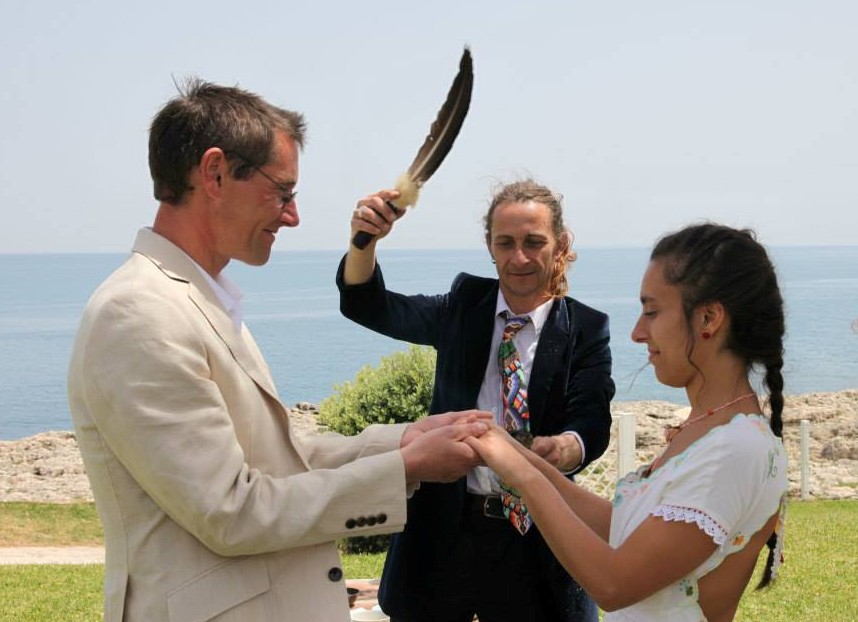
The blessing of air, Sicilian style

The blessing of air, Sicilian style

As with much group ritual, creating a good handfasting or other ceremony is often a collaborative work. It’s important to be able to listen to the needs of the people involved as much as coming with one’s own preconceptions about how things ‘should’ be done. It’s important to be able to adapt to local circumstances too. For example at a recent wedding that Nikki Wyrd and I did in North Wales, we wanted to incorporate the ‘traditional’ jumping over the broomstick. Rather than do this at the ceremony itself we waited until the morning after (the main rite took place by the sea and carrying a broom down the scramble to the isolated cove we were using wouldn’t have been easy, moreover the dramatic reveal of the broom itself would have been spoiled). Given the style of the people we were acting as celebrants to, rather than a classic besom we instead bound ribbons around their own yard brush. Combining the magical and mundane in a way we judged would both amuse and move them.
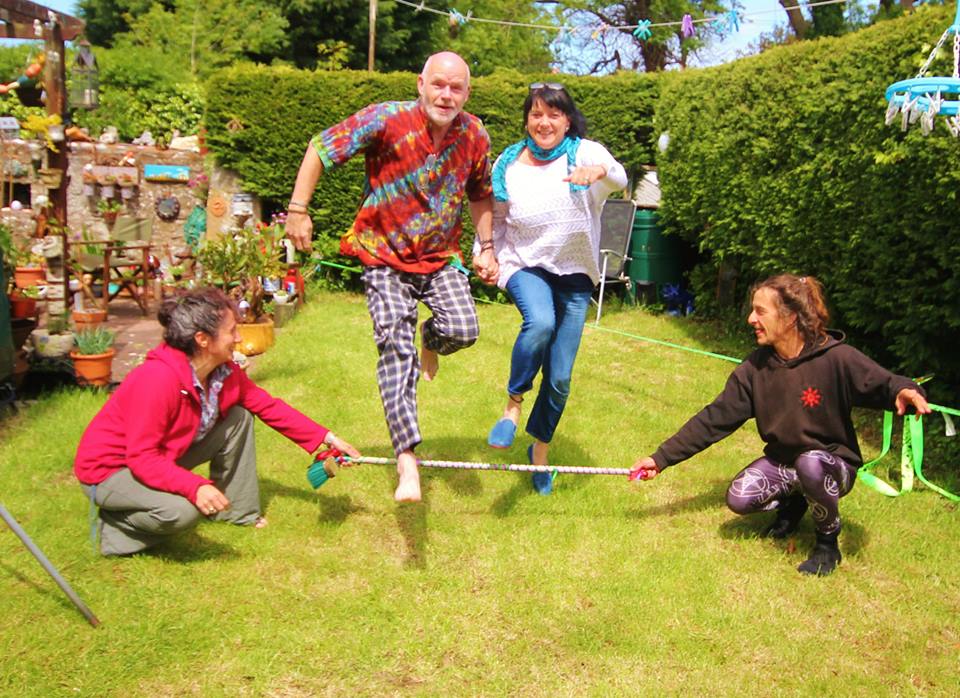
Jumping into a new life, together!

Jumping into a new life, together!

The practice of facilitating rites of passage also helps the individual magician to maintain an outward focus for their work, and not to disappear up their own ouroboros backside, into an introspective haze of rarefied magic-isms. Doing social ritual means understanding how people work, what is likely to move them, what ritual techniques will work in different settings, and being able to hold the space in a way that privileges the experience of those undertaking the ritual rather than the authority of the magician themselves. This Work is a service and one that I typically give for free (though I generally accept offers to cover my expenses). As I’ve written before: if we work with spirits the most important spirits we meet on a daily basis are other humans. Finding good ways to work with these spirits, especially when we are entrusted to help them in rites of passage, is for me a great honour. Being asked to do this kind of work is also a confirmation of my status in the minds of others. Not as some super powerful magician (or whatever) but as someone who can blend the authority and skill necessary to hold the ritual space with the sensitivity required to respond to the needs of others.

The test for whether one is actually a shaman or a priest is not how we like to style ourselves but how others refer to us. And while one might be mindful of the sort of ego inflation such titles may engender there is also the need to honestly face the truth. That the magic I do does have a utility and relevance in my wider community, and so I am grateful to the universe that I can perform this Great Work for others.

JV



Pop Magic will eat itself!

In Feeding Part-Made Gods I got down to some speculative musing about how Vampire dynamics might be at play in our engagement with strange god-forms. As we feed on the magic they embody, so also their presence in the realm of ideas is strengthened as they sup on our attention. While some may be dismayed by such visceral metaphors and what they say about our universe, it was my contention that they can be helpful when worked with consciously.

This vampiric principle, while certainly susceptible to a degree of gothic excess, is also quite helpful in understanding how Chaos Magic (CM) seems to interact with other more ‘traditional’ religious paths. In seeking to describe the type of ragged, punk rock energy often associated with CM, we are presented with a current that has a rather irreverent, shifting and arguably consumerist engagement with the religious traditions they engage with. At best this relationship seems symbiotic, at worst it could be depicted as parasitic and vulnerable to accusations of cultural appropriation.

Culture vulture

Culture vulture

In a recent dialogue with some magical friends, one colleague observed that CM seemed to be like the serpent swallowing its own tail. What my friend was seeking to convey was that while it may have brought new energy to western occultism, without traditional material to engage with it would ultimately prove barren if its relentless deconstruction was eventually turned in on itself.

This question of what constitutes ‘tradition’ and ‘traditional religion’, is fraught with potential confusion and the construction of false dichotomies. If we start with the root concept that traditio (Latin) relates to that which is handed down from a group who have had a shared experience, then we are already faced with questions like ‘how long have they had to be engaged in doing it?’ and, ‘how many of them?’. If folks within pagan communities are pointing towards forms of ‘traditional Wicca’ and ‘traditional’ forms of Crowley’s Gnostic Mass, this illustrates the fairly recent time frames we are working within.

Many of us, in walking more ‘left-field’ spiritual paths, are in search of anchor points via which our self-narrative can feel more secure. Reference to historic precedents for what we are doing often feels appealing as we seek to legitimise the risks we are taking and the spiritual terrain that we are hoping to navigate. The prevalence of this tendency seems to provide some evidence for such myth-making to be a shared human need.

Chaos magicians are no different. Certainly in seeking to understand my own love for this approach, I have sought to locate the historic examples of magical practice that help me (somewhat ironically) to create my own sense of ‘historic’ Chaos magic. Whether it be appeals to the ‘dual-observance’ mash-ups of Cunning men, or Austin Osman Spares’ use of sigils and concept of Kia, I’m undoubtedly keen to find others ‘who did it like I do it.’

Ia! Ia! It's the Kia!

Ia! Ia! It’s the Kia!

What probably separates CM from most other magical paths is the way it seeks to engage with the concept of Truth. While many paganisms and magical philosophies tend to start with a certain mythic theology or religious revelation (e.g. Wicca or Thelema), CM in its Postmodernism is far more focused on the performance and practice of magical ‘doing’ in response to the cultures that it finds itself within. Rather than claiming a revelation of some great ‘truth’, it is openly symbiotic and relational in expressing itself in the terms of something that it is responding to.

For some this may seem shallow, rootless or overly adaptive, but at best I believe that such an approach openly highlights the syncretistic dynamic that is at work within culture anyway. As magicians the interface between ideas presents us with a liminal space, within which new ways of being can be explored.

For many the concept of syncretism has something of a bad name, it speaks of blurred boundaries, conceptual overlap and a dilution of tradition. Personally I believe syncretism is all of these things, and, that it is inevitable. In thinking about an ideology, be it a political or religious one, even those that make claims to being revealed rather than emergent, are reliant on context and the adaptation of or reaction to existing ideas. As I have written about elsewhere – Slow Chaos – it may be that our discomfort with syncretism is more about the pace at which it occurs rather than it happening it all. In contrast to a more organic process whereby two or more differing perspectives interact over time, perhaps our sense of psychic indigestion relates to the rate in which we are bombarded by a plethora of competing worldviews day in, day out.

Perhaps the beginnings of an answer to how the process of syncretism can be both slowed down and directed creatively can be found via the process of hybridisation. In trying to tease apart the possible differences between the process of syncretism and that of hybridisation, one of the primary differences seems to be the degree of consciousness brought to the activity. While syncretism often occurs unconsciously via proximity, hybridisation usually involves the deliberate splicing together of at least two differing perspectives in order to produce a new entity that functions more effectively within the context that it is developed. In reflecting on my own adventures in hybridising Zen sitting practice with Heathenry. I have begun my own process of trying to identify some of the common traits that might be shared by those engaging in conscious hybridisation. Some of my suggestions are as follows:

  1. A sense of vision related to the hybrid being proposed- rather than it being just an amusing ‘mash-up’ the individual or group involved feel that something important is being offered and that there is a sense of aesthetic coherence between the paths involved; for me the combining of Zen and Heathenry related to ideas around personal responsibility and stoicism, as well as my own perception of a more minimalist sensibility.
  2. A desire to engage as thoroughly as possible with the primary source material of whichever traditions or ideologies are being combined.
  3. A high degree of transparency with regards to both the sources being worked with and the process of combination itself.

Probably like any good art, the sacred technician seeking to work with these hybridising processes needs to combine both vision and discipline. Vision ensures that the endeavour itself is fuelled by the uprising of creative energy inspired by the need to contextualize spiritual ideals. Discipline hopefully reduces the likelihood of simply using religious buzz words in order to legitimise personal whim.

SD