There is a great tradition of fans of the esoteric also being into politics, and I’m no exception. Whether this is the heretical solar-centred cosmological ideas of Giordano Bruno (not just an astronomical system, but a radical way of re-imagining the relationships of human and divine worlds), or the agitation of women such as Annie Besant (Theosophist and key figure supporting the ground-breaking London Match Girls strike), or Irish revolutionary and Hermetic Order of the Golden Dawn initiate Maud Gonne.
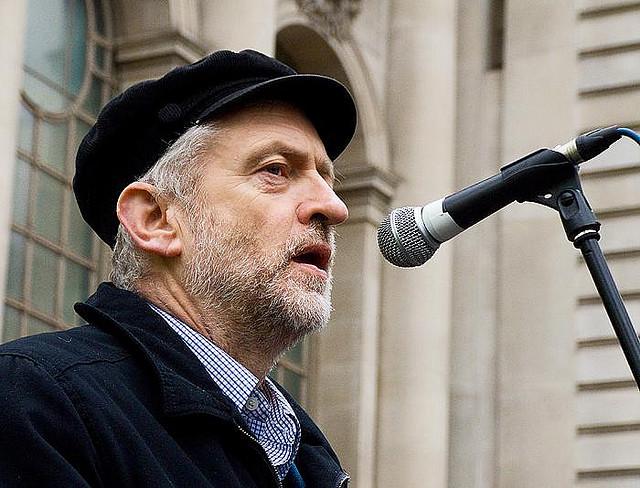
JC on the mic
Recently politics in Britain has taken some interesting twists and turns. I’ve been heartened to see the election of Jeremy Corbyn to leader of the opposition. While I’m aware that socialist policies are not without their drawbacks, I’m pleased to see the return to more radical human-centred policies (that were beaten back during the Blairite years, primarily into the Green Party), once again emerging within the Labour movement.
During the turmoil of the recent events in my nation’s political life I’ve been tempering my enthusiasm with a practice that I call (using deliberately offensive language) the ‘Momento Moron’. A traditional ‘Momento Mori’ or ‘remembrance of death’ may be an actual or model skull, placed on the desk, that serves as a reminder of the transient nature of life. A Momento Mornon is similar but, instead of reminding us of our mortality, it is the deliberate reminder of the datastream emerging from people who views I do necessarily share. In my own case this practice includes buying and reading magazines such as Hello, Take A Break Magazine & The Economist. Online it means my occasionally dropping in to read the erudite and considered comments on the ‘UKIP page Supporting Nigel Farage’ within Facebook.
The Momento Moron helps counter the tendency, noted by Tim Berners-Lee and other technorati, that the internet (and especially social media) can prevent us being exposed to differing views. We crawl into a silo of data we like, connected only to our friends and people who think like us. We reinforce our own perceptions, prejudices and proclivities by only hanging out with those who think, more or less, like we do.
In the example of the UKIP page I can become directly exposed to ideas which, were they not held with such apparent honesty, I would assume were part of some darkly-comic writing about the human tendency towards genocide (the page is less about UKIP’s policy to decriminalise cannabis, which I support, and more concerned with how we must address the current refugee crisis in Europe; mostly it seems, with the use of razor wire and guns). Noticing (if not necessarily engaging with) these views helps remind me that not every one in the world thinks like me and my mates.
The Economist, from my perspective, is a little more considered than the learned commentators of the UKIP facebook ‘swarm’. However there are still (from the perspective of my preferred reality tunnel) some bizarre ideas. For instance, in a recent series of articles on Mexico The Economist journalists bemoan the fact of the ‘informal’ economy where, “…tacos sizzle alongside every bus stop, as it is in the shops and stalls of India, where only 2% of food and grocery retailing is in the formal sector.” But help is at hand, “Electronic invoicing, which creates digital trails for the taxman, and mobile banking, which brings poor people out of the cash economy, both offer promise.” Cool! The promise of providing more regular and larger amounts for governments to spend, ostensively in the name of the people, on all kinds of things. Sure that may mean infrastructure projects, but also weapons, citizen surveillance, and increased centralised control by the State.
Meanwhile the part of the Mexican population characterised as ‘los tontos’ (‘the fools’) stick with the old traditions. “Farther out (from the centre of the big cities) the jobs became more traditional; midwives, herbal doctors and firework-makers. At the very edge of the town people did not even tell the time; there were no watches, and they were too far away to hear the church bell.” No watches, not even a sense of time? No sense of urgency? No wonder these ‘fools’ are ‘poor’. What is worse is that in “…the chunk of (Mexican) society where cultural links to Meso-american civilisation are strongly felt…Many run small firms – but rather than reinvesting to improve their businesses’ efficiency, they may prefer to splash out on fiestas and family gatherings.’’ Honestly! If only these folks spent their time hoarding their capital then they could have bigger businesses; but parties for their community? I ask you…
This dissolute and short-sighed view of the Joy of Capitalism can be laid at the door of teachers (natch); “…the CNTR (in Oaxaca), a rebel teachers’ union which uses mob tactics [or perhaps, ‘popular support’? – JV] to thwart reforms. In Oaxaca the union’s Section 22 chapter promotes its own educational agenda based around indigenous values such as communal work and village fiesta.” The horror, the horror!

Radical anti-capitalists
As an occultist one of the things I value is the complexity of the human experience; multiple sexualities, many different approaches to spiritual and philosophical questions, ethic and cultural diversity and all that. I also suspect that while ‘wealth’ may be understood in terms of sufficient good food, shelter and access to services such as healthcare, it may also be about good relationships with others, community cohesion and, who knows, even the occasional fiesta.
Folks who dislike this kind of stuff, this kind of diversity and complexity, are typically more inclined to right-wing and authoritarian political positions. It can be interesting to imagine the left-wing attitude as one that admits more possibilities, whereas a right-wing approach is often deployed when dealing with immediate problems (typically threats – see Wikipedia). This model, while perhaps rather simplistic, is helpful in that it suggests why people behave the way they do in my Momento Moron datastream – simply; they are afraid.
Fear tends to offer simple answers. It plugs into some of the deep structures in our bodyminds; we react. We don’t consider, we don’t empathise and we don’t actually want to engage with whatever the issue is. We simply want out of our situation. Fear demands order and simple, often draconian answers.
Meanwhile, trumping even the story of thousands of people trying to escape a place where their children are being killed by barrel bombs in the Middle East, we have the recent revelations about the current British Prime Minister.
For those of us who have been enjoying the #piggate #snoutrage story (as well as perhaps paying attention to the other allegations made by ‘call me Mike’ (Lord) Ashcroft), recent days have been a joy to behold. There’s also been some very intelligent reflections on the broader implications of the necrophiliac porcine narrative written by Lawrence Richards:
“The pig scandal that now has the world laughing at Cameron wasn’t from the Bullingdon Club but the Piers Gaverston, less well-known (until this week), but with a reputation for bizarre sexual rituals and initiation rites. Where the Bullingdon boys built their fraternity around shared values of hating the poor, the Piers Gaverston was about sexual humiliation and the creation of shared secrets. Its structural function is as an agreement of mutually assured destruction between the rulers of tomorrow – I know your secret and you know mine, so let’s stay on the same side, yeah?”
The Bullingdon Club (mentioned in the article above) involves some unpleasant ritual antics as part of its initiation, allegedly including burning a £50 note in front of a homeless person. Such acts are interesting examples of the ongoing magical (in the sense of the conscious manipulation of symbolic structures to change the relationship between the Self and Universe) processes that humans engage in. Recently I came across a nice example of cultural magic while working with a museum collection. A literal Victory bell, forged from the metal of a Nazi warplane that had been shot down. Melted together, these spoils of war had been formed into an object bearing the V for Victory sign (supposedly devised by Aleister Crowley) and the faces of Allied war leaders. Things like this are commonplace, we live in a symbolic world, for it is in the noosphere that human culture arises. Whether it is refusing to singing the national anthem or sexing up piglets, our acts have both a literal and metaphorical dimension.

For whom the bell tolls
Occultists work with the power that comes from these symbolic acts. Today thousands of practitioners, be they Wiccans, Druids, Shamans or whatever, use ritual technology to empower themselves and to explore the Mystery of existence. However the symbolic meaning of shagging a dead pig, or burning fifty quid in the face of the down-and-out, is far from a self-empowering act. Instead these rituals exist to form tribal affiliations within a pathological culture. And this is perhaps where we get to the heart of the matter. While we should acknowledge the human givens of conflict and competition it often seems to me that, while most people are broadly co-operatve entities, many of the people we choose to lead us are psychopathic.
While a psychopathic mindset (or brain) may be seen as one aspect of a continuum of behaviours that (considered as a species) confer on human society an adaptive, evolutionary advantage, having these people in charge may not be the way forward to assure a more humane and fair society. We have been taught that leaders need to be tough, self-assured and decisive. While these things matter, they are not the be-all and end-all of what is needed. Add to this the processes embedded in the rites of the British ruling class, of rituals design to ‘other’ the poor, to reduce the capacity for empathy, and to otherwise screw up the human psyche (the ruling class practice of putting kids into boarding schools is another example of this). Include a liberal dose of the ruling class drug of choice (cocaine) and hey presto! A world run by madmen.
It is for this reason that characters like Jeremy Corbyn, however imperfect he may be as a person and ideologue, feel like a breath of fresh air in a system that is otherwise dominated by insensitive, inhumane, economically obsessed politicians.
These are indeed interesting times! Next up, the debate about the legalisation of cannabis in Britain. The debate is to be led by an MP who has, for many years, argued for the decriminalisation of weed, with a new leader of the opposition who is on record as also being against its prohibition. As J.P.S. Haldane and others have observed; the universe is not only stranger than we suppose, it may be stranger than we can suppose. So in a world turned upside down I’ll leave the last word of this esoteric blog to His Holiness Pope Francis speaking to the US Congress:
“If politics must truly be at the service of the human person, it follows that it cannot be a slave to the economy and finance. Politics is, instead, an expression of our compelling need to live as one, in order to build as one the greatest common good: that of a community which sacrifices particular interests in order to share, in justice and peace, its goods, its interests, its social life. I do not underestimate the difficulty that this involves, but I encourage you in this effort.”
JV